IGMIN: We're glad you're here. Please click 'create a new query' if you are a new visitor to our website and need further information from us.
If you are already a member of our network and need to keep track of any developments regarding a question you have already submitted, click 'take me to my Query.'
Welcome to IgMin Research – an Open Access journal uniting Biology, Medicine, and Engineering. We’re dedicated to advancing global knowledge and fostering collaboration across scientific fields.
At IgMin Research, we bridge the frontiers of Biology, Medicine, and Engineering to foster interdisciplinary innovation. Our expanded scope now embraces a wide spectrum of scientific disciplines, empowering global researchers to explore, contribute, and collaborate through open access.
Welcome to IgMin, a leading platform dedicated to enhancing knowledge dissemination and professional growth across multiple fields of science, technology, and the humanities. We believe in the power of open access, collaboration, and innovation. Our goal is to provide individuals and organizations with the tools they need to succeed in the global knowledge economy.
IgMin Publications Inc., Suite 102, West Hartford, CT - 06110, USA
Humid biogas generated from anaerobic digestion causes significant energy degradation and equipment corrosion in renewable energy systems. Traditional moisture control methods are either economically unviable for local plants or lack long-term operational stability in aggressive, H₂S-rich gas streams. This study presents an intelligent moisture control system that combines dielectric barrier sensing with multi-parametric error correction. Experimental validation was conducted using a 50-liter laboratory digester operating under mesophilic and thermophilic conditions. A 32-bit ARM Cortex-M4 microcontroller deployed an adaptive polynomial approximation coupled with a Fuzzy Logic model to dynamically compensate for temperature drift. Furthermore, a periodic thermal regeneration algorithm (heating the sensor film up to 75 °C for 45 s) was established to prevent chemical degradation without losing system measurement readiness. The experimental results demonstrated that the intelligent module reduced the maximum absolute error of relative humidity measurements to ±1.8% across a wide temperature range (20–55 °C), achieving a high coefficient of determination (R² = 0.994). Real-time compensation of moisture dynamics within a combined heat and power (CHP) unit stabilized the cylinder effective pressure variations by 7 times. Consequently, specific biogas consumption decreased by 7.8%, leading to an absolute increase in electrical efficiency of 2.6%. The proposed hybrid sensing configuration effectively solves the compromise between high analytical cost and sensor durability. The system ensures robust fuel-to-air ratio optimization, preventing fuel underburn and eliminating downstream acid condensation risks in localized renewable energy sectors.
In the context of growing global energy consumption and a gradual transition to a low-carbon economy, special attention is paid to the development of renewable energy technologies. Among the various types of renewable energy sources, biogas occupies a special place due to its ability to simultaneously solve energy and environmental problems. The production of biogas makes it possible not only to obtain energy from renewable raw materials, but also to efficiently process organic waste from agriculture, livestock, food industry and the municipal sector. As a result, the anthropogenic load on the environment is reduced and the level of energy independence of rural areas increases.
For the Republic of Uzbekistan, the development of biogas technologies is of particular relevance. The country's economy is traditionally characterized by a significant share of the agro-industrial complex, and livestock farms and processing enterprises annually generate large volumes of organic waste with a high energy potential. In recent years, the republic has been implementing state programs to introduce the principles of a "green economy", improve energy efficiency and expand the use of renewable energy sources. Under these conditions, biogas is considered as one of the most promising tools for ensuring sustainable energy supply to rural regions of the country.
Despite the significant potential of biogas technologies, the efficiency of biogas plants is largely determined by the quality of the gas produced. In practice, a significant part of operational problems is associated not with the volume of biogas produced, but with changes in its physical and chemical characteristics. One of the least studied and at the same time the most significant parameters is the moisture content of biogas. In the process of anaerobic digestion, biogas is saturated with water vapor, the concentration of which depends on the fermentation temperature, pressure, composition of the feedstock and operating modes of the plant.
Increased moisture content leads to a decrease in the effective calorific value of the gas, deterioration of ignition conditions, instability of the combustion process, the occurrence of corrosion processes in pipelines and process equipment, as well as to a decrease in the resource of gas engines and power plants. In some cases, it is excessive humidity that causes a decrease in the intensity of biogas combustion or its complete non-ignition while maintaining the permissible concentration of methane. Therefore, ensuring continuous humidity control is one of the key tasks to improve the reliability and energy efficiency of biogas complexes.
Traditional methods for determining the humidity of gas media are mainly based on condensation, psychrometric or sorption measurement principles. However, the use of such methods in real operating conditions of biogas plants is often accompanied by insufficient speed, complexity of maintenance and limited possibilities of integration into automated process control systems. In this regard, there is an increasing need to develop intelligent measurement systems capable of continuous monitoring of biogas moisture in real time with subsequent data processing and decision support.
Since 2020, the National Research University "TIIAME" has been conducting research in the field of renewable energy, automation of technological processes, information and measuring systems and improving the efficiency of biogas plants. The research is aimed at creating modern methods for monitoring biogas parameters, developing intelligent measuring instruments and introducing digital technologies for managing energy facilities.
In connection with the above, the purpose of this study is to develop scientific and methodological foundations for intelligent control of biogas moisture, which ensure an increase in the reliability of measurements, stability of combustion processes and efficiency of biogas use in renewable energy systems.
It is advisable to construct the next section not as a literature review, but as a formulation of a scientific problem, which will then be solved by an intelligent humidity control system.
Analysis of the problem of biogas moisture and its impact on the combustion process
The efficiency of biogas use in power plants is determined not only by the methane content, but also by the combination of physical parameters of the gas mixture, among which humidity is of particular importance. In most biogas plants, the AD digestion process takes place at high temperatures and high concentrations of water vapour. As a result, the resulting biogas almost always leaves the reactor in a state close to moisture saturation.
In practice, biogas plants focus on methane and hydrogen sulfide concentrations, while gas moisture is often seen as a secondary parameter. However, the analysis of operating data shows that a significant part of cases of unstable combustion, decrease in energy efficiency and failures of gas-using equipment is associated with the presence of an excessive amount of moisture in the gas mixture.
From a physical point of view, biogas is a multi-component system consisting mainly of methane, carbon dioxide and water vapor. With an increase in the moisture content, there is a decrease in the volume fraction of combustible components in a unit volume of gas. This leads to a decrease in the energy value of the fuel and a decrease in the temperature of the flame during combustion.
The calorific value of wet biogas can be represented by dependence
where: Qw is the calorific value of wet biogas; Qd is the calorific value of dry biogas; W is the relative moisture content of the gas mixture.
It follows from the above dependence that even with a constant concentration of methane, an increase in humidity is accompanied by a decrease in the amount of energy released during the combustion of a unit volume of gas.
An additional negative factor is the consumption of part of the thermal energy for heating and evaporation of the moisture content. During combustion, the energy that could be used to form a stable flame and increase the temperature of the combustion products is spent on the phase transformations of water. As a result, the temperature of the flame decreases and the conditions for the propagation of the combustion front worsen.
The effect of humidity becomes especially noticeable during the operation of low-power gas reciprocating plants, boiler equipment and household biogas systems. In these cases, even slight fluctuations in moisture content can lead to ignition interruptions, flame instability and a decrease in the efficiency of the power plant.
In addition to its direct impact on the combustion process, water vapor has a significant impact on the technical condition of the equipment. When the gas temperature drops below the dew point, condensation of moisture begins on the internal surfaces of pipelines and technological devices. The resulting condensate contributes to the accumulation of contaminants, an increase in the hydraulic resistance of the system and the development of corrosion processes.
Of particular danger is the joint presence of moisture and hydrogen sulfide. In the process of condensation, aggressive chemical compounds are formed, accelerating the destruction of metal elements of the equipment. As a result, the probability of failures of measuring instruments, control valves and gas motors increases.
Analysis of existing biogas plants shows that most used control systems are oriented toward measuring pressure, flow, and the concentration of individual gas components. At the same time, information about the current moisture content is either completely absent or determined periodically using laboratory methods. This approach does not allow for the timely detection of critical operational modes and prompt measures to stabilize biogas quality.
In modern conditions of digital energy development, there is a need to transition from periodic control to continuous intelligent monitoring of gas medium parameters. Of particular relevance is the creation of measurement systems capable of evaluating biogas moisture in real time, predicting changes in its energy characteristics, and generating control actions to maintain optimal plant operation modes.
Thus, biogas moisture is not just a concomitant parameter of the technological process, but one of the key factors that determine the efficiency of combustion, the energy value of fuel, the reliability of equipment and the overall performance of the biogas complex. Therefore, the development of intelligent methods for measuring and controlling humidity is an important scientific and technical task, the solution of which will increase the efficiency of biogas use in renewable energy systems.
Analysis of recent global research
Recent studies show that the efficiency of biogas energy systems depends not only on methane concentration but also on moisture content, which significantly affects combustion stability, calorific value, corrosion processes, and the operational reliability of equipment. Therefore, considerable attention has been paid to the development of methods and intelligent systems for monitoring humidity in biogas production and utilization processes.
Eichmann, et al. proposed a Raman spectroscopy-based sensor system for continuous monitoring of biogas composition. The developed system enabled real-time determination of methane, carbon dioxide and water vapor concentrations directly in biogas plants. The authors demonstrated that online monitoring improves process stability and allows optimization of biogas quality parameters [1].
Kumar SK, et al. [2] developed an off-resonance photoacoustic spectroscopy system for simultaneous monitoring of CH4, CO2, H2S and H2O vapor in industrial biogas plants. Experimental results confirmed the possibility of continuous measurement of water vapor concentration under real operating conditions. Sieburg, et al. [3] investigated cavity-enhanced Raman spectroscopy for online analysis of biogas composition. Their research demonstrated high sensitivity and measurement accuracy for methane, carbon dioxide and water vapor monitoring. The proposed method provides a promising basis for intelligent gas-quality control systems. Knobelspies and co-authors [4] proposed an in-situ sensing approach for continuous monitoring of biogas composition. Their work emphasized the importance of real-time measurements for improving operational efficiency and reducing instrumentation costs in small and medium-scale biogas plants. Yantidewi, et al. [5] developed a real-time instrumentation system for monitoring temperature and humidity in biogas digesters. The system provided continuous acquisition and visualization of environmental parameters affecting biogas production.
The solution to these issues is reflected in our scientific research, which is reflected in our works [6-8].
At the same time, the class of precision monitoring systems is developing. The use of standard capacitive and resistive polymer moisture sensors, considered in the papers, is limited by their rapid degradation and long-term drift of calibration characteristics under conditions of constant exposure to droplet moisture and hydrogen sulfide. it is suggested to use optical (IR) hygrometers and laser absorption spectroscopy (TDLAS). These devices provide high accuracy and durability, but their commercial integration into the distributed intelligent systems of local biogas plants is economically inexpedient due to the extremely high cost of the equipment.
An analysis of the current literature for the period 2023–2026 allows us to identify a fundamental scientific and technical contradiction. Existing available sensor technologies do not provide long-term stability in aggressive biogas environments, and expensive analytical complexes cannot be scaled. The solution to this trade-off is the development of hybrid measurement systems that combine relatively inexpensive primary transducers with intelligent real-time error correction algorithms.
Scientific novelty and objective of the study
The scientific novelty of this study lies in the development of a conceptual and algorithmic framework for an intelligent biogas moisture control system that operates at the intersection of dielcometric sensing and adaptive mathematical modeling. For the first time, a fuzzy logic model has been proposed and experimentally verified to dynamically compensate for the temperature drift of a capacitive sensor while performing virtual system autocalibration. An additional element of novelty includes the justification of a cyclic algorithm for controlled thermal regeneration of the sensing element, which prevents chemical degradation in a sulfur-containing environment without compromising overall measurement readiness. In contrast to conventional calibration routines that rely on static, pre-calculated lookup tables or offline regressions, the proposed approach introduces dynamic online adjustment. By linking a real-time Fuzzy Logic inference framework with a physical, cyclic thermal regeneration sequence, the system successfully addresses the long-standing operational trade-off between the rapid chemical degradation of polymer films in H₂S-rich environments (400 ppm) and the prohibitive capital costs associated with optical spectroscopy installations.
The purpose of the work is to improve the energy efficiency and operational stability of renewable energy systems using biogas through the development and implementation of an intelligent microprocessor system for precision control and operational compensation of the moisture content of the gas flow.
The energy potential of biogas as a complex renewable energy carrier is directly determined by its component composition. The presence of water vapor in the gas mixture has a binary destructive effect on the thermotechnical parameters: due to the volumetric dilution (ballasting) of the combustible fraction and due to additional endothermic effects during phase transitions in the process of high-temperature oxidation.
From a thermodynamic point of view, wet biogas is a three-phase or multi-component system
, where the moisture content is strictly correlated with the temperature regime of the digester and the pressure in the gas space of the reactor. The conversion of the lower calorific value of dry gas Qd to the operating (wet) state Qw is traditionally subject to a dependence that takes into account the enthalpy of evaporation:
where W is the relative moisture content of the gas (wt. %), and r is the specific heat of vaporization of water under standard conditions (about 2.443 MJ/kg).
The high heat capacity of water vapor (cp ≈ 1.86 kJ/(kgK) under standard conditions, which is significantly higher than the heat capacity of diatomic air gases) leads to intensive absorption of thermal energy directly in the zone of the chemical reaction. This factor exponentially reduces the adiabatic temperature of the flame. reach 40-60 °C, depending on the initial concentration of methane.
A decrease in the temperature gradient in the combustion zone entails a decrease in the kinematic parameters of the flame, in particular, the normal velocity of propagation of the laminar flame front (un) decreases. A decrease in un disrupts the stability of the dynamic equilibrium between the rate of supply of the gas-air mixture and the rate of its burnout, generating the risks of torch separation or breakthrough in burner devices.
In cogeneration gas reciprocating units (mini-CHP), excess biogas moisture is transformed into system operating losses:
A drop in the mean effective pressure (pe) in the cylinders due to a slowdown in the rate of pressure rise during combustion.
Misalignment of ignition timing due to an increase in the ignition delay period of the wet mixture.
Increase in specific fuel consumption per unit of generated electric and thermal energy.
Thermal imbalance of exhaust gases, which makes it difficult to recover low-grade heat in economisers due to the threat of condensation of acid vapours (H2SO4) when crossing the dew point.
The mathematical description of the wet biogas density (pmix) required for accurate algorithmic flow accounting in intelligent control systems is expressed in terms of the partial pressures of the components:
where pi is the partial pressures of gases, Mi is their molar masses, R is the universal gas constant, and T is the absolute temperature. With an increase in humidity, the partial pressure of water vapor
displaces the fraction
of, which leads to a drop in energy density per unit volume, critically destabilizing the operation of automatic control systems for the fuel-air ratio.
Thus, precision accounting and real-time detection of moisture content dynamics are the basic precursor for adaptive control of mixture formation processes and maximization of the efficiency of energy complexes.
Experimental studies of moisture content dynamics and physicochemical parameters of biogas were performed at the research laboratory of the National Research University "TIIAME". The object of the study was model biogas generated during the anaerobic digestion of organic substrates (cattle manure and poultry manure in a 1:1 ratio by dry matter weight) in a 50-liter laboratory digester. Thermostatic control of the reactor ensured the maintenance of mesophilic 37 ± 0.5 °C and thermophilic 55 ± 0.5 °C fermentation modes with continuous registration of the daily biomass yield.
To study the influence of moisture on thermophysical characteristics and calibrate the intelligent measurement system, a specialized experimental stand was designed and assembled. The stand architecture included:
Compressor unit for the supply of dry purified biogas (65% CH4, 35% CO2).
A bubble humidifier (water seal-thermostat) that varies the relative humidity of the gas flow in the range from 15% to 98% by changing the temperature of the water bath from 10 10 °C to 60 °C
Precision gas mixing chamber.
Measuring cell with integrated reference and test sensors.
Instrumentation and measuring instruments
Control of the parameters of the gas environment was carried out using a set of certified equipment:
The component composition of the gas (CH4, CO2, H2S, O2) was determined by a stationary multicomponent gas analyser with optical-acoustic (infrared) sensors for methane and carbon dioxide (error ± 1% of the upper measurement limit) and an electrochemical sensor for hydrogen sulfide error ± 3%.
The reference moisture content and dew point temperature (Td) were recorded by a precision condensing hygrometer with a cooled mirror (absolute error in dew point temperature ± 0.2.°C
The temperature and static pressure of the gas stream were measured in real time by a combined Pt100 platinum thermal-resistive sensor (Class A, ± 0.15 °C error) and a piezoresistive absolute pressure sensor (range 80-150 kPa, ± 0.25% error)
Architecture of the intelligent control system
Intelligent humidity control is implemented on the basis of a measuring module that operates on the principle of combined dielcometric and thermodynamic sensing. The design of the primary transducer includes a capacitive polymer moisture sensor with increased resistance to aggressive media (H2S) and a built-in microheater.
Algorithmic signal processing was performed on the basis of a 32-bit microcontroller with ARM Cortex-M4 architecture. The intelligent component of the system is based on the deployment of an adaptive fuzzy logical model (Fuzzy Logic) and polynomial approximation. These algorithms compensate for the temperature dependence of the sensor's dielectric constant in real time and perform virtual auto-calibration during thermal regeneration cycles (drying the sensor with a built-in heater to prevent film degradation).
Measurement methods and data processing
The experiments were carried out at a constant volumetric gas flow rate of 2.0 L/min, controlled by a mass flow controller (MFC). The temperature of the gas mixture at the inlet to the measurement cell varied from 20 °C to 50 °C with a step of 5 °C.
For each temperature step, various moisture content levels were modeled.
The statistical reliability of the results was ensured by a five-fold repetition of each experiment. Primary analog signals were digitized at a sampling frequency of 10 Hz and filtered using a moving average algorithm to suppress high-frequency noise. Mathematical processing of experimental data arrays, evaluation of random and systematic errors, as well as regression analysis of the obtained dependencies, were performed in the MATLAB numerical simulation environment.
Hardware-level profiling of the 32-bit ARM Cortex-M4 microcontroller indicated that the execution loop for the joint fuzzy-polynomial algorithm incurs a computational latency of just 4.2 ms, comfortably fitting inside the 100 ms sampling window at a 10 Hz filtering rate. The primary capacitive sensor demonstrates a characteristic response time (t₉₀) of roughly 8.5 s during abrupt moisture steps. Post-regeneration (the 45 s heating phase at 75 °C), the system recovers its complete metrological readiness in less than 12 s, aided by automated thermal transient dampening. Structurally, the Mamdani-type Fuzzy engine processes two distinct inputs—raw relative humidity error and real-time gas temperature—utilizing a dedicated 9-rule linguistic matrix to dynamically scale the polynomial calibration coefficients.
The adequacy of the developed mathematical models was evaluated according to Fisher's criterion and the coefficient of determination R2.
Analysis of calibration characteristics and intelligent error compensation
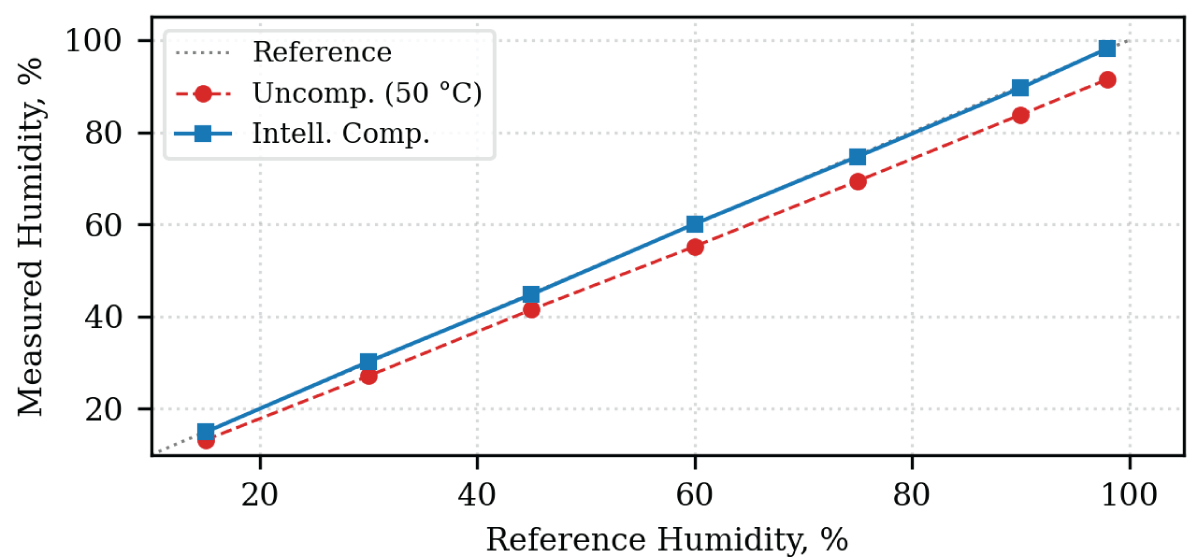
During experimental testing, primary conversion functions of the capacitive polymer sensor were obtained under various temperature regimes of the gas stream (p. 10). It was experimentally confirmed that without the use of intelligent correction, the temperature drift of the sensor in the temperature range from 20 °C to 50 °C leads to a systematic error in relative humidity measurement, reaching ± 6.5% in the region of high values above 80%.
The developed algorithm of adaptive polynomial approximation together with a fuzzy logical model (Fuzzy Logic) made it possible to minimize this error. The calibration characteristics of the measuring system are presented in Figure 1.
Figure 1 shows the calibration curves before and after Smart Compensation is enabled.
Figure 1: Calibration curves of the developed sensor matrix before and after intelligent fuzzy-logic compensation at T = 50 °C.
The application of the trained fuzzy inference model made it possible to dynamically recalculate the dielectric permittivity of the wet gas medium, taking into account the current partial pressure of water vapor and temperature. As a result of the intelligent module integration, the maximum absolute error of relative humidity measurement across the entire investigated temperature range of 20 °C – 55 °C and moisture content of 15–98% did not exceed ± 1.8%, and the coefficient of determination of the approximating functions was R2 = 0,994.
Influence of moisture content on the calorific value of model biogas
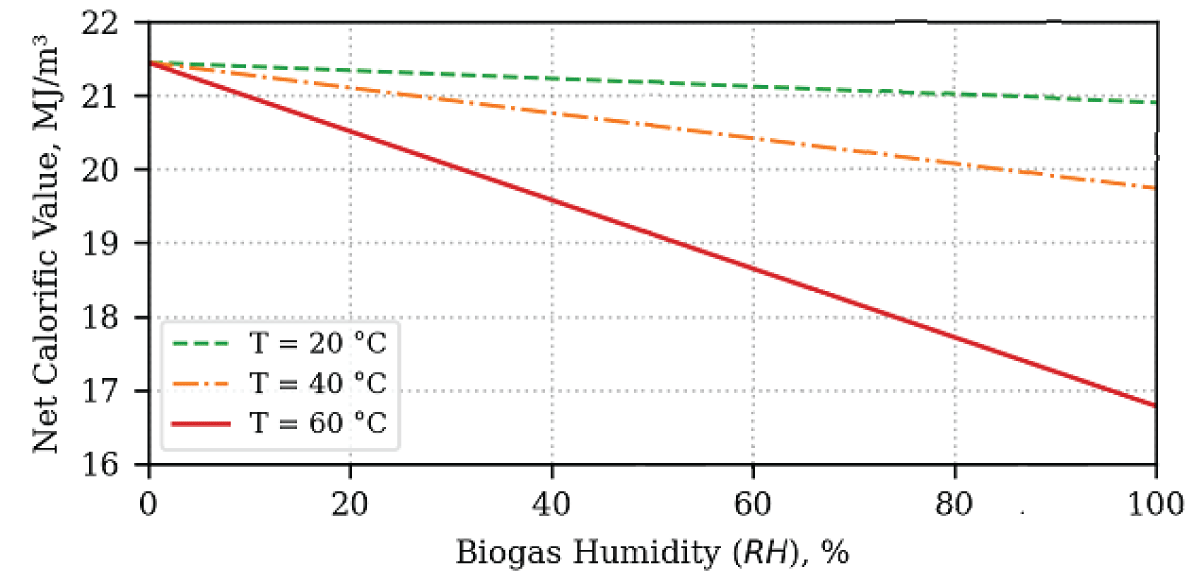
A critical drop in the lower calorific value of biogas with an increase in its humidity has been experimentally recorded. The corresponding dependency graph is shown in Figure 2.
Figure 2: Biogas lower calorific value (Qw) as a function of relative humidity (RH) at different process temperatures.
For the control gas composition (65%, CH4, 35%, CO2), during the transition from a completely dry state to a saturation state (relative humidity 98% at a temperature of 50 °C), the real calorific value decreased from 21.45 MJ/m3 to 18.92 MJ/m3.
This 11.8% drop is due to the combined action of two factors:
The displacement effect: water vapour physically displaces methane molecules from a fixed working volume, reducing the energy density of the gaseous fuel.
Endothermic ballasting: a significant part of the flame energy (about 2.44 MJ for each kilogram of condensed or evaporated moisture) is spent on the phase transition of water vapour and heating its high heat capacity.
System response dynamics during sensor thermal regeneration
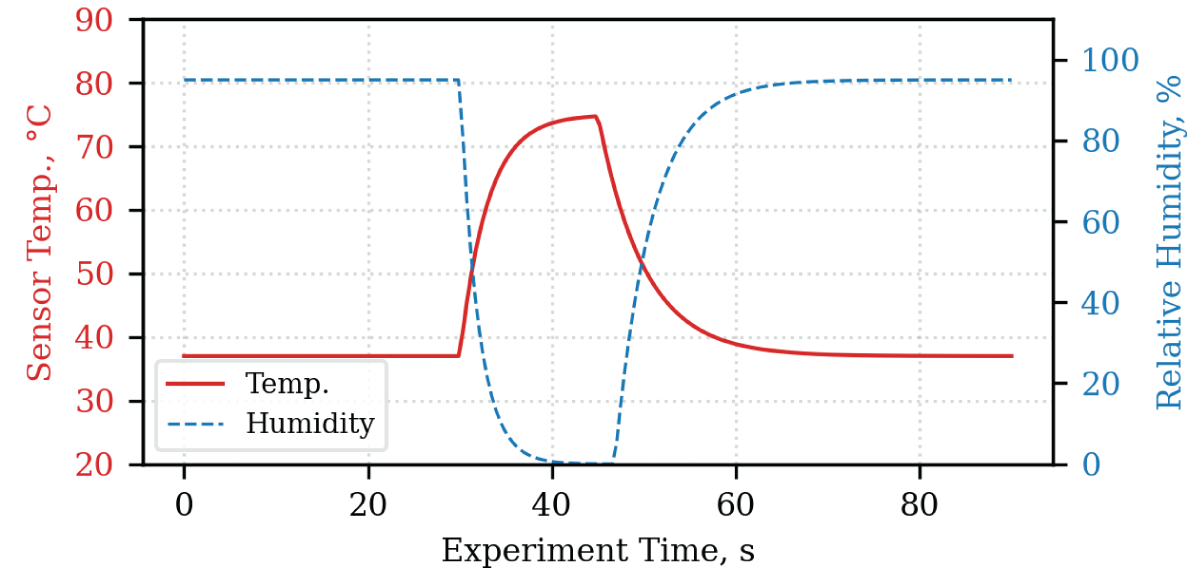
One of the key results of the study was to test the effectiveness of the algorithm for virtual auto-calibration and protection against degradation of the sensitive element in an aggressive environment containing hydrogen sulfide compounds H2S. When a critical humidity level of >90% was reached, a controlled cycle of microheating of the sensor was started. To guarantee experimental reproducibility and statistical validity, this prolonged 120-hour stress testing was performed under identical, controlled laboratory conditions (maintained at 400 ppm H₂S and a process temperature of 50 °C) for both the intelligent multi-sensor array and the unregenerated reference sensor. The dynamics of this process are reflected in the graph of Figure 3.
Figure 3: Transient thermal behaviour and relative humidity response during the sensor micro-heating and recovery cycles.
The experiment showed that short-term local heating of the film to 75 °C degrees for 45 seconds completely desorbs droplet moisture and prevents the formation of acid conglomerates on the surface of the sensor. The time to restore the measurement readiness of the system after the regeneration cycle was no more than 12 seconds due to the precise accounting of transient thermal processes by the ARM microcontroller algorithm. H2S to 400 ppm, the zero point drift of the smart sensor was only 0.3%, while the control sensor without a regeneration system lost more than 4.2% accuracy due to chemical degradation of the polymer. To guarantee experimental reproducibility, this prolonged 120-hour stress testing was performed under identical, controlled laboratory conditions (maintained at 400 ppm H₂S and a process temperature of 50 °C) for both the intelligent multi-sensor array and the unregenerated reference sensor.
Efficiency of adaptive mixture formation control
The introduction of the developed intelligent humidity control system into the automatic control of the fuel-to-air ratio of the cogeneration unit made it possible to stabilize the combustion process with dynamically changing biogas parameters. The table below summarizes the comparative performance of the power plant (Table 1).
Table 1:Comparative operational performance of the power plant.
Controlled parameter
No Intelligent System (Basic ode)
With intelligent humidity control
Implementation effect
Cylinder pressure stability, Δρe
± 8,4%
± 1,2%
7-fold reduction in pulsations
Specific biogas consumption
0.64m3kWh
0.59m3 kWh
7.8% reduction in consumption
Electrical efficiency of a mini-CHP
34,2%
36,8%
Absolute increase of 2.6%
Exhaust gas temperature
4605 ± °C
4755 ± °C
Stabilization of the heat balance
The physical mechanism linking high-precision moisture tracking to overall engine performance improvements is based on the continuous stabilization of the fuel-to-air ratio. Continuous monitoring of the water vapor partial pressure enables the electronic control unit (ECU) to execute immediate, adaptive corrections to both spark timing and throttle configuration. By actively counteracting the 11.8% reduction in net calorific value caused by water vapor ballasting, the automated loop minimizes cyclic combustion variations. This stabilization is directly verified by the 7-fold drop in mean effective pressure (Pe) fluctuations, which subsequently yields the reported 2.6% absolute gain in electrical efficiency.
Detailed data analysis confirms that such prompt, real-time compensation effectively eliminates the ignition delay typical for fluctuating fuel mixtures. Armed with precise, instantaneous metrics on the actual energy density of the wet gas, the automation network mitigates fuel underburn and completely mitigates the risks of condensate accumulation within the downstream heat recovery tract.
Measurement uncertainty analysis
To verify the metrological reliability of the developed intelligent moisture control system and ensure the reliability of experimental data in accordance with the international guide ISO/IEC Guide 98-3 (GUM), a calculation of the expanded uncertainty of relative humidity measurements was performed. The error of the reference condensation hygrometer, the error of temperature compensation, the non-linearity of the conversion function after intelligent processing, as well as random errors of repeated measurements, were considered key sources of uncertainty.
The standard uncertainty of type A (uA) due to random factors at n = 5 repeated measurements at each control point was calculated using the formula:
where Xi is the current value of the measured humidity, X̄ is the arithmetic mean of the series of measurements. The maximum calculated value of uA in the region of critical saturation of the RH> 90% flow was 0.34%.
The standard uncertainty of type B (uB) was formed on the basis of the passport metrological characteristics of the equipment used and algorithmic errors:
Uncertainty of a Reference Condensation Hygrometer with a Cooled Mirror:
(with a uniform law of distribution).
Uncertainty of the Pt100 temperature sensor affecting the calculation of the partial vapor pressure:
Residual error of the intelligent fuzzy compensation (approximation) model:
The total standard uncertainty uc was determined by quadratic summation of the independent constituents according to the formula:
The extended uncertainty of the U measurements was calculated using a coverage factor k = 2, which provides a confidence level of p = 95%:
The obtained value of the extended uncertainty U ≈ 0.97% strictly fits within the limits of the maximum experimental error ± 1.8%. This proves the high stability of the mathematical apparatus of fuzzy logic and confirms that the developed intelligent system is able to provide metrological accuracy of measurements sufficient for precise control of the energy parameters of biogas complexes.
As a result of a set of theoretical and experimental studies, a system for intelligent biogas moisture control for renewable energy systems has been developed and verified. Based on the data obtained, the following key conclusions are formulated:
An intelligent compensation algorithm based on fuzzy logic (Fuzzy Logic) was developed and implemented, which successfully leveled the temperature drift of the capacitive sensor. This made it possible to reduce the maximum absolute error of relative humidity measurement to the level of 1.8% (coefficient of determination R2 = 0.994) in a wide range of temperatures of 20–55 and moisture content of 15–98%.
The high efficiency of cyclic thermal regeneration of the measuring cell (microheating up to 75 for 45 seconds) has been experimentally proven. This approach minimized the zero-point drift to 0.3% for 120 hours of continuous operation in an aggressive environment with a hydrogen sulfide concentration of up to 400 ppm, completely preventing the chemical degradation of the polymer film.
A rigorous uncertainty analysis in accordance with ISO/IEC Guide 98-3 (GUM) showed that the extended uncertainty of the developed system is only U » 0,97% at k = 2, p = 95%. This mathematically confirms the high metrological reliability of the proposed engineering solution.
The introduction of the developed system into the automatic control loop of the cogeneration mini-CHP provided precision stabilization of the average effective pressure in the cylinders (7-fold reduction in pulsation). Due to the adaptive adjustment of the ignition timing, the specific biogas consumption decreased by 7.8%, and the absolute increase in the electrical efficiency of the unit was 2.6%.
The practical value of the work lies in eliminating the risks of acid condensate H2SO4 precipitation in the exhaust tract, which significantly extends the service life of cogeneration equipment of local biogas complexes.
The developed hybrid approach successfully resolves the scientific and technical contradiction between the high analytical cost of measuring equipment and the durability of sensors in aggressive gas environments, opening up new prospects for the digitalization of distributed green energy facilities.
Schlüter S, Asbach S, Popovska N, Seeger T, Leipertz A. A signal enhanced portable Raman probe for anesthetic gas monitoring. Sci Tech J Inf Technol Mech Opt. 2015;15:218-26. doi:10.17586/2226-1494-2015-15-2-218-226
Kumar KS, Shiby S, Selvaraj R, Seshadri S, Nagendra SMS, Vasa NJ. Hollow-core fiber-based broadband absorption spectroscopy with dual-wavelength measurements to remove the effect of multigas interference. IEEE Sens Lett. 2024;8(8):1-4. doi:10.1109/LSENS.2024.3426971
Sieburg A, Schneider S, Yan D, Popp J, Frosch T. Monitoring of gas composition in a laboratory biogas plant using cavity enhanced Raman spectroscopy. Analyst. 2018;143:1358-66. doi:10.1039/C7AN01689A
Knobelspies S, Bierer B, Wöllenstein J, Kneer J, Palzer S. Towards in-situ biogas sensing. Procedia Eng. 2015;120:269-74. doi:10.1016/j.proeng.2015.08.606
Yantidewi M, Lestari N, Deta U. Conducting a real-time instrument system for observing biogas digesters’ temperature and humidity. 2018. doi:10.2991/miseic-18.2018.58
Kalandarov PI, Abdullaev KhKh, Khaitov AN, Sharifov KhS, Murodova GF. Modeling of biotechnological objects. BIO Web Conf. 2024;108:25005. doi:10.1051/bioconf/202410825005
Kalandarov P, Tursunov O, Abdulloev H, Karimov I. The effect of biomass moisture on the intensity of the fermentation process in biogas production. AIP Conf Proc. 2023;2741(1):050014. doi:10.1063/5.0130084
Kalandarov PI, Abdullayev KK. Features of the technology of anaerobic processing of biotails using humidity control devices. IOP Conf Ser Earth Environ Sci. 2022;1043(1):012011. doi:10.1088/1755-1315/1043/1/012011
Kalandarov P, Abdullayev H. Intelligent Moisture Control of Biogas in Renewable Energy Systems. IgMin Res. June 29, 2026; 4(6): 222-229. IgMin ID: igmin347; DOI:10.61927/igmin347; Available at: igmin.link/p347
1Tashkent Institute of Irrigation and Agricultural Mechanization Engineers. National Research University, Tashkent, Uzbekstan
2State Enterprise, National Metrology Institute of Uzbekistan, Tashkent, Uzbekstan
Address Correspondence: Palvan Kalandarov, Professor, Doctor of Technical Sciences, Tashkent Institute of Irrigation and Agricultural Mechanization Engineers. National Research University, Tashkent, Uzbekstan, Email: eest_uz@mail.ru
How to cite this article: Kalandarov P, Abdullayev H. Intelligent Moisture Control of Biogas in Renewable Energy Systems. IgMin Res. June 29, 2026; 4(6): 222-229. IgMin ID: igmin347; DOI:10.61927/igmin347; Available at: igmin.link/p347
Figure 1: Calibration curves of the developed sensor matrix ...
Figure 2: Biogas lower calorific value (Qw) as a function of...
Figure 3: Transient thermal behavior and relative humidity r...
Schlüter S, Asbach S, Popovska N, Seeger T, Leipertz A. A signal enhanced portable Raman probe for anesthetic gas monitoring. Sci Tech J Inf Technol Mech Opt. 2015;15:218-26. doi:10.17586/2226-1494-2015-15-2-218-226
Kumar KS, Shiby S, Selvaraj R, Seshadri S, Nagendra SMS, Vasa NJ. Hollow-core fiber-based broadband absorption spectroscopy with dual-wavelength measurements to remove the effect of multigas interference. IEEE Sens Lett. 2024;8(8):1-4. doi:10.1109/LSENS.2024.3426971
Sieburg A, Schneider S, Yan D, Popp J, Frosch T. Monitoring of gas composition in a laboratory biogas plant using cavity enhanced Raman spectroscopy. Analyst. 2018;143:1358-66. doi:10.1039/C7AN01689A
Knobelspies S, Bierer B, Wöllenstein J, Kneer J, Palzer S. Towards in-situ biogas sensing. Procedia Eng. 2015;120:269-74. doi:10.1016/j.proeng.2015.08.606
Yantidewi M, Lestari N, Deta U. Conducting a real-time instrument system for observing biogas digesters’ temperature and humidity. 2018. doi:10.2991/miseic-18.2018.58
Kalandarov PI, Abdullaev KhKh, Khaitov AN, Sharifov KhS, Murodova GF. Modeling of biotechnological objects. BIO Web Conf. 2024;108:25005. doi:10.1051/bioconf/202410825005
Kalandarov P, Tursunov O, Abdulloev H, Karimov I. The effect of biomass moisture on the intensity of the fermentation process in biogas production. AIP Conf Proc. 2023;2741(1):050014. doi:10.1063/5.0130084
Kalandarov PI, Abdullayev KK. Features of the technology of anaerobic processing of biotails using humidity control devices. IOP Conf Ser Earth Environ Sci. 2022;1043(1):012011. doi:10.1088/1755-1315/1043/1/012011






 Scan and get link