IGMIN: We're glad you're here. Please click 'create a new query' if you are a new visitor to our website and need further information from us.
If you are already a member of our network and need to keep track of any developments regarding a question you have already submitted, click 'take me to my Query.'
Welcome to IgMin Research – an Open Access journal uniting Biology, Medicine, and Engineering. We’re dedicated to advancing global knowledge and fostering collaboration across scientific fields.
At IgMin Research, we bridge the frontiers of Biology, Medicine, and Engineering to foster interdisciplinary innovation. Our expanded scope now embraces a wide spectrum of scientific disciplines, empowering global researchers to explore, contribute, and collaborate through open access.
Welcome to IgMin, a leading platform dedicated to enhancing knowledge dissemination and professional growth across multiple fields of science, technology, and the humanities. We believe in the power of open access, collaboration, and innovation. Our goal is to provide individuals and organizations with the tools they need to succeed in the global knowledge economy.
IgMin Publications Inc., Suite 102, West Hartford, CT - 06110, USA
Water is a scarce commodity on Mars, yet large amounts of water are needed for crew life support, and in most human mission scenarios, even greater amounts of water are needed to produce propellants for departing Mars for the return trip to Earth. Evidence suggests that significant amounts of water occur as mineral hydration of magnesium or calcium sulfates in the accessible upper layer of Mars regolith at various scattered equatorial locations. Several sulfates occur on Mars with water content 20% to 50% of the sulfate mass.
Several forms of hydrated sulfates are known to provide a significant share of observed water-equivalent hydrogen in the upper meter of Mars regolith. These include “Gypsum” (CaSO₄⋅2H₂O) containing 20.9% H2O by weight, and “Epsomite” (MgSO4·7H2O) (commonly known as “epsom salts”) containing 51% H2O by weight, as well as hexahydrite (MgSO4·6H2O) and starkeyite (MgSO4·4H2O).
Scans using the neutron spectrometer from orbit show a remarkable correlation between the occurrence of S and H in the equatorial region, indicating that hydrated sulfates are a primary source of H2O there. Recent higher-resolution scans using the collimated neutron spectrometer show significant pockets of higher H2O content. This implies that even higher local concentrations of H2O almost surely exist within those areas, most likely as hydrated sulfates.
The power requirements to evolve H2O from a range of potential hydrated magnesium sulfates are moderate. We suggest that a human mission to Mars at equatorial latitudes based on hydrated sulfates as a source of water is a potential competitor to a mission at higher latitudes based on putative accessible ice.
Water is a scarce commodity on Mars, yet large amounts of water are needed for crew life support, and in most human mission scenarios, even greater amounts of water are needed to produce propellants for departing Mars for the return trip to Earth [11Rapp D, Inglezakis V. Accessible H2O on Mars: a critical review of current knowledge. IgMin Res. 2025 Nov 25;3(11):407‑39. IgMin ID: igmin322. doi: 10.61927/igmin322. Available from: igmin.link/p322-33Rapp D. Human missions to Mars using the Starship. IgMin Res. 2025 Aug 6;3(8):268‑77. IgMin ID: igmin308. doi: 10.61927/igmin308. Available from: igmin.link/p308]. With observations of Mars from orbit over the past decade or two, optimism has developed in the Mars mission community that accessible water-ice is likely to be accessible at latitudes of about 40°N or higher, and planning for future human missions is ongoing for landing sites near 40°N [44Golombek M, Williams N, Wooster P, McEwen A, Putzig N, Bramson A, et al. SpaceX Starship landing sites on Mars. Presented at: 52nd Lunar Planet Sci Conf; 2021.-66Heldmann JL, Marinova MM, Lim DSS, et al. Mission architecture using the SpaceX Starship vehicle to enable a sustained human presence on Mars. New Space. 2022 Sep 1;10(3):259‑73. doi: 10.1089/space.2020.0058. Epub 2022 Sep 13. PMID: 36199953; PMCID: PMC9527650]. While an equatorial landing is preferred for several reasons, the possibility of near-surface water ice at higher latitudes swayed NASA planners to accept a higher-latitude landing site, believing there will be accessible water ice [44Golombek M, Williams N, Wooster P, McEwen A, Putzig N, Bramson A, et al. SpaceX Starship landing sites on Mars. Presented at: 52nd Lunar Planet Sci Conf; 2021.-66Heldmann JL, Marinova MM, Lim DSS, et al. Mission architecture using the SpaceX Starship vehicle to enable a sustained human presence on Mars. New Space. 2022 Sep 1;10(3):259‑73. doi: 10.1089/space.2020.0058. Epub 2022 Sep 13. PMID: 36199953; PMCID: PMC9527650]. Alternatively, Rapp (2025) proposed a simplified human mission to Mars that does not require indigenous Mars water that might suffice for the first landings. [33Rapp D. Human missions to Mars using the Starship. IgMin Res. 2025 Aug 6;3(8):268‑77. IgMin ID: igmin308. doi: 10.61927/igmin308. Available from: igmin.link/p308] Nevertheless, for future, larger-scale Mars landings, indigenous sources of water on Mars will be required.
It is widely known that some of the minerals in the Martian regolith include water of hydration within their crystal structures, and these minerals are widely distributed across the surface of Mars. Indeed, the calibration of neutron spectrometers for H detection from orbit is based on comparison of any given pixel to a pixel in the background assumed to contain 2% water by weight, at least partly due to hydrated minerals spread across the background pixel [77Boynton WV, Feldman WC, Squyres SW, et al. Distribution of hydrogen in the near surface of Mars: evidence for subsurface ice deposits. Science. 2002;297:81‑5.,88Feldman WC, Prettyman TH, Maurice S, et al. Global distribution of near‑surface hydrogen on Mars. J Geophys Res. 2004;109:E09006.]. Since these pixels are very large (typically 600 km x 600 km), the fact that the average water percentage is 2% across 600 km x 600 km does not preclude the existence of smaller local outcrops of far more concentrated hydrated minerals where the H2O percentage in the regolith might be 20% by weight or higher. Such as-yet unvalidated sources of H2O at equatorial latitudes might be even more accessible and exploitable than the putative water-ice resources at higher latitudes suggested by orbital observations. If equatorial mineral hydrates prove to be accessible as suggested by recent observations with a collimated neutron spectrometer from orbit, that might provide a basis for landing at equatorial sites, provided these sites meet other criteria for landing. Therefore, we suggest that the rush to define missions at higher latitudes might be premature until the availability of mineral hydrates at equatorial latitudes is clarified.
Gypsum is a common mineral on Mars with formula CaSO₄⋅2H₂O, containing 20.9% H2O by weight [99Vaniman D, Chipera S, Rampe E, et al. Gypsum on Mars: a detailed view at Gale Crater. Minerals. 2024;14:815. doi: 10.3390/min14080815]. Epsomite (MgSO4·7H2O) (commonly known as “epsom salts”), hexahydrite (MgSO4·6H2O) and starkeyite (MgSO4·4H2O) provide even higher percentages of H2O than Gypsum.
There is not much pragmatic interest in the occurrence of sulfates at latitudes outside the equatorial region because accessible ice is believed to occur at higher latitudes. But a good source of hydrated sulfates at equatorial latitudes could be a valuable alternative, allowing a more favorable equatorial landing site, with water extraction at moderate temperatures.
Figure 1 shows a comparison of observed relative concentrations of S and H in the top ~1 m of Mars regolith by the Odyssey gamma ray spectrometer [1010Karunatillake S, Wray JJ, Gasnault O, et al. Sulfates hydrating bulk soil in the Martian low and middle latitudes. Geophys Res Lett. 2014;41(22):7987‑96. doi: 10.1002/2014GL061136]. The strong correlation between the S and H distributions in the near-surface suggests that the three red/yellow areas of higher H2O concentration in the equatorial zone are mainly due to sulfates.
1010Karunatillake S, Wray JJ, Gasnault O, et al. Sulfates hydrating bulk soil in the Martian low and middle latitudes. Geophys Res Lett. 2014;41(22):7987‑96. doi: 10.1002/2014GL061136]. The pixels in both cases were about 600 km x 600 km." /> Figure 1: Comparison of relative H and S concentrations in the upper ~1 m of Mars regolith as observed by the gamma ray spectrometer on the Odyssey spacecraft [1010Karunatillake S, Wray JJ, Gasnault O, et al. Sulfates hydrating bulk soil in the Martian low and middle latitudes. Geophys Res Lett. 2014;41(22):7987‑96. doi: 10.1002/2014GL061136]. The pixels in both cases were about 600 km x 600 km.
Because the pixels are so large (600 km x 600 km), the distribution of H within each pixel might range from being broadly uniform to highly non-uniform, with local pockets of highly concentrated mineral hydrates. For example, a pixel with, say, 3% H, might contain anywhere between (a) 100% of the area with 3% H vs. (b) 10% of the area with 30% H, or perhaps (c) 95% of the area with 2% H and 5% of the area with 22% H. Any other combination is possible.
Goals of this study
The purpose of this research was to pull together the results from various scattered and independent measurements and studies on near-surface H2O and hydrated sulfates in the equatorial zone of Mars and develop a synoptic view of the potential for hydrated sulfates to provide H2O for human missions to Mars. In that connection, it was desired to:
[11Rapp D, Inglezakis V. Accessible H2O on Mars: a critical review of current knowledge. IgMin Res. 2025 Nov 25;3(11):407‑39. IgMin ID: igmin322. doi: 10.61927/igmin322. Available from: igmin.link/p322] Show that the highest concentrations of near-surface sulfates and H2O occur in the same geographical areas of the equatorial zone of Mars, indicating that these local areas of high H2O are likely due to hydrated sulfates.
[22Rapp D. Reliability of water for life support for a near‑term human mission to Mars: requirements, Earth supply, recycling, storage and Mars indigenous water. IgMin Res. 2026;4(7):292‑305. doi: 10.61927/igmin353] Show the locations in the equatorial zone where the highest concentrations of hydrated minerals occur.
[33Rapp D. Human missions to Mars using the Starship. IgMin Res. 2025 Aug 6;3(8):268‑77. IgMin ID: igmin308. doi: 10.61927/igmin308. Available from: igmin.link/p308] Roughly estimate the power requirement to remove H2O from several attractive hydrated sulfates.
This study adopts a literature-synthesis and analytical calculation approach to assess whether hydrated sulfates in equatorial Martian regolith could constitute an accessible water resource for future human missions. Previous investigations have established the presence and potential significance of hydrated minerals and sulfates on Mars, including magnesium sulfate hydrates and gypsum [99Vaniman D, Chipera S, Rampe E, et al. Gypsum on Mars: a detailed view at Gale Crater. Minerals. 2024;14:815. doi: 10.3390/min14080815,14–1614–16Feldman WC, Mellon MT, Maurice S, et al. Hydrated states of MgSO4 at equatorial latitudes on Mars. Geophys Res Lett. 2004;31:L16702. doi: 10.1029/2004GL020181,2020Marion GM, Kargel JS. Stability of magnesium sulfate minerals in Martian environments. Lunar Planet Sci Conf XXXVI. 2005. Available from: https://ntrs.nasa.gov/api/citations/20050174605/downloads/20050174605.pdf]. Studies of the distribution of near-surface hydrogen have also demonstrated the occurrence of water-equivalent hydrogen (WEH) across broad regions of the Martian surface [77Boynton WV, Feldman WC, Squyres SW, et al. Distribution of hydrogen in the near surface of Mars: evidence for subsurface ice deposits. Science. 2002;297:81‑5.,88Feldman WC, Prettyman TH, Maurice S, et al. Global distribution of near‑surface hydrogen on Mars. J Geophys Res. 2004;109:E09006.]. More recent analyses have provided improved spatial characterization of near-surface WEH using higher-resolution neutron observations [2121Pathare AV, Feldman WC, Prettyman TH, Maurice S. Climatic implications of new global mapping of near‑surface water‑equivalent hydrogen on Mars. Icarus. 2018;301:97‑116. doi: 10.1016/j.icarus.2017.09.031,2222Malakhov AV, Mitrofanov IG, Golovin DV, et al. High‑resolution map of water in the Martian regolith observed by FREND neutron telescope onboard ExoMars TGO. J Geophys Res Planets. 2022;127(5):e2022JE007258. doi: 10.1029/2022JE007258].
The orbital-data component of this study synthesizes observations from the Mars Odyssey gamma-ray and neutron spectrometers and the Fine Resolution Epithermal Neutron Detector (FREND) aboard the ExoMars Trace Gas Orbiter. Earlier global observations established the broad distribution of near-surface hydrogen [77Boynton WV, Feldman WC, Squyres SW, et al. Distribution of hydrogen in the near surface of Mars: evidence for subsurface ice deposits. Science. 2002;297:81‑5.,88Feldman WC, Prettyman TH, Maurice S, et al. Global distribution of near‑surface hydrogen on Mars. J Geophys Res. 2004;109:E09006.], while subsequent analyses examined the relationship between sulfur and hydration in Martian soils [1010Karunatillake S, Wray JJ, Gasnault O, et al. Sulfates hydrating bulk soil in the Martian low and middle latitudes. Geophys Res Lett. 2014;41(22):7987‑96. doi: 10.1002/2014GL061136] and identified regions with enhanced WEH through reanalysis of neutron-spectrometer observations [2121Pathare AV, Feldman WC, Prettyman TH, Maurice S. Climatic implications of new global mapping of near‑surface water‑equivalent hydrogen on Mars. Icarus. 2018;301:97‑116. doi: 10.1016/j.icarus.2017.09.031]. The higher-resolution FREND observations reported by Malakhov, et al. [2222Malakhov AV, Mitrofanov IG, Golovin DV, et al. High‑resolution map of water in the Martian regolith observed by FREND neutron telescope onboard ExoMars TGO. J Geophys Res Planets. 2022;127(5):e2022JE007258. doi: 10.1029/2022JE007258] are used to examine localized equatorial regions with elevated WEH.
The study compares the spatial distributions of hydrogen and sulfur and evaluates whether their geographical correspondence provides supporting evidence for hydrated sulfates as a potential source of water-equivalent hydrogen in equatorial regolith. Previous mineralogical and geochemical investigations have documented sulfates and hydrated minerals at several Martian locations, including Meridiani Planum and Gale Crater [11–1611–16Flahaut J, Carter J, Poulet F, et al. Embedded clays and sulfates in Meridiani Planum, Mars. Icarus. 2015;248:269‑88.]. However, the orbital correlation between sulfur and hydrogen is treated as supporting evidence rather than definitive mineralogical identification because orbital measurements alone cannot establish the exact mineralogical phase responsible for the observed hydrogen.
For the water-extraction assessment, several hydrated sulfate phases and dehydration pathways are considered. Magnesium sulfate hydrates have been investigated extensively under Martian environmental conditions, including their hydration states, stability, and dehydration behavior [14–1614–16Feldman WC, Mellon MT, Maurice S, et al. Hydrated states of MgSO4 at equatorial latitudes on Mars. Geophys Res Lett. 2004;31:L16702. doi: 10.1029/2004GL020181,2020Marion GM, Kargel JS. Stability of magnesium sulfate minerals in Martian environments. Lunar Planet Sci Conf XXXVI. 2005. Available from: https://ntrs.nasa.gov/api/citations/20050174605/downloads/20050174605.pdf]. Epsomite (MgSO₄·7H₂O), hexahydrite (MgSO₄·6H₂O), and other magnesium sulfate hydrates have been identified as potentially relevant phases in the Martian water cycle [14–1614–16Feldman WC, Mellon MT, Maurice S, et al. Hydrated states of MgSO4 at equatorial latitudes on Mars. Geophys Res Lett. 2004;31:L16702. doi: 10.1029/2004GL020181,2020Marion GM, Kargel JS. Stability of magnesium sulfate minerals in Martian environments. Lunar Planet Sci Conf XXXVI. 2005. Available from: https://ntrs.nasa.gov/api/citations/20050174605/downloads/20050174605.pdf]. Gypsum (CaSO₄·2H₂O) is considered separately as a calcium sulfate hydrate documented on Mars [99Vaniman D, Chipera S, Rampe E, et al. Gypsum on Mars: a detailed view at Gale Crater. Minerals. 2024;14:815. doi: 10.3390/min14080815].
The processing analysis considers alternative dehydration pathways in which different numbers of water molecules are removed from the hydrated sulfate. The manuscript expresses these pathways using an x-y-z notation, where x represents the initial hydration number, y represents the final hydration number, and z represents the number of H₂O molecules removed per formula unit. Experimental and thermochemical investigations of magnesium sulfate hydrates provide relevant background for evaluating their dehydration and heat-storage characteristics [2727Wang L, Li S, Shi C, et al. Experimental study on desorption and heat storage characteristics of magnesium sulfate hydrate in a moving‑bed heat exchange system. Processes. 2026;14:919. doi: 10.3390/pr14060919,2828van Essen VM, Zondag HA, Cot Gores J, et al. Characterization of MgSO4 hydrate for thermochemical seasonal heat storage. J Sol Energy Eng. 2009.].
For each dehydration pathway, the estimated energy requirement is intended to comprise the energy required to heat the starting material from an assumed Martian temperature to the processing temperature together with the energy associated with dehydration. Previous work has examined thermal challenges associated with extracting water from Martian soil and hydrated minerals [1818Abbud‑Madrid A, Beaty DW, Boucher D, et al. Mars water in‑situ resource utilization (ISRU) planning (M‑WIP) study. 2016. Available from: https://www.researchgate.net/publication/301614744_Mars_Water_In-Situ_Resource_Utilization_ISRU_Planning_M-WIP_Study,1919Kleinhenz J. ISRU soil water extraction: thermal challenges. NASA Tech Rep. 2019. Available from: https://ntrs.nasa.gov/api/citations/20190002020/downloads/20190002020.pdf], while experimental studies have investigated the thermal behavior of magnesium sulfate hydrates [2727Wang L, Li S, Shi C, et al. Experimental study on desorption and heat storage characteristics of magnesium sulfate hydrate in a moving‑bed heat exchange system. Processes. 2026;14:919. doi: 10.3390/pr14060919,2828van Essen VM, Zondag HA, Cot Gores J, et al. Characterization of MgSO4 hydrate for thermochemical seasonal heat storage. J Sol Energy Eng. 2009.]. The present calculation therefore uses these studies as contextual support for evaluating the potential thermal requirements of water recovery.
The analysis further considers different levels of heat recuperation to examine how recovery of sensible heat from processed material could influence the estimated energy requirement. The calculated values are subsequently scaled to an illustrative production rate of 3 kg H₂O h⁻¹, corresponding to the production of approximately 36 metric tons of water over 500 days. Previous Mars water-ISRU studies have considered thermal extraction of water from hydrated minerals and provide a basis for assessing the engineering relevance of such calculations [17–1917–19Clarke J, Willson D, Cooper D. In‑situ resource utilization through water extraction from hydrated minerals – relevance to Mars missions and an Australian analogue. Mars Society Australia. 2008. Available from: https://marssociety.org.au/sites/default/files/library/coober_pedy_ISRU_AMEC.pdf,24–2624–26Bertolini E. In‑situ resource utilization: the extraction of water from Martian gypsum in aid of human colonization of the Red Planet [thesis]. Milano: Politecnico; 2023.].
The analysis is intended as a preliminary assessment of the thermal energy associated with dehydration rather than as a complete engineering design of a Martian water-production plant. Accordingly, processes such as excavation, material transport, beneficiation, vacuum generation, vapor handling, condensation, water storage, and waste-regolith management should be identified explicitly as either included or excluded from the system boundary. Existing engineering studies have considered several of these processes in the context of Martian hydrated-mineral water extraction [1717Clarke J, Willson D, Cooper D. In‑situ resource utilization through water extraction from hydrated minerals – relevance to Mars missions and an Australian analogue. Mars Society Australia. 2008. Available from: https://marssociety.org.au/sites/default/files/library/coober_pedy_ISRU_AMEC.pdf,1919Kleinhenz J. ISRU soil water extraction: thermal challenges. NASA Tech Rep. 2019. Available from: https://ntrs.nasa.gov/api/citations/20190002020/downloads/20190002020.pdf,24–2624–26Bertolini E. In‑situ resource utilization: the extraction of water from Martian gypsum in aid of human colonization of the Red Planet [thesis]. Milano: Politecnico; 2023.].
Important editorial note: Before publication, the molecular masses, water mass fractions, dehydration enthalpies, heat capacities, processing temperatures, pressure conditions, and heat-recovery assumptions used in the calculations should be verified and documented. The current Q2 tables contain numerical inconsistencies that must be resolved before the quantitative results are presented as definitive.
Sulfates on Mars
Several papers reported the existence of sulfates on the Mars surface at various locations, and others discussed the stability of sulfates on Mars, but they were mainly interested in the evolutionary history of water on Mars, rather than the utilitarian merit of sulfates as sources of water for missions. One of the many articles was:
Flahaut, et al. (2015) reported: “sulfate-rich outcrops of the Burns Formation in Meridiani Planum” (between 3.5°S to 6.5°N latitude and 8.0°W to 8.0°E longitude) and “Sulfates and clays are detected across the entire etched terrains and hematite plains of Meridiani Planum. [1111Flahaut J, Carter J, Poulet F, et al. Embedded clays and sulfates in Meridiani Planum, Mars. Icarus. 2015;248:269‑88.] Their widespread distribution suggests the following regional stratigraphy: a sulfate-rich bottom unit (kieserite + PHS), an intermediate clay-enriched unit (Fe and Al-rich smectites), a topmost sulfate-rich unit (PHS + jarosite, gypsum, hematite)” [1111Flahaut J, Carter J, Poulet F, et al. Embedded clays and sulfates in Meridiani Planum, Mars. Icarus. 2015;248:269‑88.].
Hynek, et al. (2019) reported extensive sulfate deposits that presumably carry with them water of hydration [1212Hynek BM, McCollom TM, Szynkiewicz A. Sulfur cycling and mass balance at Meridiani, Mars. Geophys Res Lett. 2019;46. doi: 10.1029/2019GL085115M].
David, et al. (2022) demonstrated that sulfates are the main contributor to the water content of soils and are likely to be the source of the hydrogen and sulfur measured from orbit [1313David G, Dehouck E, Meslin P‑Y, et al. Evidence for amorphous sulfates as the main carrier of soil hydration in Gale Crater, Mars. Geophys Res Lett. 2022;49:e2022GL098755. doi: 10.1029/2022GL098755].
Feldman, et al. (2004) pointed out that significant deposits of hydrogen have been observed within large areas near the equator of Mars, and equilibrium analysis suggested that water ice would not be stable, so the question was: how did this hydrogen occur? [1414Feldman WC, Mellon MT, Maurice S, et al. Hydrated states of MgSO4 at equatorial latitudes on Mars. Geophys Res Lett. 2004;31:L16702. doi: 10.1029/2004GL020181]. They decided to investigate hydrated MgSO4 as a source of equatorial hydrogen because large endowments of hydrated MgSO4 had been identified at some equatorial locations in previous work. They concluded that Epsomite (MgSO₄⋅7H₂O) (also known as “Epson salts”) “appears to be either stable or close to stability at all locations where water equivalent hydrogen (WEH) is abundant at equatorial latitudes”.
Chou and Seal, (2007) concluded that magnesium sulfate probably plays a dominant role in the water cycle of Mars away from the polar ice caps due to its abundance, its occurrence in numerous hydration states, and its ability to hydrate and dehydrate rapidly [1515Chou I‑M, Seal RR. Magnesium and calcium sulfate stabilities and the water budget of Mars. J Geophys Res Planets. 2007;112:E11. doi: 10.1029/2007JE002898]. New experimental studies on the metastable reaction between hexahydrite (MgSO4·6H2O) and starkeyite (MgSO4·4H2O) as a function of temperature and relative humidity, supplemented by recent investigations of the stable reaction between epsomite (MgSO4·7H2O) and hexahydrite and by phase equilibrium calculations, suggest that the most important magnesium sulfate phases involved in the Martian water cycle are MgSO4·11H2O, epsomite, starkeyite, and possibly kieserite (MgSO4·H2O).
Vaniman, et al. (2004) suggested a prominent role for Mg sulfates in accounting for equatorial H2O [1616Vaniman DT, Bish DL, Chipera SJ, et al. Magnesium sulphate salts and the history of water on Mars. Nature. 2004;431(7009):663‑5. doi: 10.1038/nature02973]. They reported the exposure of several MgSO4·nH2O phases to varied temperature, pressure, and humidity to constrain their possible H2O contents under Martian surface conditions. Magnesium sulfate salts can retain sufficient H2O to explain at least a portion of the surface hydrogen observed from orbit.
Clarke, et al. (2008) were early advocates of using sulfates on Mars as a source of water for ISRU [1717Clarke J, Willson D, Cooper D. In‑situ resource utilization through water extraction from hydrated minerals – relevance to Mars missions and an Australian analogue. Mars Society Australia. 2008. Available from: https://marssociety.org.au/sites/default/files/library/coober_pedy_ISRU_AMEC.pdf]. Regolith with water content 5-20% is well within the capabilities of small excavators. They suggested use of an area in South Australia (the largest known terrestrial occurrence of magnesium sulfates (mainly Epsomite)) as an ideal location for full-scale ISRU trials of water extraction from hydrated minerals.
The so-called “MWIP study” developed scenarios for processing water from hydrated minerals [1818Abbud‑Madrid A, Beaty DW, Boucher D, et al. Mars water in‑situ resource utilization (ISRU) planning (M‑WIP) study. 2016. Available from: https://www.researchgate.net/publication/301614744_Mars_Water_In-Situ_Resource_Utilization_ISRU_Planning_M-WIP_Study,1919Kleinhenz J. ISRU soil water extraction: thermal challenges. NASA Tech Rep. 2019. Available from: https://ntrs.nasa.gov/api/citations/20190002020/downloads/20190002020.pdf]. Of particular interest was the assumed scenario where 40% of the regolith consists of gypsum (containing 21% H2O by weight) for which H2O would represent 8% of the regolith mass, with dehydration at 150°C.
Marion and Kargel ,(2005) claimed: “At Meridiani Planum, MgSO4 salts constitute 15 to 40 wt.% of sedimentary rocks [2020Marion GM, Kargel JS. Stability of magnesium sulfate minerals in Martian environments. Lunar Planet Sci Conf XXXVI. 2005. Available from: https://ntrs.nasa.gov/api/citations/20050174605/downloads/20050174605.pdf]. Additional S is hosted by gypsum and jarosite. Reflectance and thermal emission spectroscopy are consistent with the presence of kieserite MgSO4·4H2O and epsomite MgSO4·7H2O. Theoretically, the dodecahydrate MgSO4·12H2O should also have precipitated.” They explored the stability of various MgSO4 hydrates on Mars and found that various hydrates are stable when water vapor is present, which might occur with buried ice well below the surface. In the absence of water vapor, higher hydrates lose H2O and transform to lower hydrates.
Pathare, et al. (2017) performed an upgraded analysis of the original data from the Mars Odyssey neutron spectrometer [77Boynton WV, Feldman WC, Squyres SW, et al. Distribution of hydrogen in the near surface of Mars: evidence for subsurface ice deposits. Science. 2002;297:81‑5.,88Feldman WC, Prettyman TH, Maurice S, et al. Global distribution of near‑surface hydrogen on Mars. J Geophys Res. 2004;109:E09006.] in which they were able to improve the resolution, and they provided maps of a few equatorial areas where water equivalent hydrogen (WEH) was unusually high [2121Pathare AV, Feldman WC, Prettyman TH, Maurice S. Climatic implications of new global mapping of near‑surface water‑equivalent hydrogen on Mars. Icarus. 2018;301:97‑116. doi: 10.1016/j.icarus.2017.09.031]. We used their reported data and produced very simplified diagrams focused on the equatorial regions with high WEH (reported as percent H2O by weight). These are shown in Figures 2 and 3. Note that in the equatorial region of Mars, 1 degree of latitude corresponds to roughly 60 km, so the small areas of interest in these plots might still contain smaller areas with even greater WEH.
2121Pathare AV, Feldman WC, Prettyman TH, Maurice S. Climatic implications of new global mapping of near‑surface water‑equivalent hydrogen on Mars. Icarus. 2018;301:97‑116. doi: 10.1016/j.icarus.2017.09.031]." /> Figure 2: Estimated WEH % at a local area on Mars by reanalysis of Mars Odyssey neutron spectrometer data [2121Pathare AV, Feldman WC, Prettyman TH, Maurice S. Climatic implications of new global mapping of near‑surface water‑equivalent hydrogen on Mars. Icarus. 2018;301:97‑116. doi: 10.1016/j.icarus.2017.09.031].
2121Pathare AV, Feldman WC, Prettyman TH, Maurice S. Climatic implications of new global mapping of near‑surface water‑equivalent hydrogen on Mars. Icarus. 2018;301:97‑116. doi: 10.1016/j.icarus.2017.09.031]." /> Figure 3: Estimated WEH % at a local area on Mars by reanalysis of Mars Odyssey neutron spectrometer data [2121Pathare AV, Feldman WC, Prettyman TH, Maurice S. Climatic implications of new global mapping of near‑surface water‑equivalent hydrogen on Mars. Icarus. 2018;301:97‑116. doi: 10.1016/j.icarus.2017.09.031].
Evidence from highest resolution neutron spectroscopy
The FREND instrument (Fine Resolution Epithermal Neutron Detector) onboard the Trace Gas Orbiter (TGO) of the Russian European ExoMars mission included a neutron collimator – a passive system significantly limiting the instrument's field of view (FOV), allowing higher resolution but requiring longer integration times. The results of higher-resolution observations of WEH in the top ~ 1 m of regolith were reported by Malakhov, et al. [2222Malakhov AV, Mitrofanov IG, Golovin DV, et al. High‑resolution map of water in the Martian regolith observed by FREND neutron telescope onboard ExoMars TGO. J Geophys Res Planets. 2022;127(5):e2022JE007258. doi: 10.1029/2022JE007258]. The observations of WEH at equatorial latitudes are most likely to be due to mineral hydrates, of which Magnesium Sulfates are the most likely candidates.
Figure 4 provides a comparison of the higher-resolution map (200 km) to the omnidirectional map (~600 km) previously reported in the original neutron spectroscopy data. The high-resolution and low-resolution maps correlate very well, and it can easily be visualized how the low-resolution map provides greater detail when the resolution is increased. It is notable that throughout the equatorial range, the highest value of WEH in the higher-resolution plot is 8% with local inferences of 12%. The highest WEH in the lower resolution plot is 6% with local inferences of 8%. This shows that smaller local areas with higher WEH become diffused at lower resolution because they are averaged with areas of lower WEH. Therefore, we can expect that as the pixel size is further reduced from 200 km, the 8% – 12% areas in the high-resolution plot will show smaller areas with even higher WEH.
2222Malakhov AV, Mitrofanov IG, Golovin DV, et al. High‑resolution map of water in the Martian regolith observed by FREND neutron telescope onboard ExoMars TGO. J Geophys Res Planets. 2022;127(5):e2022JE007258. doi: 10.1029/2022JE007258]." /> Figure 4: Water equivalent hydrogen maps, measured by collimated FREND/DSEN. (a) Upper map is collimated for maximum resolution (200 km). (b) Lower map is omnidirectional (550 km). Black and white isolines correspond to WEH values. Adapted from Figure 2 of Malakahov et al. (2022) [2222Malakhov AV, Mitrofanov IG, Golovin DV, et al. High‑resolution map of water in the Martian regolith observed by FREND neutron telescope onboard ExoMars TGO. J Geophys Res Planets. 2022;127(5):e2022JE007258. doi: 10.1029/2022JE007258].
Malakahov, et al. (2022) selected two areas in Figure 4 to focus on, and the WEH contours for these two areas are shown in Figure 5. Figure 5 shows that in Arabia Terra, local areas with WEH ≥ 10% occur at 5°N latitude, and at higher resolution, the WEH values will grow. For Medusa Fossae, values of WEH ≥ 12% occur at 12° to 15°S latitude, and at higher resolution, the WEH values will grow.
2222Malakhov AV, Mitrofanov IG, Golovin DV, et al. High‑resolution map of water in the Martian regolith observed by FREND neutron telescope onboard ExoMars TGO. J Geophys Res Planets. 2022;127(5):e2022JE007258. doi: 10.1029/2022JE007258]." /> Figure 5: Enhanced segments of the global map shown in Figure 4, showing details of two areas with the most water content: Arabia Terra (top left), Medusa Fossae (top right). Adapted from Figure 3 of Malakahov et al. (2022) [2222Malakhov AV, Mitrofanov IG, Golovin DV, et al. High‑resolution map of water in the Martian regolith observed by FREND neutron telescope onboard ExoMars TGO. J Geophys Res Planets. 2022;127(5):e2022JE007258. doi: 10.1029/2022JE007258].
Malakahov, et al. (2022) noted several local equatorial areas with greater-than-average WEH. They focused on these areas and somehow achieved higher resolution. They presented two maps of WEH in local areas in the equatorial zone with much greater-than-average WEH that we have modified slightly for clarity. (See far left of upper Figure in Figure 4). These are shown as Figures 6 and 7. It seems likely that the WEH in these maps is mainly due to hydrated sulfates. Note that Figure 6 corresponds well to Figure 3, and Figure 7 corresponds closely to Figure 2.
2222Malakhov AV, Mitrofanov IG, Golovin DV, et al. High‑resolution map of water in the Martian regolith observed by FREND neutron telescope onboard ExoMars TGO. J Geophys Res Planets. 2022;127(5):e2022JE007258. doi: 10.1029/2022JE007258]." /> Figure 6: Close-up chart of the highest-resolution view of a local area on Mars with unusually high WEH. The contour lines are lines of constant WEH [2222Malakhov AV, Mitrofanov IG, Golovin DV, et al. High‑resolution map of water in the Martian regolith observed by FREND neutron telescope onboard ExoMars TGO. J Geophys Res Planets. 2022;127(5):e2022JE007258. doi: 10.1029/2022JE007258].
2222Malakhov AV, Mitrofanov IG, Golovin DV, et al. High‑resolution map of water in the Martian regolith observed by FREND neutron telescope onboard ExoMars TGO. J Geophys Res Planets. 2022;127(5):e2022JE007258. doi: 10.1029/2022JE007258]." /> Figure 7: Close-up chart of the highest-resolution view of a local area on Mars with unusually high WEH. The contour lines are lines of constant WEH [2222Malakhov AV, Mitrofanov IG, Golovin DV, et al. High‑resolution map of water in the Martian regolith observed by FREND neutron telescope onboard ExoMars TGO. J Geophys Res Planets. 2022;127(5):e2022JE007258. doi: 10.1029/2022JE007258].
They also noted that these areas of unusually high WEH tend to follow the terrain and occur at low elevation compared to surrounding areas.
Inglezakis, (2026) reviewed the occurrence of near-surface water vapor on Mars [2323Inglezakis VJ. Martian aqua: occurrence of water and appraisal of acquisition technologies. Adv Space Res. 2026;77:635‑70. doi: 10.1016/j.asr.2025.11.002]. His Figure 12 shows that the peaks in equatorial near-surface water vapor occur at the same locations where surface WEH is a maximum, as shown in Figures 1 through 7.
Processing
An important factor in evaluating the feasibility of using sulfate hydrates as a source of water for Mars missions is the power required to process the regolith containing the sulfate hydrate. Of course, the power required to extricate regolith, deliver it to the reactor, and remove waste regolith must also be included. But here, we only deal with power for processing.
We consider seven possible combinations of starting hydrated sulfates and various numbers of H2O molecules removed by processing. We use the notation x-y-z where x is the starting hydration number of H2O molecules in Magnesium Sulfate, y is the final hydration number of H2O molecules in Magnesium Sulfate, and z = (x – y) is the number of H2O molecules removed per molecule of hydrated sulfate. Thus, we consider the following processes:
7-6-1: Starting with MgSO4·7H2O and processing to MgSO4·6H2O losing 1 H2O
7-2-5: Starting with MgSO4·7H2O and processing to MgSO4·2H2O losing 5 H2O
7-1-6: Starting with MgSO4·7H2O and processing to MgSO4·1H2O losing 6 H2O
6-2-4: Starting with MgSO4·6H2O and processing to MgSO4·2H2O losing 4 H2O
6-1-5: Starting with MgSO4·6H2O and processing to MgSO4·1H2O losing 5 H2O
2-1-1: Starting with CaSO4·2H2O and processing to CaSO4·0.5H2O losing 1.5 H2O
We begin by setting the energy required to derive water from pure hydrated sulfates as the sum of the energy required to warm from Martian temperature to the dehydration temperature, plus the energy for dehydration. For expediency, the average Mars temperature is assumed to be –70°C. The estimated actual energy to warm the sulfate is reduced to 40% of the theoretical energy, assuming 60% heat recuperation by using spent sulfate to warm incoming sulfate. Then, additional energy is allocated to warm regolith for any percentage of sulfate in the regolith (Tables 1,2).
Table 1: Basic data.
Table 2: Energetics of Pure Sulfates (assuming no heat recovery).
Next, we calculate the power requirement to produce 3 kg/h of water from regolith containing sulfates. This figure was chosen for illustration to produce 36 metric tons of H2O in 500 days. The data can be scaled to any other requirement. We take the energy per kg of water and multiply it by 3 to get the energy to produce 3 kg of water. We allow production for one hour. Then we divide by 3,600 s/h to get the energy per second in kJ/s, which is the power in kW. The results are shown in Figures 8, 9, and 10, assuming no heat recuperation to warm incoming sulfate-laden regolith, 30% recuperation, and 50% recuperation.
Figure 8: Estimated power requirement to produce 3 kg/h of H2O from hydrated magnesium sulfates as a function of the percentage of sulfate in the regolith, assuming no heat recuperation.
Figure 9: Estimated power requirement to produce 3 kg/h of H2O from hydrated magnesium sulfates as a function of the percentage of sulfate in the regolith, assuming 30% heat recuperation.
Figure 10: Estimated power requirement to produce 3 kg/h of H2O from hydrated magnesium sulfates as a function of the percentage of sulfate in the regolith, assuming 50% heat recuperation.
Observations from the Mars Odyssey gamma-ray and neutron spectrometers have established the widespread presence of hydrogen in the near-surface Martian regolith [77Boynton WV, Feldman WC, Squyres SW, et al. Distribution of hydrogen in the near surface of Mars: evidence for subsurface ice deposits. Science. 2002;297:81‑5.,88Feldman WC, Prettyman TH, Maurice S, et al. Global distribution of near‑surface hydrogen on Mars. J Geophys Res. 2004;109:E09006.]. Because the neutron measurements integrate over relatively large surface areas, the reported WEH values represent spatially averaged quantities and may therefore obscure smaller regions containing substantially higher local concentrations.
Previous analyses of Martian sulfates have demonstrated that sulfur-bearing minerals can contribute to soil hydration and may account for a significant proportion of the hydrogen observed in some regions [1010Karunatillake S, Wray JJ, Gasnault O, et al. Sulfates hydrating bulk soil in the Martian low and middle latitudes. Geophys Res Lett. 2014;41(22):7987‑96. doi: 10.1002/2014GL061136,1313David G, Dehouck E, Meslin P‑Y, et al. Evidence for amorphous sulfates as the main carrier of soil hydration in Gale Crater, Mars. Geophys Res Lett. 2022;49:e2022GL098755. doi: 10.1029/2022GL098755]. Investigations of sulfate-rich terrains have also documented the occurrence of magnesium and calcium sulfate minerals on Mars [99Vaniman D, Chipera S, Rampe E, et al. Gypsum on Mars: a detailed view at Gale Crater. Minerals. 2024;14:815. doi: 10.3390/min14080815,11–1611–16Flahaut J, Carter J, Poulet F, et al. Embedded clays and sulfates in Meridiani Planum, Mars. Icarus. 2015;248:269‑88.].
The reanalysis of Mars Odyssey neutron-spectrometer observations by Pathare, et al. [2121Pathare AV, Feldman WC, Prettyman TH, Maurice S. Climatic implications of new global mapping of near‑surface water‑equivalent hydrogen on Mars. Icarus. 2018;301:97‑116. doi: 10.1016/j.icarus.2017.09.031] identified several equatorial regions exhibiting unusually high WEH. These observations provide the basis for the localized analyses presented in Figures 2 and 3. Because the spatial resolution remains relatively coarse, individual high-contrast deposits may be averaged with surrounding material containing lower WEH values [2121Pathare AV, Feldman WC, Prettyman TH, Maurice S. Climatic implications of new global mapping of near‑surface water‑equivalent hydrogen on Mars. Icarus. 2018;301:97‑116. doi: 10.1016/j.icarus.2017.09.031].
Higher-resolution observations from the FREND instrument aboard the ExoMars Trace Gas Orbiter provide additional information concerning the spatial distribution of WEH [2222Malakhov AV, Mitrofanov IG, Golovin DV, et al. High‑resolution map of water in the Martian regolith observed by FREND neutron telescope onboard ExoMars TGO. J Geophys Res Planets. 2022;127(5):e2022JE007258. doi: 10.1029/2022JE007258]. The higher-resolution observations reveal localized regions of enhanced WEH in the equatorial zone, including areas associated with Arabia Terra and Medusa Fossae [2222Malakhov AV, Mitrofanov IG, Golovin DV, et al. High‑resolution map of water in the Martian regolith observed by FREND neutron telescope onboard ExoMars TGO. J Geophys Res Planets. 2022;127(5):e2022JE007258. doi: 10.1029/2022JE007258]. These observations suggest that spatial averaging at lower resolution can reduce the apparent magnitude of local hydration maxima.
The correspondence between elevated sulfur and hydrogen concentrations provides supporting evidence for a possible relationship between sulfates and the observed WEH in equatorial regions [1010Karunatillake S, Wray JJ, Gasnault O, et al. Sulfates hydrating bulk soil in the Martian low and middle latitudes. Geophys Res Lett. 2014;41(22):7987‑96. doi: 10.1002/2014GL061136,1313David G, Dehouck E, Meslin P‑Y, et al. Evidence for amorphous sulfates as the main carrier of soil hydration in Gale Crater, Mars. Geophys Res Lett. 2022;49:e2022GL098755. doi: 10.1029/2022GL098755]. However, this correspondence does not independently establish the specific mineralogical phase responsible for the hydrogen. Mineralogical studies have demonstrated that Mars contains several sulfate phases with different hydration states, including magnesium sulfate hydrates and gypsum [99Vaniman D, Chipera S, Rampe E, et al. Gypsum on Mars: a detailed view at Gale Crater. Minerals. 2024;14:815. doi: 10.3390/min14080815,14–1614–16Feldman WC, Mellon MT, Maurice S, et al. Hydrated states of MgSO4 at equatorial latitudes on Mars. Geophys Res Lett. 2004;31:L16702. doi: 10.1029/2004GL020181,2020Marion GM, Kargel JS. Stability of magnesium sulfate minerals in Martian environments. Lunar Planet Sci Conf XXXVI. 2005. Available from: https://ntrs.nasa.gov/api/citations/20050174605/downloads/20050174605.pdf]. Consequently, the observed hydrogen should be interpreted as potentially associated with hydrated minerals rather than being attributed exclusively to a single sulfate phase.
The available observations therefore indicate that localized regions of elevated WEH occur at equatorial latitudes and that hydrated sulfates represent a plausible candidate source. However, the orbital observations do not provide sufficient spatial or mineralogical resolution to establish the accessibility, concentration, depth distribution, or exact mineralogical composition of any individual deposit. Ground-based or landed measurements would be required to resolve these uncertainties.
Distribution and potential mineralogical sources
Several investigations have documented hydrated sulfate minerals on Mars. Flahaut, et al. [1111Flahaut J, Carter J, Poulet F, et al. Embedded clays and sulfates in Meridiani Planum, Mars. Icarus. 2015;248:269‑88.] reported sulfate-rich units in Meridiani Planum, including magnesium and calcium sulfate-bearing materials. Hynek, et al. [1212Hynek BM, McCollom TM, Szynkiewicz A. Sulfur cycling and mass balance at Meridiani, Mars. Geophys Res Lett. 2019;46. doi: 10.1029/2019GL085115M] examined sulfur cycling and the distribution of sulfate-related materials at Meridiani Planum, while David, et al. [1313David G, Dehouck E, Meslin P‑Y, et al. Evidence for amorphous sulfates as the main carrier of soil hydration in Gale Crater, Mars. Geophys Res Lett. 2022;49:e2022GL098755. doi: 10.1029/2022GL098755] identified amorphous sulfates as an important carrier of soil hydration at Gale Crater.
Feldman, et al. [1414Feldman WC, Mellon MT, Maurice S, et al. Hydrated states of MgSO4 at equatorial latitudes on Mars. Geophys Res Lett. 2004;31:L16702. doi: 10.1029/2004GL020181] investigated hydrated states of MgSO₄ at equatorial latitudes and concluded that hydrated magnesium sulfate could account for part of the hydrogen observed in these regions. Chou and Seal [1515Chou I‑M, Seal RR. Magnesium and calcium sulfate stabilities and the water budget of Mars. J Geophys Res Planets. 2007;112:E11. doi: 10.1029/2007JE002898] examined the stability of magnesium and calcium sulfates and their implications for the Martian water budget. Vaniman, et al. [1616Vaniman DT, Bish DL, Chipera SJ, et al. Magnesium sulphate salts and the history of water on Mars. Nature. 2004;431(7009):663‑5. doi: 10.1038/nature02973] likewise examined magnesium sulfate salts in relation to the history and distribution of water on Mars.
Gypsum provides another potentially relevant hydrated mineral. Recent work has specifically documented gypsum on Mars and examined its occurrence at Gale Crater [99Vaniman D, Chipera S, Rampe E, et al. Gypsum on Mars: a detailed view at Gale Crater. Minerals. 2024;14:815. doi: 10.3390/min14080815]. Because gypsum has a different chemical composition from magnesium sulfate hydrates, it should be treated as a distinct mineral phase in both the mineralogical discussion and quantitative calculations.
These studies collectively support the interpretation that hydrated sulfate minerals could contribute to the water-equivalent hydrogen observed in portions of the Martian regolith. Nevertheless, the precise abundance and spatial distribution of individual hydrated phases remain uncertain, particularly in equatorial regions where orbital spatial resolution is limited.
Thermal water-extraction assessment
The thermal assessment evaluates the energy required to remove water from selected hydrated sulfate phases. Previous ISRU studies have considered hydrated minerals as potential sources of Martian water and have examined the thermal requirements associated with extracting bound water [17–1917–19Clarke J, Willson D, Cooper D. In‑situ resource utilization through water extraction from hydrated minerals – relevance to Mars missions and an Australian analogue. Mars Society Australia. 2008. Available from: https://marssociety.org.au/sites/default/files/library/coober_pedy_ISRU_AMEC.pdf]. Engineering and feasibility studies have also examined water recovery from Martian gypsum and other polyhydrated sulfate materials [24–2624–26Bertolini E. In‑situ resource utilization: the extraction of water from Martian gypsum in aid of human colonization of the Red Planet [thesis]. Milano: Politecnico; 2023.].
The present analysis considers alternative hydration pathways for magnesium sulfate hydrates, including transitions from higher hydration states to lower hydration states. The selected pathways are intended to represent different fractions of structurally bound water that could potentially be recovered through thermal processing. Experimental studies of magnesium sulfate hydrates demonstrate that hydration and dehydration behavior varies with temperature and environmental conditions [1414Feldman WC, Mellon MT, Maurice S, et al. Hydrated states of MgSO4 at equatorial latitudes on Mars. Geophys Res Lett. 2004;31:L16702. doi: 10.1029/2004GL020181,1515Chou I‑M, Seal RR. Magnesium and calcium sulfate stabilities and the water budget of Mars. J Geophys Res Planets. 2007;112:E11. doi: 10.1029/2007JE002898,2727Wang L, Li S, Shi C, et al. Experimental study on desorption and heat storage characteristics of magnesium sulfate hydrate in a moving‑bed heat exchange system. Processes. 2026;14:919. doi: 10.3390/pr14060919,2828van Essen VM, Zondag HA, Cot Gores J, et al. Characterization of MgSO4 hydrate for thermochemical seasonal heat storage. J Sol Energy Eng. 2009.].
The calculated specific energy requirement depends on both the amount of water released and the energy required to heat the sulfate material to the selected processing temperature. Consequently, pathways that recover larger quantities of water per unit mass of starting material can produce lower calculated energy requirements per kilogram of recovered water under otherwise identical assumptions.
The calculations further examine the effect of heat recuperation. Recovery of sensible heat from dehydrated material could reduce the external energy required to heat incoming hydrated material. Studies of magnesium sulfate hydrates as thermochemical heat-storage materials provide relevant experimental context for considering heat recovery in such systems [2727Wang L, Li S, Shi C, et al. Experimental study on desorption and heat storage characteristics of magnesium sulfate hydrate in a moving‑bed heat exchange system. Processes. 2026;14:919. doi: 10.3390/pr14060919,2828van Essen VM, Zondag HA, Cot Gores J, et al. Characterization of MgSO4 hydrate for thermochemical seasonal heat storage. J Sol Energy Eng. 2009.].
However, the calculated thermal values represent a limited processing boundary. They should not be interpreted as complete mission-level energy requirements because excavation, transportation, beneficiation, vacuum generation, vapor transport, condensation, storage, and waste handling are not fully represented. Previous ISRU studies have demonstrated that these additional engineering processes can influence the overall performance of Martian water-extraction systems [17–1917–19Clarke J, Willson D, Cooper D. In‑situ resource utilization through water extraction from hydrated minerals – relevance to Mars missions and an Australian analogue. Mars Society Australia. 2008. Available from: https://marssociety.org.au/sites/default/files/library/coober_pedy_ISRU_AMEC.pdf,24–2624–26Bertolini E. In‑situ resource utilization: the extraction of water from Martian gypsum in aid of human colonization of the Red Planet [thesis]. Milano: Politecnico; 2023.].
Accordingly, the numerical energy values should be considered preliminary estimates of dehydration and material-heating requirements, rather than complete system-level energy requirements.
Illustrative water-production requirement
An illustrative production rate of 3 kg H₂O h⁻¹ is used to demonstrate the scaling of the calculated specific energy requirements. At continuous operation, this rate corresponds to approximately 36 metric tons of water over 500 days. The production rate is intended as an illustrative mission-scale requirement and can be adjusted according to the water demand of a particular Mars mission architecture.
Previous studies have considered the use of indigenous Martian water for life support and propellant production in human-mission scenarios [1–61–6Rapp D, Inglezakis V. Accessible H2O on Mars: a critical review of current knowledge. IgMin Res. 2025 Nov 25;3(11):407‑39. IgMin ID: igmin322. doi: 10.61927/igmin322. Available from: igmin.link/p322]. Water-production requirements are particularly important because indigenous water could support both crew needs and the manufacture of return-trip propellant in architectures based on in-situ resource utilization [22Rapp D. Reliability of water for life support for a near‑term human mission to Mars: requirements, Earth supply, recycling, storage and Mars indigenous water. IgMin Res. 2026;4(7):292‑305. doi: 10.61927/igmin353,33Rapp D. Human missions to Mars using the Starship. IgMin Res. 2025 Aug 6;3(8):268‑77. IgMin ID: igmin308. doi: 10.61927/igmin308. Available from: igmin.link/p308,66Heldmann JL, Marinova MM, Lim DSS, et al. Mission architecture using the SpaceX Starship vehicle to enable a sustained human presence on Mars. New Space. 2022 Sep 1;10(3):259‑73. doi: 10.1089/space.2020.0058. Epub 2022 Sep 13. PMID: 36199953; PMCID: PMC9527650].
The results presented here therefore provide a preliminary comparison of dehydration pathways rather than a complete assessment of a mission architecture. The engineering attractiveness of hydrated sulfate extraction ultimately depends not only on the thermal energy required for dehydration but also on deposit concentration, excavation requirements, material-processing rates, water-recovery efficiency, system mass, power-system availability, and the logistics of operating an ISRU plant on Mars [17–1917–19Clarke J, Willson D, Cooper D. In‑situ resource utilization through water extraction from hydrated minerals – relevance to Mars missions and an Australian analogue. Mars Society Australia. 2008. Available from: https://marssociety.org.au/sites/default/files/library/coober_pedy_ISRU_AMEC.pdf,24–2624–26Bertolini E. In‑situ resource utilization: the extraction of water from Martian gypsum in aid of human colonization of the Red Planet [thesis]. Milano: Politecnico; 2023.].
Water is a scarce commodity on Mars, yet large amounts of water are needed for crew life support, and in most human mission scenarios, even larger amounts of water are needed to produce propellants for departing Mars for the return trip to Earth. The discovery of large potential ice-rich areas on Mars around 40°N or higher [11Rapp D, Inglezakis V. Accessible H2O on Mars: a critical review of current knowledge. IgMin Res. 2025 Nov 25;3(11):407‑39. IgMin ID: igmin322. doi: 10.61927/igmin322. Available from: igmin.link/p322] influenced NASA mission analysts to plan for human missions to Mars at such higher latitudes, assuming that accessible water ice would be plentiful [44Golombek M, Williams N, Wooster P, McEwen A, Putzig N, Bramson A, et al. SpaceX Starship landing sites on Mars. Presented at: 52nd Lunar Planet Sci Conf; 2021.-66Heldmann JL, Marinova MM, Lim DSS, et al. Mission architecture using the SpaceX Starship vehicle to enable a sustained human presence on Mars. New Space. 2022 Sep 1;10(3):259‑73. doi: 10.1089/space.2020.0058. Epub 2022 Sep 13. PMID: 36199953; PMCID: PMC9527650]. However, Rapp and Inglezakis (2025) took a more cautious view of the potential accessibility of water ice based on these early observations from orbit. [11Rapp D, Inglezakis V. Accessible H2O on Mars: a critical review of current knowledge. IgMin Res. 2025 Nov 25;3(11):407‑39. IgMin ID: igmin322. doi: 10.61927/igmin322. Available from: igmin.link/p322] It remains to be determined how accessible these putative ice deposits are. With the optimistic view of ice-rich areas on Mars around 40°N adopted by much of the Mars community, interest in hydrated minerals as a source of H2O has diminished.
There are many published reports on hydrated minerals on Mars, but almost all of these were concerned with the evolution of water systems on Mars from the scientific view, and only a few dealt with hydrated minerals as a pragmatic source of water for missions.
Scans using the neutron spectrometer from orbit show a remarkable correlation between the occurrence of S and H in the equatorial region, indicating that hydrated sulfates are a primary source of significant H2O there. Recent higher-resolution scans using a collimated neutron spectrometer from orbit show pockets of much higher H2O content over several equatorial areas. Since even these higher-resolution scans still involve 200 km x 200 km pixels, this implies that much higher local concentrations of H2O almost surely exist within these 200 km x 200 km pixels. The evidence strongly suggests that local concentrations of hydrated sulfates provide significant sources of H2O in the equatorial region.
Hydrated magnesium sulfates provide the dominant source of H2O in the accessible upper layer of Mars regolith at various scattered equatorial locations. Several forms of hydrated MgSO4 are known to provide a significant share of observed water-equivalent hydrogen in the upper meter of Mars regolith. These include “Gypsum” (MgSO₄⋅2H₂O) containing 20.9% H2O by weight, and “Epsomite” (MgSO4·7H2O) (commonly known as “epsom salts”) containing 51% H2O by weight, as well as hexahydrite (MgSO4·6H2O) and starkeyite (MgSO4·4H2O).
The power requirements to evolve H2O from a range of potential hydrated magnesium sulfates can easily be provided by typical power systems.
Practical engineering systems to exploit H2O from hydrated magnesium sulfates embedded in Mars regolith are beyond the scope of this paper. However, we briefly mention a few relevant papers.
Bertolini (2023) prepared a preliminary design of a processing plant to recover H2O from gypsum embedded in Mars regolith [2424Bertolini E. In‑situ resource utilization: the extraction of water from Martian gypsum in aid of human colonization of the Red Planet [thesis]. Milano: Politecnico; 2023.]. van Susante, et al. (2020) developed an approach for obtaining H2O from gypsum based on disaggregation of the gypsum by using a water jet system inside an enclosure [2525van Susante PJ, Allen J, Eisele T, et al. Research results, prototype development and testing for water extraction from polyhydrated sulphate rock on Mars. AIAA Conf Proc. 2020. doi: 10.2514/6.2020‑4238]. “The resulting small gypsum particles and water mixture, the slurry, is sucked into a gravity separation system where most of the liquid water is syphoned off and recycled back to the water jet while the gypsum particles and the remainder of the liquid water are transferred into the reactor vessel and heated to 210°C to extract all the liquid water and crystalline bound water. The water vapor is then condensed and captured to feed back into the water jet reservoir and the excess stored for further processing.”
Jamanca, et al. (2023) provided a brief description of a plan to extract H2O from the Meridiani Planum on Mars along the planet's equator. [2626Jamanca L, Guevara CG. Water production from hydrated sulfur hydrates on Mars: a geological and technical assessment. 2023. Available from: https://epslibrary.at/items/d91d5cdc-74ea-4e03-a098-09b75c175c29/water-production-from-hydrated-sulfates-on-mars-a-geological-and-technical-assessment] They assumed 25% sulfate, of which 50% was gypsum, so the water concentration was 2.9%. However, it seems likely that regions of highest H2O content will contain higher percentages of sulfate, including sulfates with much higher water content than gypsum (Figures 4 and 5).
They provided a flow chart of the system, but with very few details.
Because of the ease of transforming hydrated magnesium sulfates from hydrated form to dehydrated form at moderate temperatures with significant energy change, use of MgSO4·7H2O was studied experimentally as a potential energy storage material [2727Wang L, Li S, Shi C, et al. Experimental study on desorption and heat storage characteristics of magnesium sulfate hydrate in a moving‑bed heat exchange system. Processes. 2026;14:919. doi: 10.3390/pr14060919,2828van Essen VM, Zondag HA, Cot Gores J, et al. Characterization of MgSO4 hydrate for thermochemical seasonal heat storage. J Sol Energy Eng. 2009.]. These studies showed the ease of dehydrating this material at temperatures below 80°C.
In a private communication to me from G. Voecks at JPL, it was revealed that experiments were conducted at JPL using microwave power to extract water from MgSO4·7H2O and other hydrates in a Mars regolith simulant. The tests were primarily focused on determining the practicality of this process. Although the project was not completed for lack of funds, some results were obtained. They were successful in extracting water from MgSO4-hydrates in a simultaneous heating/evacuating the water operation via microwave energy. However, moving regolith-hydrate mixtures through a continuous flow system was challenging.
A large-scale water supply on Mars would be a significant capability to enable several alternative mission concepts. For example, SpaceX proposed a mission in which a Starship would return to LEO directly from the Mars surface. Propellants for the return trip would be produced by ISRU based on atmospheric CO2 and several hundred metric tons of indigenous H2O [2929Rapp D. Will SpaceX send humans to Mars in 2028? IgMin Res. 2024 Dec 13;2(12):969‑83. IgMin ID: igmin274. doi: 10.61927/igmin274. Available from: igmin.link/p274-3131Rapp D. Landing site selection for the first human mission to Mars. IgMin Res. 2026 Feb 9;4(2):66‑75. IgMin ID: igmin333. doi: 10.61927/igmin333. Available from: igmin.link/p333]. The landing site would be near 40°N latitude.
In choosing a site for a human mission to Mars, accessibility of large amounts of indigenous H2O is the deciding factor among many factors [11Rapp D, Inglezakis V. Accessible H2O on Mars: a critical review of current knowledge. IgMin Res. 2025 Nov 25;3(11):407‑39. IgMin ID: igmin322. doi: 10.61927/igmin322. Available from: igmin.link/p322,4-64-6Golombek M, Williams N, Wooster P, McEwen A, Putzig N, Bramson A, et al. SpaceX Starship landing sites on Mars. Presented at: 52nd Lunar Planet Sci Conf; 2021.]. The evidence for large concentrations of magnesium sulfates providing accessible H2O in some equatorial regions of Mars, while highly suggestive, has not been verified by ground truth, nor have the local geographical features been identified. In almost the same way, the evidence for accessible water ice at latitudes around 40°N or greater, based on observations from orbit, is also highly suggestive, but lacks resolution, detail, and ground truth. We remain in a state of uncertainty regarding the accessibility and concentration of these putative resources, and resolution of the geographical details could influence the choice of an optimum landing site, whether at ~40°N or at near-equatorial sites. At this juncture, lacking definitive observations for both resources, we suggest that a human mission to Mars at equatorial latitudes based on hydrated sulfates as a source of water is at least as attractive as a mission to higher latitudes based on putative accessible ice.
Future work
None of the several rover missions conducted over the past couple of decades were aimed at finding and resolving putative deposits of water ice or hydrated minerals. Instead, other scientific priorities determined the landing sites.
With NASA currently burdened by the demands of the lunar enterprise, it seems unlikely that NASA will be able to fund missions in the intermediate term to provide greater resolution of the distribution of near-surface hydrated sulfates on Mars.
A strategy based on finding the water of hydration at equatorial sites might not be optimum for immediate science return, but it would provide leverage for future scientific exploration and might be advantageous in the intermediate term. In any event, the location -8° latitude and -167° longitude is so remarkably replete with H2O (Figure 4) that this location ought to be a top priority for the next science mission landing site (if there is one). However, NASA has no present plans for a Mars surface mission, and if it did, based on experience, it seems unlikely that this location would be chosen as the landing site, since other science priorities are likely to drive the landing site elsewhere.
While the programmatic outlook for NASA missions to Mars is not optimistic, the European Rosalind Franklin Rover mission, to be launched in 2028/2029, chose a landing site at Oxia Planum, located at approximately 18.3°N latitude and 24.6°W longitude, which appears to be a region with slight enhancement of hydrated sulfates, even though the mission description showed no interest in hydrated sulfates. Since the plan is to drill down to 2 m seeking ancient biosignatures, they might find some hydrated minerals at the same time?
A JPL team developed a rover-mounted hydrated mineral detector (HMD) based on a dielectric spectrometer to detect bulk subsurface hydrated minerals along the rover traverse across the Mars surface at 2m resolution [3232Kim H, Ng SS, Oh J, et al. Rover‑mounted hydrated mineral detector for Mars exploration: a preliminary report. Planet Sci J. 2022;3:144. doi: 10.3847/PSJ/ac6e5f]. Field testing demonstrated detection of buried gypsum samples along the rover traverse irrespective of surface obscuration. The HMD (TRL 4) is a proof-of-concept instrument that can be developed and matured for future Mars rover missions. Prospects for further funding are uncertain at best.
The reviewed orbital evidence supports the possibility that hydrated sulfates contribute materially to the water-equivalent hydrogen observed in parts of the equatorial Martian regolith. Higher-resolution neutron observations indicate that spatial averaging can obscure smaller regions with elevated WEH, making localized hydrated-mineral deposits a plausible target for future investigation.
The processing analysis indicates qualitatively that dehydration requirements depend on the hydration pathway, sulfate abundance, processing temperature, and degree of heat recuperation. However, the current quantitative energy estimates require correction of the chemical formulas, molecular masses, water-mass fractions, and thermodynamic assumptions before definitive engineering conclusions can be drawn.
The principal conclusion is that equatorial hydrated sulfates represent a credible potential water resource for future human Mars missions and merit targeted orbital characterization and eventual ground-truth investigation. Nevertheless, the present evidence is insufficient to establish their local abundance, accessibility, or complete mission-level water-production performance. Future investigations should therefore combine higher-resolution orbital observations, mineralogical characterization, and experimental validation of water-extraction processes before equatorial hydrated-sulfate resources are incorporated into a definitive human-mission architecture.
Rapp D, Inglezakis V. Accessible H2O on Mars: a critical review of current knowledge. IgMin Res. 2025 Nov 25;3(11):407‑39. IgMin ID: igmin322. doi: 10.61927/igmin322. Available from: igmin.link/p322
Rapp D. Reliability of water for life support for a near‑term human mission to Mars: requirements, Earth supply, recycling, storage and Mars indigenous water. IgMin Res. 2026;4(7):292‑305. doi: 10.61927/igmin353
Rapp D. Human missions to Mars using the Starship. IgMin Res. 2025 Aug 6;3(8):268‑77. IgMin ID: igmin308. doi: 10.61927/igmin308. Available from: igmin.link/p308
Golombek M, Williams N, Wooster P, McEwen A, Putzig N, Bramson A, et al. SpaceX Starship landing sites on Mars. Presented at: 52nd Lunar Planet Sci Conf; 2021.
Hoffman SJ, Andrews A, Joosten BK, Watts K. A water rich Mars surface mission scenario. 2017 IEEE Aerosp Conf. 2017. Available from: https://ieeexplore.ieee.org/abstract/document/7943911
Heldmann JL, Marinova MM, Lim DSS, et al. Mission architecture using the SpaceX Starship vehicle to enable a sustained human presence on Mars. New Space. 2022 Sep 1;10(3):259‑73. doi: 10.1089/space.2020.0058. Epub 2022 Sep 13. PMID: 36199953; PMCID: PMC9527650
Boynton WV, Feldman WC, Squyres SW, et al. Distribution of hydrogen in the near surface of Mars: evidence for subsurface ice deposits. Science. 2002;297:81‑5.
Feldman WC, Prettyman TH, Maurice S, et al. Global distribution of near‑surface hydrogen on Mars. J Geophys Res. 2004;109:E09006.
Vaniman D, Chipera S, Rampe E, et al. Gypsum on Mars: a detailed view at Gale Crater. Minerals. 2024;14:815. doi: 10.3390/min14080815
Karunatillake S, Wray JJ, Gasnault O, et al. Sulfates hydrating bulk soil in the Martian low and middle latitudes. Geophys Res Lett. 2014;41(22):7987‑96. doi: 10.1002/2014GL061136
Flahaut J, Carter J, Poulet F, et al. Embedded clays and sulfates in Meridiani Planum, Mars. Icarus. 2015;248:269‑88.
Hynek BM, McCollom TM, Szynkiewicz A. Sulfur cycling and mass balance at Meridiani, Mars. Geophys Res Lett. 2019;46. doi: 10.1029/2019GL085115M
David G, Dehouck E, Meslin P‑Y, et al. Evidence for amorphous sulfates as the main carrier of soil hydration in Gale Crater, Mars. Geophys Res Lett. 2022;49:e2022GL098755. doi: 10.1029/2022GL098755
Feldman WC, Mellon MT, Maurice S, et al. Hydrated states of MgSO4 at equatorial latitudes on Mars. Geophys Res Lett. 2004;31:L16702. doi: 10.1029/2004GL020181
Chou I‑M, Seal RR. Magnesium and calcium sulfate stabilities and the water budget of Mars. J Geophys Res Planets. 2007;112:E11. doi: 10.1029/2007JE002898
Vaniman DT, Bish DL, Chipera SJ, et al. Magnesium sulphate salts and the history of water on Mars. Nature. 2004;431(7009):663‑5. doi: 10.1038/nature02973
Clarke J, Willson D, Cooper D. In‑situ resource utilization through water extraction from hydrated minerals – relevance to Mars missions and an Australian analogue. Mars Society Australia. 2008. Available from: https://marssociety.org.au/sites/default/files/library/coober_pedy_ISRU_AMEC.pdf
Abbud‑Madrid A, Beaty DW, Boucher D, et al. Mars water in‑situ resource utilization (ISRU) planning (M‑WIP) study. 2016. Available from: https://www.researchgate.net/publication/301614744_Mars_Water_In-Situ_Resource_Utilization_ISRU_Planning_M-WIP_Study
Kleinhenz J. ISRU soil water extraction: thermal challenges. NASA Tech Rep. 2019. Available from: https://ntrs.nasa.gov/api/citations/20190002020/downloads/20190002020.pdf
Marion GM, Kargel JS. Stability of magnesium sulfate minerals in Martian environments. Lunar Planet Sci Conf XXXVI. 2005. Available from: https://ntrs.nasa.gov/api/citations/20050174605/downloads/20050174605.pdf
Pathare AV, Feldman WC, Prettyman TH, Maurice S. Climatic implications of new global mapping of near‑surface water‑equivalent hydrogen on Mars. Icarus. 2018;301:97‑116. doi: 10.1016/j.icarus.2017.09.031
Malakhov AV, Mitrofanov IG, Golovin DV, et al. High‑resolution map of water in the Martian regolith observed by FREND neutron telescope onboard ExoMars TGO. J Geophys Res Planets. 2022;127(5):e2022JE007258. doi: 10.1029/2022JE007258
Inglezakis VJ. Martian aqua: occurrence of water and appraisal of acquisition technologies. Adv Space Res. 2026;77:635‑70. doi: 10.1016/j.asr.2025.11.002
Bertolini E. In‑situ resource utilization: the extraction of water from Martian gypsum in aid of human colonization of the Red Planet [thesis]. Milano: Politecnico; 2023.
van Susante PJ, Allen J, Eisele T, et al. Research results, prototype development and testing for water extraction from polyhydrated sulphate rock on Mars. AIAA Conf Proc. 2020. doi: 10.2514/6.2020‑4238
Jamanca L, Guevara CG. Water production from hydrated sulfur hydrates on Mars: a geological and technical assessment. 2023. Available from: https://epslibrary.at/items/d91d5cdc-74ea-4e03-a098-09b75c175c29/water-production-from-hydrated-sulfates-on-mars-a-geological-and-technical-assessment
Wang L, Li S, Shi C, et al. Experimental study on desorption and heat storage characteristics of magnesium sulfate hydrate in a moving‑bed heat exchange system. Processes. 2026;14:919. doi: 10.3390/pr14060919
van Essen VM, Zondag HA, Cot Gores J, et al. Characterization of MgSO4 hydrate for thermochemical seasonal heat storage. J Sol Energy Eng. 2009.
Rapp D. Will SpaceX send humans to Mars in 2028? IgMin Res. 2024 Dec 13;2(12):969‑83. IgMin ID: igmin274. doi: 10.61927/igmin274. Available from: igmin.link/p274
Rapp D. Preparing for SpaceX mission to Mars. IgMin Res. 2025 Mar 4;3(3):123‑32. IgMin ID: igmin292. doi: 10.61927/igmin292. Available from: igmin.link/p292
Rapp D. Landing site selection for the first human mission to Mars. IgMin Res. 2026 Feb 9;4(2):66‑75. IgMin ID: igmin333. doi: 10.61927/igmin333. Available from: igmin.link/p333
Kim H, Ng SS, Oh J, et al. Rover‑mounted hydrated mineral detector for Mars exploration: a preliminary report. Planet Sci J. 2022;3:144. doi: 10.3847/PSJ/ac6e5f
Rapp D. Mineral Hydration as a Source of Accessible Water on Mars to Enable Human Missions at Equatorial Sites. IgMin Res. September 14, 2026; 4(9): 391-401. IgMin ID: igmin363; DOI:10.61927/igmin363; Available at: igmin.link/p363
Address Correspondence: Donald Rapp, Independent Researcher, South Pasadena, CA, USA, Email: drdrapp@yahoo.com
How to cite this article: Rapp D. Mineral Hydration as a Source of Accessible Water on Mars to Enable Human Missions at Equatorial Sites. IgMin Res. September 14, 2026; 4(9): 391-401. IgMin ID: igmin363; DOI:10.61927/igmin363; Available at: igmin.link/p363
Figure 1: Comparison of relative H and S concentrations in t...
Figure 2: Estimated WEH % at a local area on Mars by reanaly...
Figure 3: Estimated WEH % at a local area on Mars by reanaly...
Figure 4: Water equivalent hydrogen maps, measured by collim...
Figure 5: Enhanced segments of the global map shown in Figur...
Figure 6: Close-up chart of the highest-resolution view of a...
Figure 7: Close-up chart of the highest-resolution view of a...
Figure 8: Estimated power requirement to produce 3 kg/h of H...
Figure 9: Estimated power requirement to produce 3 kg/h of H...
Figure 10: Estimated power requirement to produce 3 kg/h of H...
Table 1: Basic data....
Table 2: Energetics of Pure Sulfates (assuming no heat reco...
Rapp D, Inglezakis V. Accessible H2O on Mars: a critical review of current knowledge. IgMin Res. 2025 Nov 25;3(11):407‑39. IgMin ID: igmin322. doi: 10.61927/igmin322. Available from: igmin.link/p322
Rapp D. Reliability of water for life support for a near‑term human mission to Mars: requirements, Earth supply, recycling, storage and Mars indigenous water. IgMin Res. 2026;4(7):292‑305. doi: 10.61927/igmin353
Rapp D. Human missions to Mars using the Starship. IgMin Res. 2025 Aug 6;3(8):268‑77. IgMin ID: igmin308. doi: 10.61927/igmin308. Available from: igmin.link/p308
Golombek M, Williams N, Wooster P, McEwen A, Putzig N, Bramson A, et al. SpaceX Starship landing sites on Mars. Presented at: 52nd Lunar Planet Sci Conf; 2021.
Hoffman SJ, Andrews A, Joosten BK, Watts K. A water rich Mars surface mission scenario. 2017 IEEE Aerosp Conf. 2017. Available from: https://ieeexplore.ieee.org/abstract/document/7943911
Heldmann JL, Marinova MM, Lim DSS, et al. Mission architecture using the SpaceX Starship vehicle to enable a sustained human presence on Mars. New Space. 2022 Sep 1;10(3):259‑73. doi: 10.1089/space.2020.0058. Epub 2022 Sep 13. PMID: 36199953; PMCID: PMC9527650
Boynton WV, Feldman WC, Squyres SW, et al. Distribution of hydrogen in the near surface of Mars: evidence for subsurface ice deposits. Science. 2002;297:81‑5.
Feldman WC, Prettyman TH, Maurice S, et al. Global distribution of near‑surface hydrogen on Mars. J Geophys Res. 2004;109:E09006.
Vaniman D, Chipera S, Rampe E, et al. Gypsum on Mars: a detailed view at Gale Crater. Minerals. 2024;14:815. doi: 10.3390/min14080815
Karunatillake S, Wray JJ, Gasnault O, et al. Sulfates hydrating bulk soil in the Martian low and middle latitudes. Geophys Res Lett. 2014;41(22):7987‑96. doi: 10.1002/2014GL061136
Flahaut J, Carter J, Poulet F, et al. Embedded clays and sulfates in Meridiani Planum, Mars. Icarus. 2015;248:269‑88.
Hynek BM, McCollom TM, Szynkiewicz A. Sulfur cycling and mass balance at Meridiani, Mars. Geophys Res Lett. 2019;46. doi: 10.1029/2019GL085115M
David G, Dehouck E, Meslin P‑Y, et al. Evidence for amorphous sulfates as the main carrier of soil hydration in Gale Crater, Mars. Geophys Res Lett. 2022;49:e2022GL098755. doi: 10.1029/2022GL098755
Feldman WC, Mellon MT, Maurice S, et al. Hydrated states of MgSO4 at equatorial latitudes on Mars. Geophys Res Lett. 2004;31:L16702. doi: 10.1029/2004GL020181
Chou I‑M, Seal RR. Magnesium and calcium sulfate stabilities and the water budget of Mars. J Geophys Res Planets. 2007;112:E11. doi: 10.1029/2007JE002898
Vaniman DT, Bish DL, Chipera SJ, et al. Magnesium sulphate salts and the history of water on Mars. Nature. 2004;431(7009):663‑5. doi: 10.1038/nature02973
Clarke J, Willson D, Cooper D. In‑situ resource utilization through water extraction from hydrated minerals – relevance to Mars missions and an Australian analogue. Mars Society Australia. 2008. Available from: https://marssociety.org.au/sites/default/files/library/coober_pedy_ISRU_AMEC.pdf
Abbud‑Madrid A, Beaty DW, Boucher D, et al. Mars water in‑situ resource utilization (ISRU) planning (M‑WIP) study. 2016. Available from: https://www.researchgate.net/publication/301614744_Mars_Water_In-Situ_Resource_Utilization_ISRU_Planning_M-WIP_Study
Kleinhenz J. ISRU soil water extraction: thermal challenges. NASA Tech Rep. 2019. Available from: https://ntrs.nasa.gov/api/citations/20190002020/downloads/20190002020.pdf
Marion GM, Kargel JS. Stability of magnesium sulfate minerals in Martian environments. Lunar Planet Sci Conf XXXVI. 2005. Available from: https://ntrs.nasa.gov/api/citations/20050174605/downloads/20050174605.pdf
Pathare AV, Feldman WC, Prettyman TH, Maurice S. Climatic implications of new global mapping of near‑surface water‑equivalent hydrogen on Mars. Icarus. 2018;301:97‑116. doi: 10.1016/j.icarus.2017.09.031
Malakhov AV, Mitrofanov IG, Golovin DV, et al. High‑resolution map of water in the Martian regolith observed by FREND neutron telescope onboard ExoMars TGO. J Geophys Res Planets. 2022;127(5):e2022JE007258. doi: 10.1029/2022JE007258
Inglezakis VJ. Martian aqua: occurrence of water and appraisal of acquisition technologies. Adv Space Res. 2026;77:635‑70. doi: 10.1016/j.asr.2025.11.002
Bertolini E. In‑situ resource utilization: the extraction of water from Martian gypsum in aid of human colonization of the Red Planet [thesis]. Milano: Politecnico; 2023.
van Susante PJ, Allen J, Eisele T, et al. Research results, prototype development and testing for water extraction from polyhydrated sulphate rock on Mars. AIAA Conf Proc. 2020. doi: 10.2514/6.2020‑4238
Jamanca L, Guevara CG. Water production from hydrated sulfur hydrates on Mars: a geological and technical assessment. 2023. Available from: https://epslibrary.at/items/d91d5cdc-74ea-4e03-a098-09b75c175c29/water-production-from-hydrated-sulfates-on-mars-a-geological-and-technical-assessment
Wang L, Li S, Shi C, et al. Experimental study on desorption and heat storage characteristics of magnesium sulfate hydrate in a moving‑bed heat exchange system. Processes. 2026;14:919. doi: 10.3390/pr14060919
van Essen VM, Zondag HA, Cot Gores J, et al. Characterization of MgSO4 hydrate for thermochemical seasonal heat storage. J Sol Energy Eng. 2009.
Rapp D. Will SpaceX send humans to Mars in 2028? IgMin Res. 2024 Dec 13;2(12):969‑83. IgMin ID: igmin274. doi: 10.61927/igmin274. Available from: igmin.link/p274
Rapp D. Preparing for SpaceX mission to Mars. IgMin Res. 2025 Mar 4;3(3):123‑32. IgMin ID: igmin292. doi: 10.61927/igmin292. Available from: igmin.link/p292
Rapp D. Landing site selection for the first human mission to Mars. IgMin Res. 2026 Feb 9;4(2):66‑75. IgMin ID: igmin333. doi: 10.61927/igmin333. Available from: igmin.link/p333
Kim H, Ng SS, Oh J, et al. Rover‑mounted hydrated mineral detector for Mars exploration: a preliminary report. Planet Sci J. 2022;3:144. doi: 10.3847/PSJ/ac6e5f






 Scan and get link
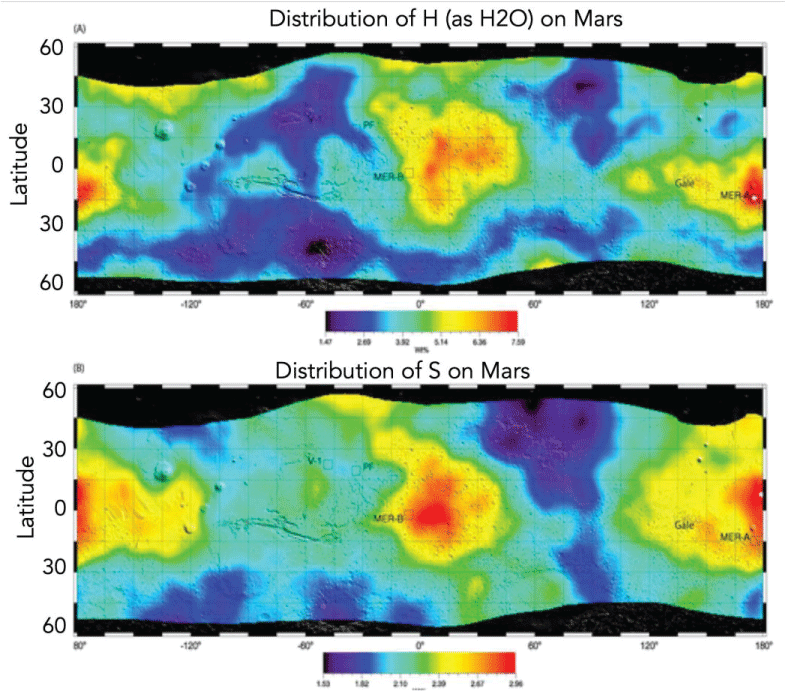
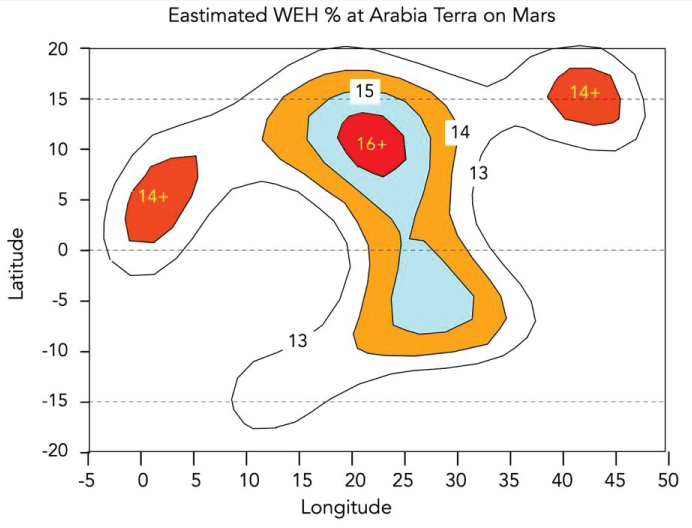
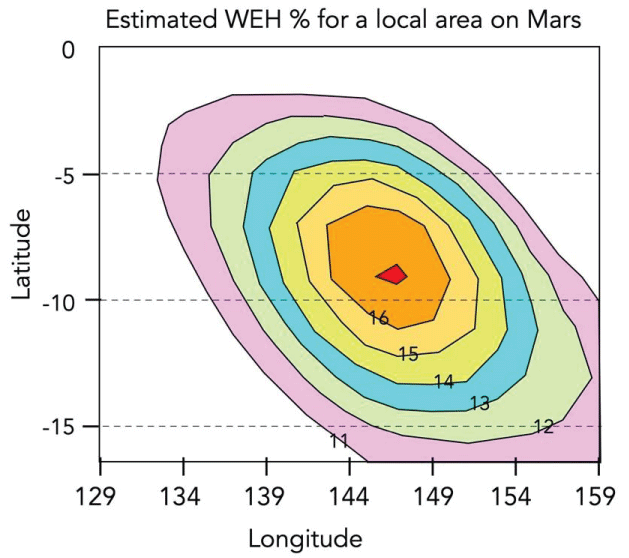
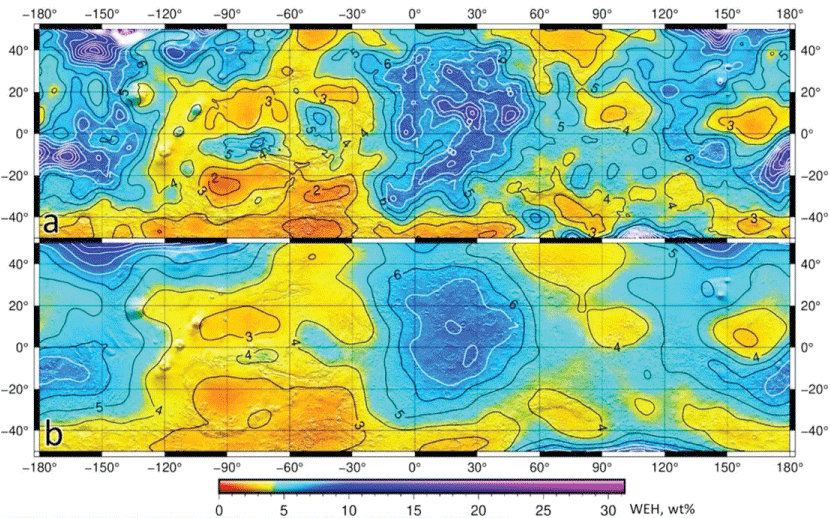
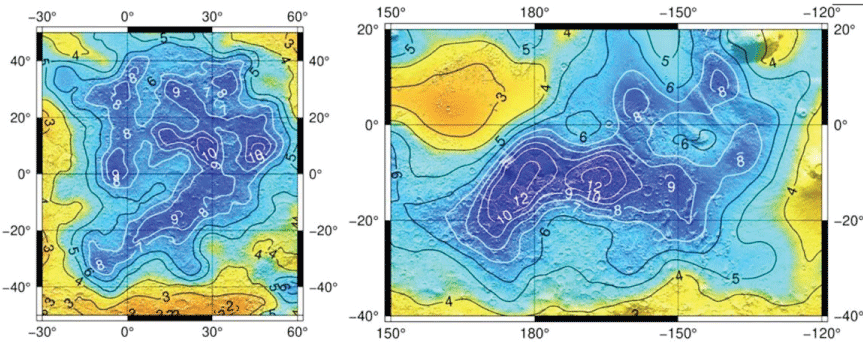
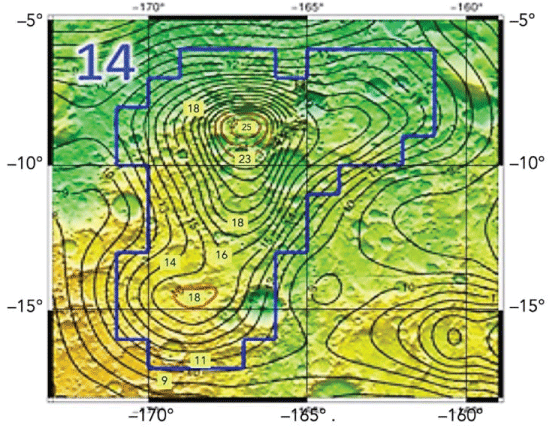
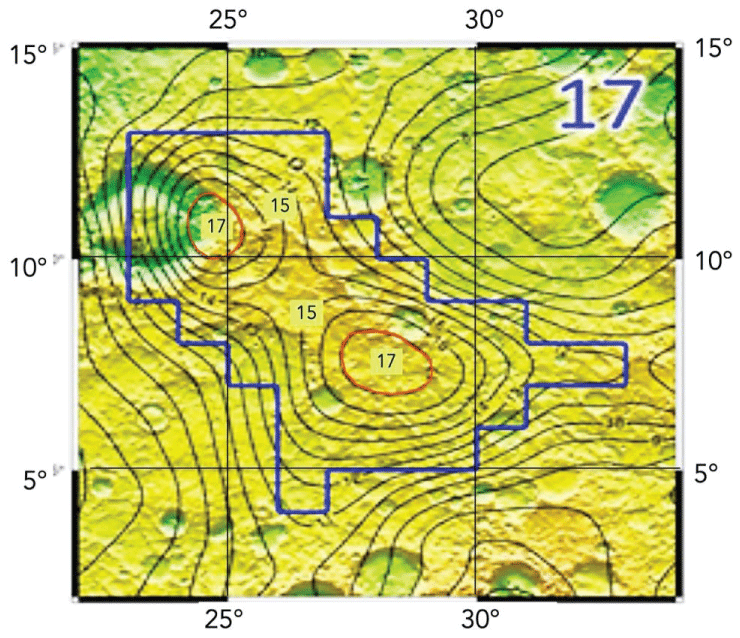

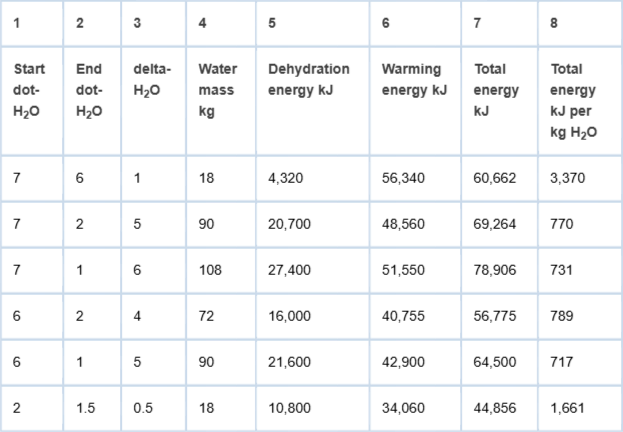
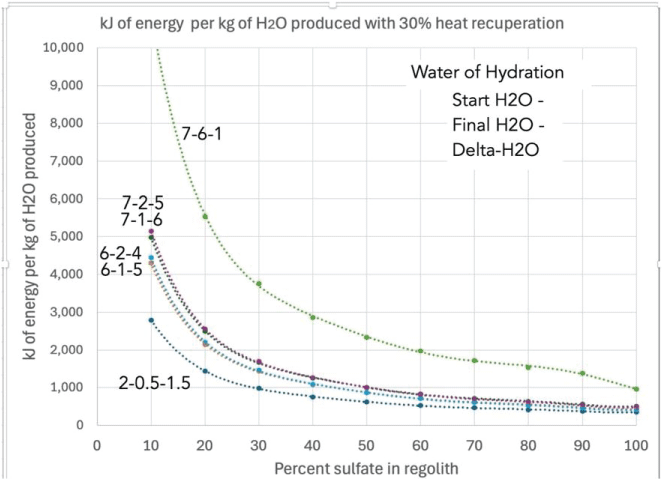
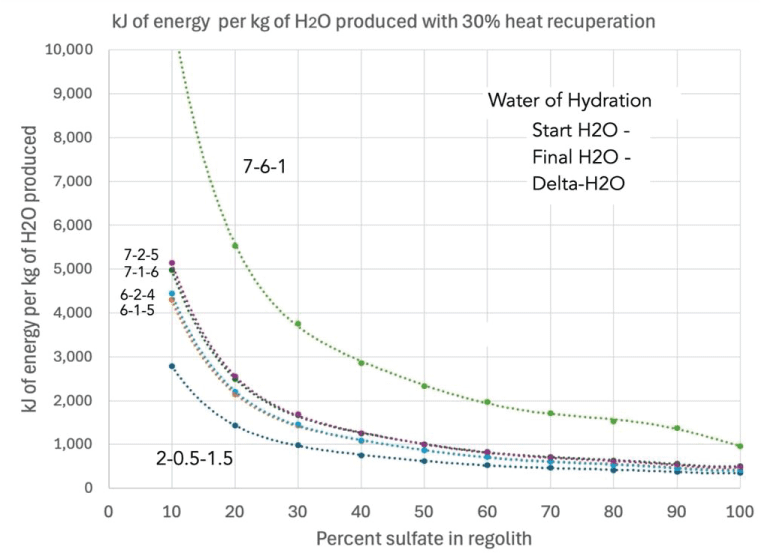
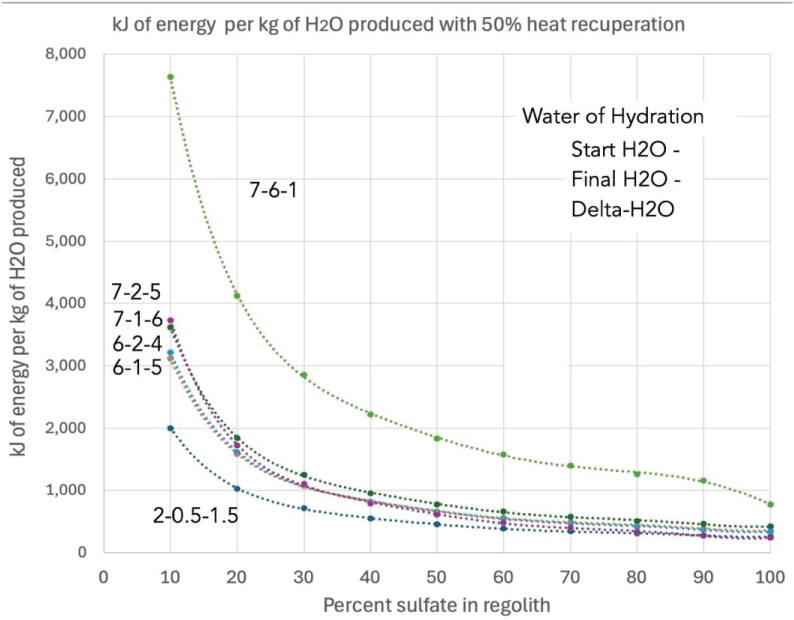

![Comparison of relative H and S concentrations in the upper ~1 m of Mars regolith as observed by the gamma ray spectrometer on the Odyssey spacecraft [10]. The pixels in both cases were about 600 km x 600 km.](https://www.igminresearch.es/articles/figures/igmin363/igmin363.g001.png)
![Estimated WEH % at a local area on Mars by reanalysis of Mars Odyssey neutron spectrometer data [21].](https://www.igminresearch.es/articles/figures/igmin363/igmin363.g002.png)
![Estimated WEH % at a local area on Mars by reanalysis of Mars Odyssey neutron spectrometer data [21].](https://www.igminresearch.es/articles/figures/igmin363/igmin363.g003.png)
![Water equivalent hydrogen maps, measured by collimated FREND/DSEN. (a) Upper map is collimated for maximum resolution (200 km). (b) Lower map is omnidirectional (550 km). Black and white isolines correspond to WEH values. Adapted from Figure 2 of Malakahov et al. (2022) [22].](https://www.igminresearch.es/articles/figures/igmin363/igmin363.g004.png)
![Enhanced segments of the global map shown in Figure 4, showing details of two areas with the most water content: Arabia Terra (top left), Medusa Fossae (top right). Adapted from Figure 3 of Malakahov et al. (2022) [22].](https://www.igminresearch.es/articles/figures/igmin363/igmin363.g005.png)
![Close-up chart of the highest-resolution view of a local area on Mars with unusually high WEH. The contour lines are lines of constant WEH [22].](https://www.igminresearch.es/articles/figures/igmin363/igmin363.g006.png)
![Close-up chart of the highest-resolution view of a local area on Mars with unusually high WEH. The contour lines are lines of constant WEH [22].](https://www.igminresearch.es/articles/figures/igmin363/igmin363.g007.png)