



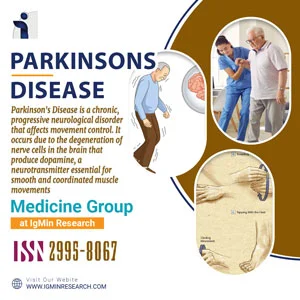
Parkinsons Disease at IgMin Research | Medicine Group
We aim to connect experts across disciplines to create new pathways for growth.
About
Parkinson's Disease is a progressive neurological disorder that profoundly impacts motor and non-motor functions. This complex condition arises due to the degeneration of dopamine-producing neurons in the brain, leading to symptoms such as tremors, rigidity, bradykinesia, and postural instability. Research into Parkinson's Disease spans diverse fields, including neurobiology, genetics, and pharmacology, aiming to uncover its underlying mechanisms and develop innovative treatments.
Advances in the understanding and management of Parkinson's Disease are driving the development of therapies that improve quality of life and slow disease progression. From exploring the role of neuroinflammation to leveraging precision medicine, this field is at the forefront of neuroscience research. Parkinson's Disease studies hold immense promise for uncovering insights into neurodegenerative processes, fostering breakthroughs that could benefit millions worldwide.
Why publish with us?
Global Visibility – Indexed in major databases
Fast Peer Review – Decision within 14–21 days
Open Access – Maximize readership and citation
Multidisciplinary Scope – Biology, Medicine and Engineering
Editorial Board Excellence – Global experts involved
University Library Indexing – Via OCLC
Permanent Archiving – CrossRef DOI
APC – Affordable APCs with discounts
Citation – High Citation Potential
Which articles are now trending?
Research Articles
- Assessing Bee (Hymenoptera, Apoidea, Anthophila) Diversity and Floral Preference in Two Habitats in the Iberian Peninsula
- Computational Porous Media Techniques for High-Fidelity Simulation of Headphone-Ear Coupling from 20 Hz to 20 kHz
- Methodology of the Professional-Business Game for the Development of a Cadet Leader in Professional Training Courses (L-1B) of the Tactical Level of Military Education
- Effect of Rainfall on Water Parameters in Recreational Lakes in Heidelberg, Germany
- Purification of Monoacylglycerides using Urea
- Gaussian-Transform for the Dirac Wave Function and its Application to the Multicenter Molecular Integral Over Dirac Wave Functions for Solving the Molecular Matrix Dirac Equation