


Help ?

IGMIN: We're glad you're here. Please click 'create a new query' if you are a new visitor to our website and need further information from us.

If you are already a member of our network and need to keep track of any developments regarding a question you have already submitted, click 'take me to my Query.'

Search

Organised by  IgMin Fevicon

Regional sites

Browse by Subjects

Welcome to IgMin Research – an Open Access journal uniting Biology, Medicine, and Engineering. We’re dedicated to advancing global knowledge and fostering collaboration across scientific fields.

Browse by Sections

At IgMin Research, we bridge the frontiers of Biology, Medicine, and Engineering to foster interdisciplinary innovation. Our expanded scope now embraces a wide spectrum of scientific disciplines, empowering global researchers to explore, contribute, and collaborate through open access.

Members

Our mission is to merge scientific expertise to boost knowledge and fuel faster developments.

Articles

Our mission is to merge scientific expertise to boost knowledge and fuel faster developments.

Explore Content

Our mission is to merge scientific expertise to boost knowledge and fuel faster developments.

Identify Us

Our mission is to merge scientific expertise to boost knowledge and fuel faster developments.

IgMin Corporation

Welcome to IgMin, a leading platform dedicated to enhancing knowledge dissemination and professional growth across multiple fields of science, technology, and the humanities. We believe in the power of open access, collaboration, and innovation. Our goal is to provide individuals and organizations with the tools they need to succeed in the global knowledge economy.

Publications Support
publications.support@igmin.org
E-Books Support
ebooks.support@igmin.org
Webinars & Conferences Support
webinarsandconference@igmin.org
Content Writing Support
contentwriting.support@igmin.org

Search

Select Language

Explore Section

Content for the explore section slider goes here.

Abstract

Abstract at IgMin Research

Our mission is to merge scientific expertise to boost knowledge and fuel faster developments.

Biology Group Research Article Article ID: igmin324

How Increased CO2 Warms the Earth

Climate Change Biology DOI10.61927/igmin324 Affiliation

Affiliation

    1445 Indiana Ave., South Pasadena, CA 91030, USA

28
VIEWS
11
DOWNLOADS
Connect with Us

Abstract

It is widely believed that emission of greenhouse gases, particularly CO2, is warming the world, and the consequences of this are serious. The world is heavily engaged in reducing emissions of CO2. The global effort to reduce emissions involves investment of very large sums, yet the proper scientific explanation of how CO2 warms the Earth is not widely understood. The objective of this research is to provide a clear, understandable description and quantitative model of the physics whereby increased CO2 produces global warming.
The Sun continuously inputs power at 341 W/m2 to the Earth, and the Earth radiates power to space. The difference between the two determines whether the Earth warms or cools to maintain a power balance. The approach taken here is to estimate the effect of rising CO2 on the ability of the Earth to radiate power to space.
The methodology involves dividing the Earth’s atmosphere into 150 100-m layers and modeling CO2 irradiance (12-17-micron wavelength band) through these layers. Each layer radiates in the IR according to the Stefan-Boltzmann law at its temperature. As the CO2 concentration increases, the range of primary emitting layers increases in altitude, where it is on average cooler, reducing outward radiation from the Earth in the 12-17-micron wavelength band. The Earth must warm to compensate. 
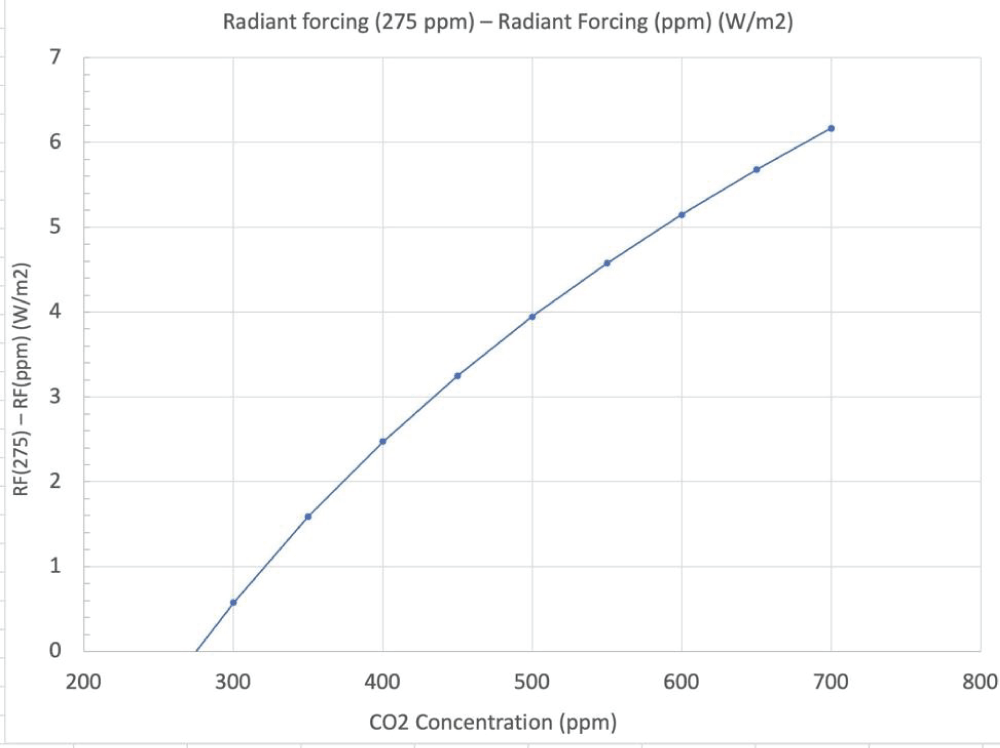
The forcing in the year 2025 was related to the known temperature increase from the 1800s and thus converted the calculated curve of radiative forcing vs. CO2 concentration to a curve of temperature gain from the 1800s vs. CO2 concentration. This plot is of fundamental importance in predicting future climate change and devising policies for mitigation. It indicates that we are likely to reach a temperature increase from the 1800s of 2.0 °C if CO2 reaches about 500 ppm, and 3.0 °C if CO2 reaches about 680 ppm.
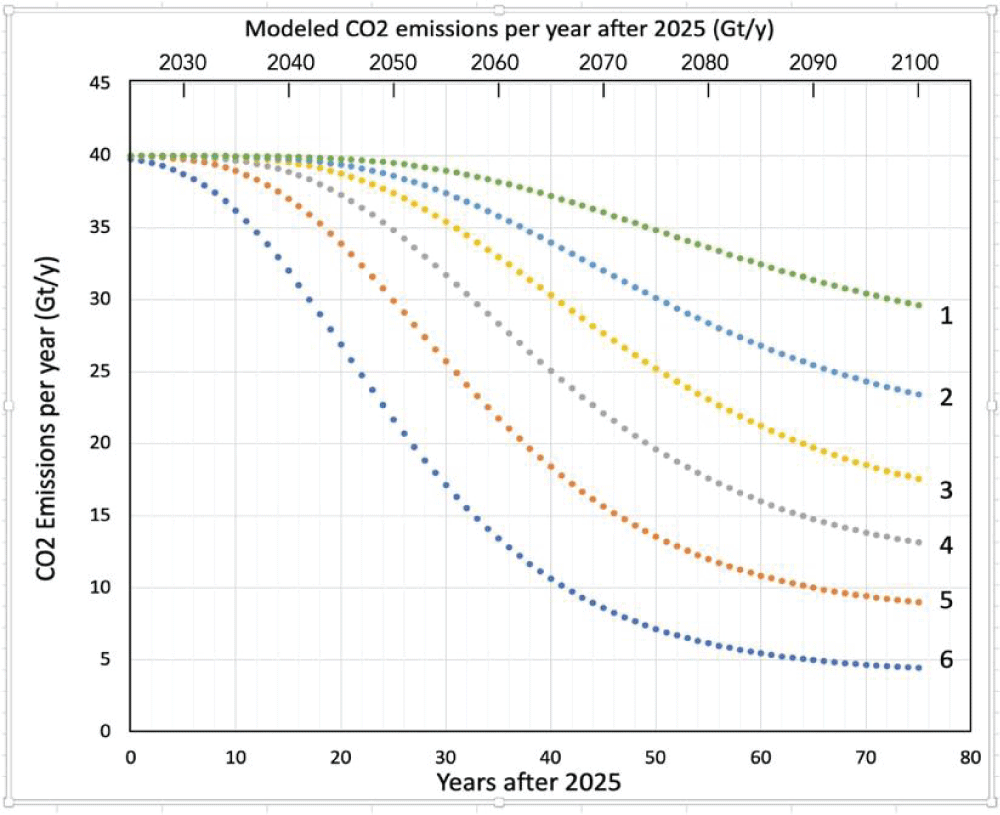
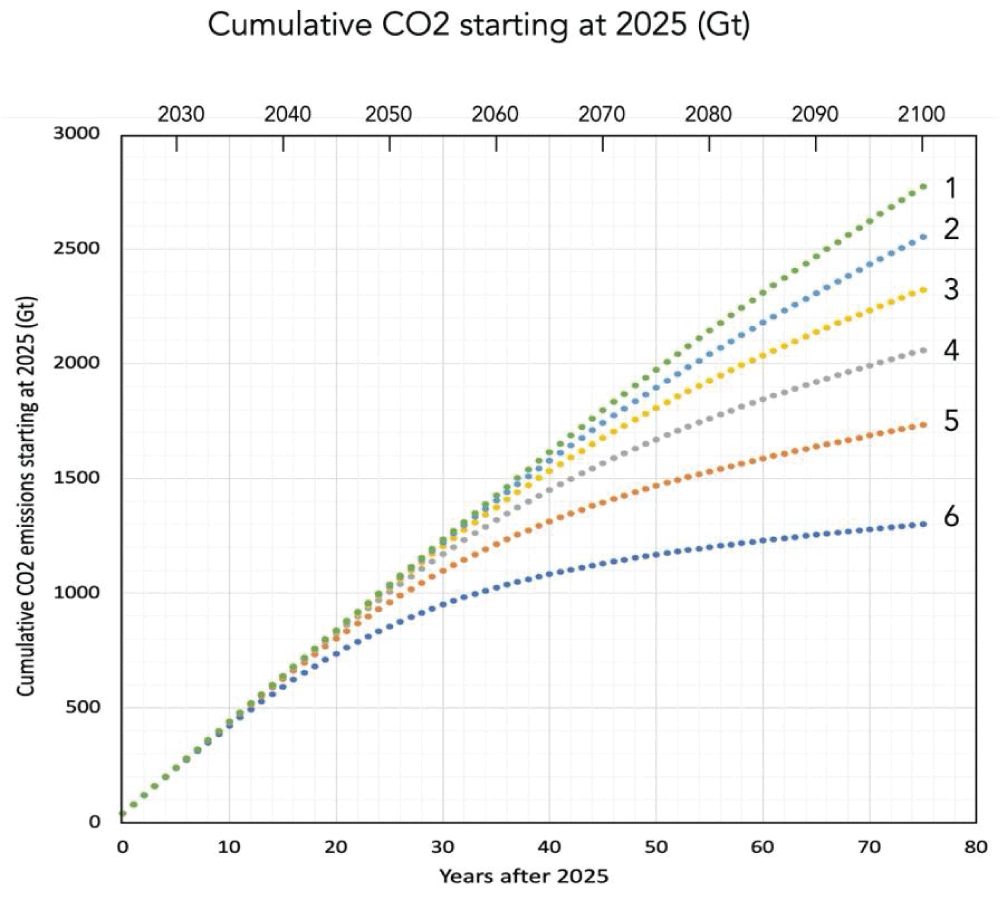
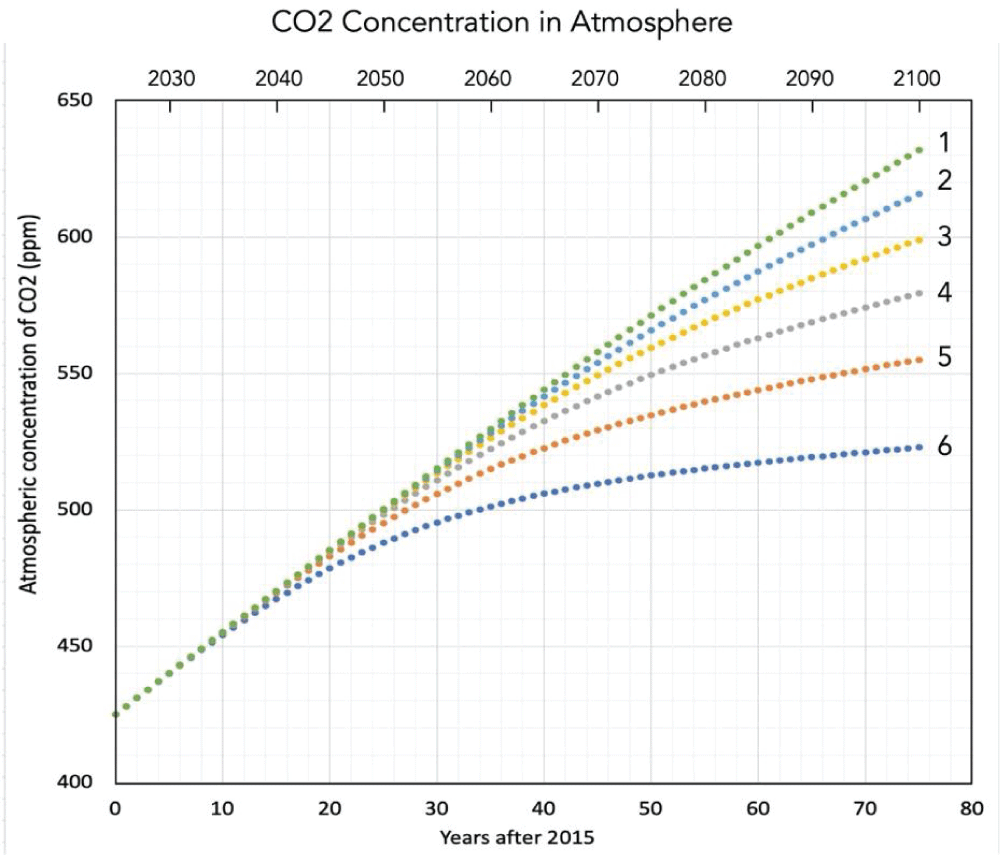
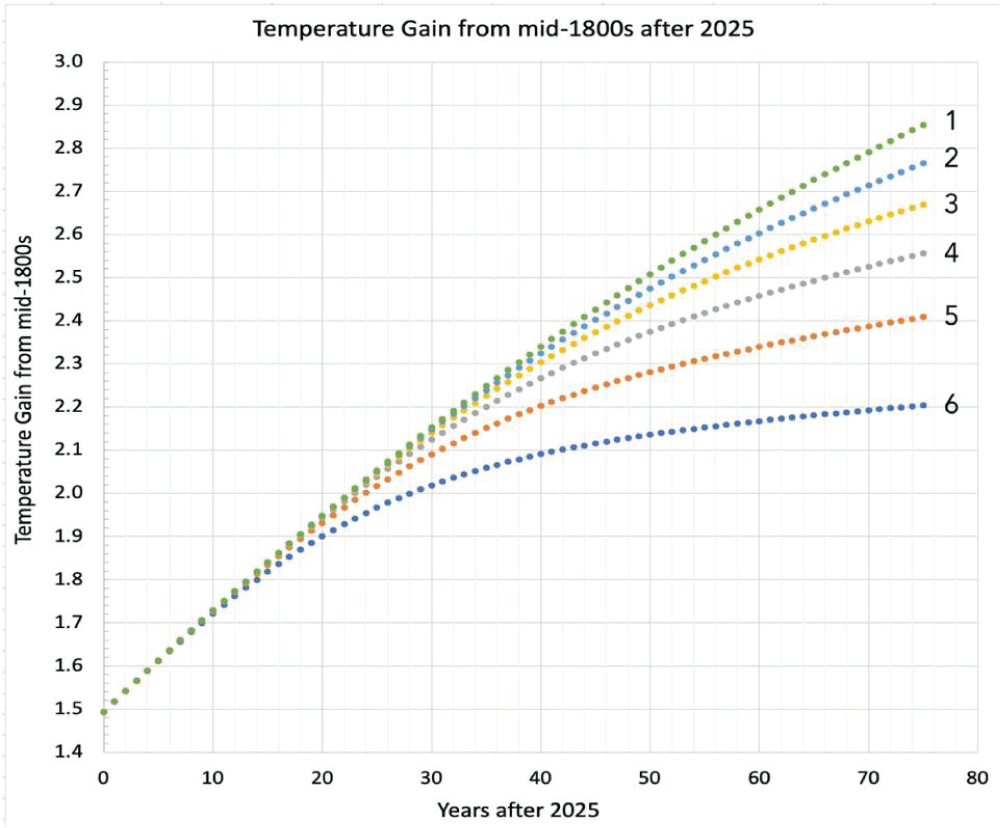
Six hypothetical scenarios were created for further CO2 emissions in the 21st century, and future temperatures for each scenario were estimated. The results span a range from 2.2 °C to 2.9 °C for the temperature increase from the 1800s to the year 2100, depending on the emission scenario.

Figures

References

    1. van Wijngaarden WA, Happer W. Dependence of Earth’s thermal radiation on five most abundant greenhouse gases. arXiv [physics.ao-ph]. 2020. doi:10.48550/arXiv.2006.03098
    2. Zhong W, Haigh JD. The greenhouse effect and carbon dioxide. Weather. 2013;68(4):100-105. doi:10.1002/wea.2072
    3. Henry B. Scientific proof that CO2 does NOT cause global warming. World J Adv Res Rev. 2024;21(3):1688-1690. doi:10.30574/wjarr.2024.21.3.0884
    4. Intergovernmental Panel on Climate Change (IPCC). Sixth Assessment Report. 2023. Available from: https://www.ipcc.ch/assessment-report/ar6/
    5. Myhre G, Highwood EJ, Shine KP, Stordal F. New estimates of radiative forcing due to well-mixed greenhouse gases. Phys Rev Lett. 1998;80:2715-2718.
    6. Dufresne J, Eymet V, Crevoisier C, Grandpeix JY. Greenhouse effect: the relative contributions of emission height and total absorption. J Climate. 2020;33:3827-3844. doi:10.1175/JCLI-D-19-0193.1
    7. Miskolczi F. Greenhouse gas theories and observed radiative properties of the Earth’s atmosphere. 2023. Available from: https://www.researchgate.net/publication/374530216
    8. Pierrehumbert RT. Infrared radiation and planetary temperature. Phys Today. 2011;64:33-38. doi:10.1063/1.3541943
    9. Lindzen RS. Taking greenhouse warming seriously. Energy Environ. 2007;18:937-950.
    10. Vinos J. The test that exonerates CO2. 2022. Available from: https://wattsupwiththat.com/2023/02/24/the-test-that-exonerates-co2/
    11. Lindsey R. Climate and Earth’s Energy Budget. NASA Earth Observatory. 2009. Available from: https://earthobservatory.nasa.gov/features/EnergyBalance
    12. Trenberth KE, Fasullo JT, Kiehl J. Earth’s global energy budget. 2009. Available from: https://journals.ametsoc.org/view/journals/bams/90/3/2008bams2634_1.xml
    13. Wild M, Folini D, Schär C. The global energy balance from a surface perspective. 2012. Available from: https://link.springer.com/article/10.1007/s00382-012-1569-8
    14. Stephens G, Li J, Wild M, et al. An update on Earth’s energy balance in light of the latest global observations. Nature Geosci. 2012;5:691–696. doi:10.1038/ngeo1580
    15. Rapp D. How increased CO2 warms the Earth: two contexts for the greenhouse gas effect. IgMin Res. 2024 Oct 24;2(10):854–859. IgMin ID: igmin259. doi:10.61927/igmin259. Available from: https://igmin.link/p259
    16. Best C. A collection of posts regarding the CO2 greenhouse effect and AGW. Available from: https://clivebest.com/blog/?page_id=6048
    17. Best C. A simple model of the CO2 greenhouse effect. 2012 Nov 2. Available from: https://clivebest.com/blog/?p=4265
    18. Best C. The CO2 GHE demystified. 2013 Feb 23. Available from: https://clivebest.com/blog/?p=4597
    19. Best C. Radiative forcing of CO2. 2013 Feb 27. Available from: https://clivebest.com/blog/?p=4698
    20. Rapp D. Estimate of temperature rise in the 21st century for various scenarios. IgMin Res. 2024 Jul 11;2(7):564–569. IgMin ID: igmin218. doi:10.61927/igmin218. Available from: https://igmin.link/p218
    21. NASA. Aerosols: small particles with big climate effects. Available from: https://science.nasa.gov/science-research/earth-science/climate-science/aerosols-small-particles-with-big-climate-effects/

Similar Articles

A New Modification of Classification of Traumatic Patients with Pelvic Fracture
Zahra Sedghazar, Ruba Altahla, Somayeh Sadeghi, Maria Karaminasian, Wan Li, Li Jun and Jamal Alshorman
DOI10.61927/igmin297
Levetiracetam-induced Rhabdomyolysis - A Rare Complication
Ayisha Farooq Khan, Naeemuddin Shaikh, Faryal Abdy and Dureshahwar Kanwar
DOI10.61927/igmin228
Exploring Upper Limb Kinematics in Limited Vision Conditions: Preliminary Insights from 3D Motion Analysis and IMU Data
Artemis Zarkadoula, Themistoklis Tsatalas, George Bellis, Paris Papaggelos, Evangelia Vlahogianni, Stefanos Moustos, Eirini Koukourava and Dimitrios Tsaopoulos
DOI10.61927/igmin138
Potentially Toxic Metals in Cucumber Cucumis sativus Collected from Peninsular Malaysia: A Human Health Risk Assessment
Chee Kong Yap, Rosimah Nulit, Aziran Yaacob, Zaieka Shamsudin, Meng Chuan Ong, Wan Mohd Syazwan, Hideo Okamura, Yoshifumi Horie, Chee Seng Leow, Ahmad Dwi Setyawan, Krishnan Kumar, Wan Hee Cheng and Kennedy Aaron Aguol
DOI10.61927/igmin200
Cyber Threat Analysis (CTA) in Current Conflicts
Zbigniew Ciekanowski and Sławomir Żurawski
DOI10.61927/igmin169

Why publish with us?

  • Global Visibility – Indexed in major databases

  • Fast Peer Review – Decision within 14–21 days

  • Open Access – Maximize readership and citation

  • Multidisciplinary Scope – Biology, Medicine and Engineering

  • Editorial Board Excellence – Global experts involved

  • University Library Indexing – Via OCLC

  • Permanent Archiving – CrossRef DOI

  • APC – Affordable APCs with discounts

  • Citation – High Citation Potential

Submit Your Article

Advertisement