IGMIN: We're glad you're here. Please click 'create a new query' if you are a new visitor to our website and need further information from us.
If you are already a member of our network and need to keep track of any developments regarding a question you have already submitted, click 'take me to my Query.'
Welcome to IgMin Research – an Open Access journal uniting Biology, Medicine, and Engineering. We’re dedicated to advancing global knowledge and fostering collaboration across scientific fields.
At IgMin Research, we bridge the frontiers of Biology, Medicine, and Engineering to foster interdisciplinary innovation. Our expanded scope now embraces a wide spectrum of scientific disciplines, empowering global researchers to explore, contribute, and collaborate through open access.
Welcome to IgMin, a leading platform dedicated to enhancing knowledge dissemination and professional growth across multiple fields of science, technology, and the humanities. We believe in the power of open access, collaboration, and innovation. Our goal is to provide individuals and organizations with the tools they need to succeed in the global knowledge economy.
IgMin Publications Inc., Suite 102, West Hartford, CT - 06110, USA
Background: Health systems increasingly rely on digital records, information exchanges, and specialized service platforms, but technical connectivity alone does not ensure coordinated, equitable, and accountable care. This paper proposes the Integrated Health Data System (IHDS), an evidence-informed conceptual reference architecture intended for adaptation across health-system settings. A concentric geometric model is used as a visual language for organizing interdependent capabilities, not as evidence of technical performance.
Methods: A design-science and conceptual framework approach informed a purposive review of WHO and WHO-ITU guidance, OpenHIE and HL7 interoperability specifications, learning-health-system theory, systems thinking, governance scholarship, and emerging-technology evidence. The July 2026 evidence scan was documented by source type, search concepts, selection criteria, and a description of how the evidence informed domain selection. Functions and safeguards were mapped to an exchange-centred design and examined through an internal standards comparison, a hypothetical referral-pathway walkthrough, and explicit appraisal of assumptions and limitations. No prototype or implementation evaluation was undertaken.
Results: IHDS specifies a longitudinal information-exchange core, six direct care and knowledge domains, six enabling domains, including a Pharmaceutical and Life Sciences Ecosystem, five complementary architecture views, cross-cutting interoperability and governance capabilities, an adaptable local-regional-shared-service topology, and a four-stage capability-maturity pathway. Eight testable propositions describe prospective evaluation targets.
Conclusion: IHDS offers a proposed organizing architecture for interoperable and potentially learning-oriented health systems. Its technical and organizational value remains a hypothesis requiring independent expert assessment, jurisdiction-specific standards mapping, participatory design, and pilot testing before feasibility or outcome claims are warranted.
Digital health programmes often begin with software procurement, although the more difficult task is institutional design. Health systems must specify who creates information, who may use it, how records move between services, how errors are corrected, and where accountability rests. The World Health Organization [11World Health Organization. Global strategy on digital health 2020-2025. 2021b. https://www.who.int/publications/i/item/9789240020924] treats digital health as a health-system programme combining organizational, financial, human, and technical resources, consistent with systems-thinking scholarship [22de Savigny D, Adam T. (Eds.). Systems thinking for health systems strengthening. Alliance for Health Policy and Systems Research, World Health Organization. 2009; https://ahpsr.who.int/publications/i/item/2009-11-13-systems-thinking-for-health-systems-strengthening]. The central question is therefore not which technology should be purchased first, but which relationships must be made reliable.
Interoperability requires more than linking databases. The WHO-ITU Digital Health Platform Handbook describes reusable infrastructure and shared services for connected health systems [33International Telecommunication Union, & World Health Organization. Digital health platform handbook: Building a digital information infrastructure (infostructure) for health. 2020; https://www.itu.int/dms_pub/itu-d/opb/str/D-STR-DIGITAL.HEALTH-2020-PDF-E.pdf]. OpenHIE specifies interoperable components, registries, and exchange workflows that connect otherwise separate points of care [44OpenHIE Community. (n.d.). OpenHIE architecture specification. Retrieved July 31, 2026, from https://guides.ohie.org/arch-spec/]. HL7 FHIR provides a technical standard for exchanging structured health information, while local implementation profiles, terminology services, and governance determine how such exchange is used [55Health Level Seven International. FHIR release 5 (v5.0.0): 2023; https://hl7.org/fhir/overview.html,66Li, E, Clarke J, Ashrafian H, Darzi A, Neves AL. The impact of electronic health record interoperability on safety and quality of care in high-income countries: Systematic review. 2022; Journal of Medical Internet Research, 24(9), e38144. https://doi.org/10.2196/38144]. A new reference architecture should complement these established components rather than imply that their core functions are newly invented.
Fragmentation persists when referrals, diagnostics, medicine management, financing, community follow-up, and public-health functions are governed or implemented separately. Reviews of health-information-system interoperability identify technical, semantic, organizational, and regulatory constraints that cannot be solved through software interfaces alone [66Li, E, Clarke J, Ashrafian H, Darzi A, Neves AL. The impact of electronic health record interoperability on safety and quality of care in high-income countries: Systematic review. 2022; Journal of Medical Internet Research, 24(9), e38144. https://doi.org/10.2196/38144,77Torab-Miandoab A, Samad-Soltani T, Jodati A, Rezaei-Hachesu P. Interoperability of heterogeneous health information systems: A systematic literature review. BMC Medical Informatics and Decision Making. 2023; 23, 18. https://doi.org/10.1186/s12911-023-02115-5]. Connectivity, affordability, disability access, literacy, and trust may also shape whether digitally mediated services improve access or create new barriers. These challenges arise in health systems with different levels of infrastructure and administrative capacity and motivate a configurable, rather than country-prescribed, architecture.
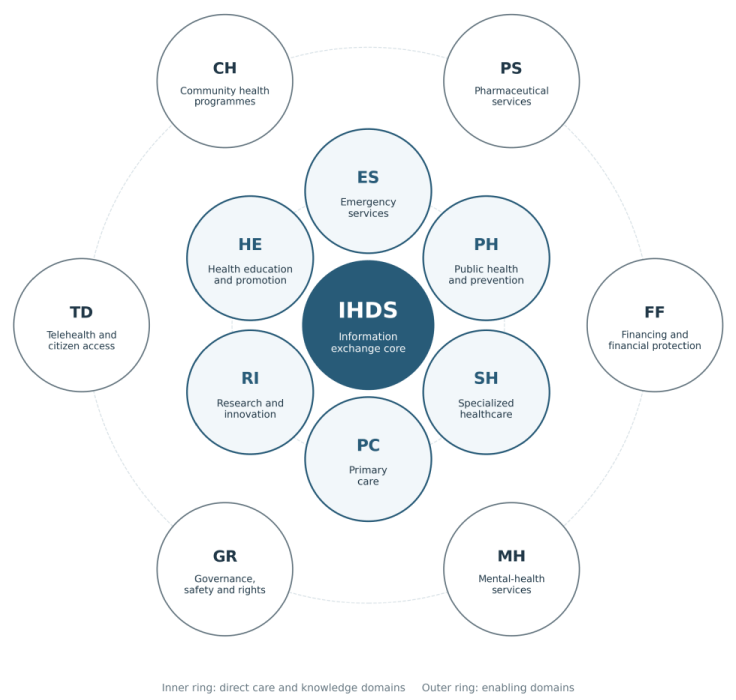
IHDS organizes these relationships through a concentric model. A central information exchange is surrounded by six direct domains: emergency care, public health and prevention, specialized care, primary care, research and innovation, and health education. Six enabling domains address medicines, financing, mental health, regulation, telehealth, and community programmes. Local and regional operation, shared coordination, staged implementation, decision support, and future technology assessment are included without prescribing a particular national administrative structure.
The spiritual language requires a clear scientific limit. Sacred geometry has meaning in philosophical, artistic, and spiritual traditions, but symbolic recurrence does not prove that a health system will work. In this paper, geometry is used as a design language for centrality, interdependence, and expansion. Claims about interoperability, governance, clinical safety, equity, and implementation are based on health-system evidence and standards. Circular models have long been used in public health to show nested relationships, including the Mandala of Health [88Hancock T. The mandala of health: A model of the human ecosystem. Family & Community Health. 1985; 8(3), 1-10. https://doi.org/10.1097/00003727-198511000-00002,99Hancock T. Health, human development and the community ecosystem: Three ecological models. Health Promotion International. 1993; 8(1), 41-47. https://doi.org/10.1093/heapro/8.1.41], while design research has shown that visual metaphors can help groups examine complex relationships [1010Lockton D, Singh D, Sabnis S, Chou M, Foley S, Pantoja A. New metaphors: A workshop method for generating ideas and reframing problems in design and beyond. In Proceedings of the 2019 Conference on Creativity and Cognition (pp. 319-332). Association for Computing Machinery. https://doi.org/10.1145/3325480.3326570]. Whether the IHDS representation improves understanding or deliberation remains an empirical question.
The study had four aims: to specify the health-system functions represented in IHDS; to translate the geometric form into explicit design principles; to compare the resulting architecture with established international standards and reference patterns; and to identify what must be tested before claims about implementation or benefit can be made. The intended output is a proposed reference architecture that may be examined, adapted, or rejected in specific institutional settings.
This study combined design-science research with conceptual framework analysis. Design-science research is suited to problems in which the scholarly output is a model, method, or architecture that must solve a defined practical problem [1111Hevner AR, March ST, Park J, Ram S. Design science in information systems research. MIS Quarterly. 2004; 28(1), 75-105. https://doi.org/10.2307/25148625]. The work followed the stages described by Hevner and colleagues and by Peffers and colleagues: problem identification, definition of objectives, design, demonstration, evaluation, and communication [1111Hevner AR, March ST, Park J, Ram S. Design science in information systems research. MIS Quarterly. 2004; 28(1), 75-105. https://doi.org/10.2307/25148625,1212Peffers K, Tuunanen T, Rothenberger MA, Chatterjee S. A design science research methodology for information systems research. Journal of Management Information Systems. 2007; 24(3), 45-77. https://doi.org/10.2753/MIS0742-1222240302]. Conceptual framework analysis was used to define the model's concepts and relationships across different bodies of literature [1313Jabareen Y. Building a conceptual framework: Philosophy, definitions, and procedure. International Journal of Qualitative Methods. 2009; 8(4), 49-62. https://doi.org/10.1177/160940690900800406].
IHDS is a conceptual reference architecture, not a deployed information system or a simulated clinical service. It describes candidate roles, capabilities, exchanges, and governance requirements while leaving products, hosting, administrative tiers, and procurement decisions open. The architecture is a substantive design proposal grounded in existing health-system functions and standards; its effectiveness and portability have not yet been empirically demonstrated.
Evidence identification and selection
A structured, purposive evidence review was conducted in July 2026. Searches covered PubMed, Google Scholar, official World Health Organization (WHO) and International Telecommunication Union (ITU) websites, OpenHIE and HL7 technical repositories, and backward reference lists. The search concepts included combinations of the terms 'digital health platform', 'health information exchange', 'interoperability', 'FHIR', 'digital public infrastructure', 'health equity', 'design science', 'learning health system', 'systems thinking', 'circular health model', 'AI governance', 'blockchain', and 'quantum computing'. The search was intended to identify design principles, implementation standards, governance requirements, and limitations of emerging technologies, not to estimate intervention effects. The final reference list contains 29 sources. This is a targeted evidence scan, not a systematic or exhaustive review.
Sources were retained when they described an established architectural principle, supported the conceptual method, addressed equity or governance, or provided evidence limiting an emerging-technology claim. Official standards and WHO guidance were prioritized for normative requirements, while systematic reviews and peer-reviewed research informed feasibility and risk. Marketing material, unsupported forecasts, and sources lacking a clear connection to the design questions were excluded. Where recommendations differed, the architecture distinguishes technical standards from broader policy guidance, defers legal and operational choices to the implementing jurisdiction, and treats claims with limited evidence as conditional. The material was assessed against six questions: relevance, functional coverage, interoperability, rights and governance, feasibility, and evaluability. No quantitative synthesis or independent expert-rating process was undertaken.
Framework construction
Framework construction began with the 13-circle geometric arrangement and translated each circle into a defined capability. The central circle was specified as a governed information exchange and longitudinal record-access function, not as an unrestricted central database. Six functions directly involved in care or knowledge generation were assigned to the inner ring; six enabling or integrative functions were assigned to the outer ring. These assignments were informed by the service functions described in WHO digital-intervention guidance, the WHO-ITU platform model, and OpenHIE, but the 1+6+6 arrangement itself is a geometric design constraint, not a domain count established by the literature [33International Telecommunication Union, & World Health Organization. Digital health platform handbook: Building a digital information infrastructure (infostructure) for health. 2020; https://www.itu.int/dms_pub/itu-d/opb/str/D-STR-DIGITAL.HEALTH-2020-PDF-E.pdf,44OpenHIE Community. (n.d.). OpenHIE architecture specification. Retrieved July 31, 2026, from https://guides.ohie.org/arch-spec/,1414World Health Organization. WHO guideline: Recommendations on digital interventions for health system strengthening. 2019; https://www.who.int/publications/i/item/9789241550505,1515World Health Organization. Classification of digital interventions, services and applications in health: A shared language to describe the uses of digital technology for health (2nd ed.) 2023a. https://www.who.int/publications/i/item/9789240081949]. Each domain was described by its purpose, principal actors, information requirements, transactions, and safeguards. Identity, terminology, lawful access, security, offline operation, analytics, and governance were added as cross-cutting requirements because safe exchange cannot be achieved by service categories alone.
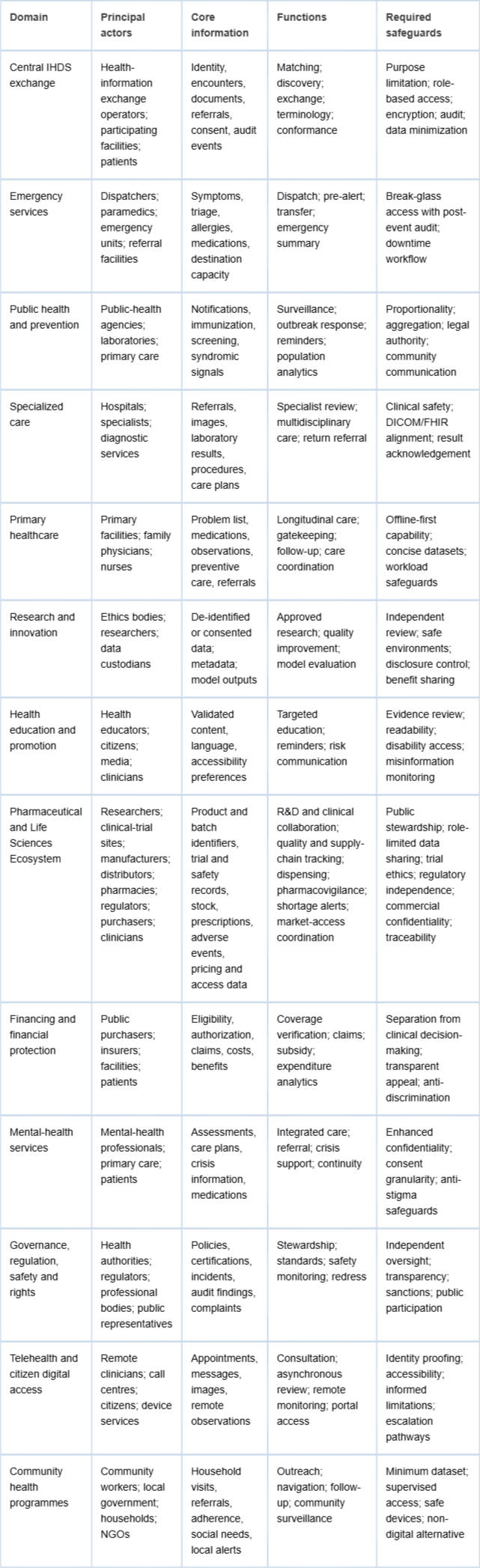
The architecture was compared with the digital health platform approach developed by ITU and WHO [33International Telecommunication Union, & World Health Organization. Digital health platform handbook: Building a digital information infrastructure (infostructure) for health. 2020; https://www.itu.int/dms_pub/itu-d/opb/str/D-STR-DIGITAL.HEALTH-2020-PDF-E.pdf], the draft WHO-ITU reference architecture [1616World Health Organization. Ethics and governance of artificial intelligence for health: Guidance on large multi-modal models. 2025. https://www.who.int/publications/i/item/9789240084759], the OpenHIE specification [44OpenHIE Community. (n.d.). OpenHIE architecture specification. Retrieved July 31, 2026, from https://guides.ohie.org/arch-spec/], and HL7 FHIR [55Health Level Seven International. FHIR release 5 (v5.0.0): 2023; https://hl7.org/fhir/overview.html]. Scholarship on SMART guidelines and interoperability was used to check whether foundational functions were missing [77Torab-Miandoab A, Samad-Soltani T, Jodati A, Rezaei-Hachesu P. Interoperability of heterogeneous health information systems: A systematic literature review. BMC Medical Informatics and Decision Making. 2023; 23, 18. https://doi.org/10.1186/s12911-023-02115-5,1717Mehl G, Tunçalp Ö, Ratanaprayul N, Tamrat T, Barreix M, Lowrance D, Bartolomeos K, Say L, Kostanjsek N, Jakob R, Grove J, Mariano B, Jr, Swaminathan S. WHO SMART guidelines: Optimising country-level use of guideline recommendations in the digital age. The Lancet Digital Health. 2021. 3(4), e213-e216. https://doi.org/10.1016/S2589-7500(21)00038-8]. The internal completeness check considered whether all domains had identifiable actors, transactions, information needs, interfaces, and safeguards, and whether shared capabilities such as registries, terminology, audit, and conformance were represented. Table 2 specifies domain responsibilities,
with established architectural patterns. This is an author-led coverage check, not an independently validated finding that the 13 domains are complete. Applicable legal requirements, the FHIR release, and jurisdictional implementation profiles must be determined in any future implementation.
Conceptual evaluation
The completed design was appraised internally through reasoned argument, standards comparison, negative-case analysis, and an illustrative scenario walkthrough [1111Hevner AR, March ST, Park J, Ram S. Design science in information systems research. MIS Quarterly. 2004; 28(1), 75-105. https://doi.org/10.2307/25148625,1212Peffers K, Tuunanen T, Rothenberger MA, Chatterjee S. A design science research methodology for information systems research. Journal of Management Information Systems. 2007; 24(3), 45-77. https://doi.org/10.2753/MIS0742-1222240302]. The appraisal considered relevance, internal consistency, functional coverage, compatibility with established standards, and acknowledged failure modes. For example, evidence on fragmented information flows supports a proposed exchange and referral mechanism, while guidance on access and governance motivates minimum-necessary disclosure and accountable oversight; neither source type establishes that IHDS improves outcomes.
This internal appraisal supports a reasoned conceptual specification only. It does not establish technical conformance, usability, cost-effectiveness, implementation feasibility, or changes in health outcomes. Such claims require independent expert assessment, structured technical modelling, participatory co-design, and pilot evaluation.
Scientific position on sacred geometry
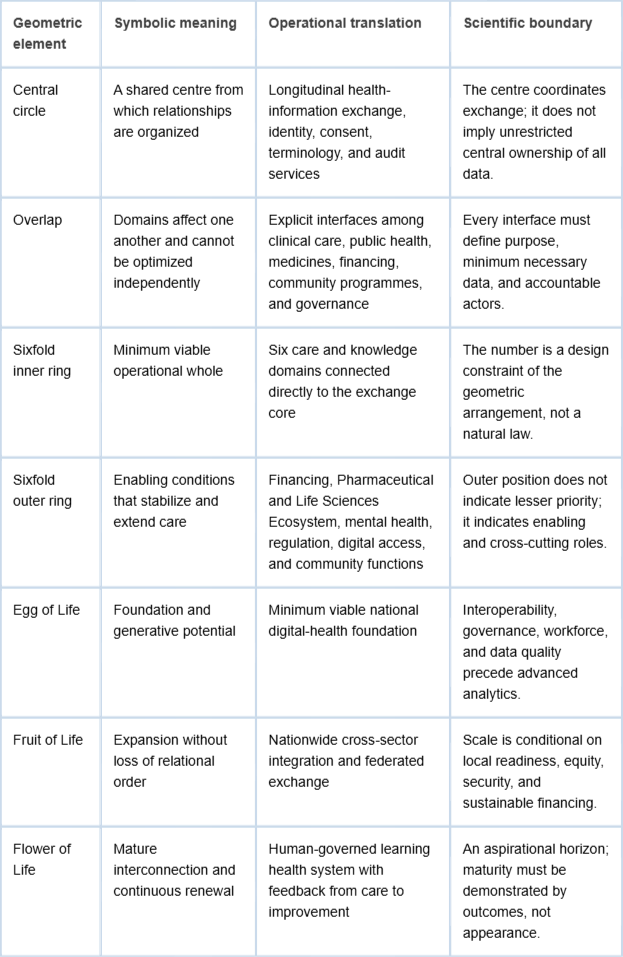
In IHDS, sacred geometry refers to a spiritual interpretation of patterned interdependence and to the use of overlapping circles as a representational grammar. The paper makes no claim that the Egg of Life, Fruit of Life, or Flower of Life causes healing, predicts system performance, or validates a technical design. The terms express three propositions about organization: services are incomplete in isolation, the centre exists to coordinate exchange, and maturity requires wider relationships without loss of accountability.
This distinction is necessary because a metaphor becomes useful in research only after its relationships are defined and made testable. The Mandala of Health provides a precedent for using a circular form to represent nested health relationships [88Hancock T. The mandala of health: A model of the human ecosystem. Family & Community Health. 1985; 8(3), 1-10. https://doi.org/10.1097/00003727-198511000-00002,99Hancock T. Health, human development and the community ecosystem: Three ecological models. Health Promotion International. 1993; 8(1), 41-47. https://doi.org/10.1093/heapro/8.1.41]. Design scholarship also shows that metaphors can make complex systems easier to inspect and discuss [1010Lockton D, Singh D, Sabnis S, Chou M, Foley S, Pantoja A. New metaphors: A workshop method for generating ideas and reframing problems in design and beyond. In Proceedings of the 2019 Conference on Creativity and Cognition (pp. 319-332). Association for Computing Machinery. https://doi.org/10.1145/3325480.3326570]. Table 1 states the operational meaning and scientific limit of each geometric element used in IHDS.
Table 1: Translation of sacred geometry from symbolism into explicit IHDS design principles.
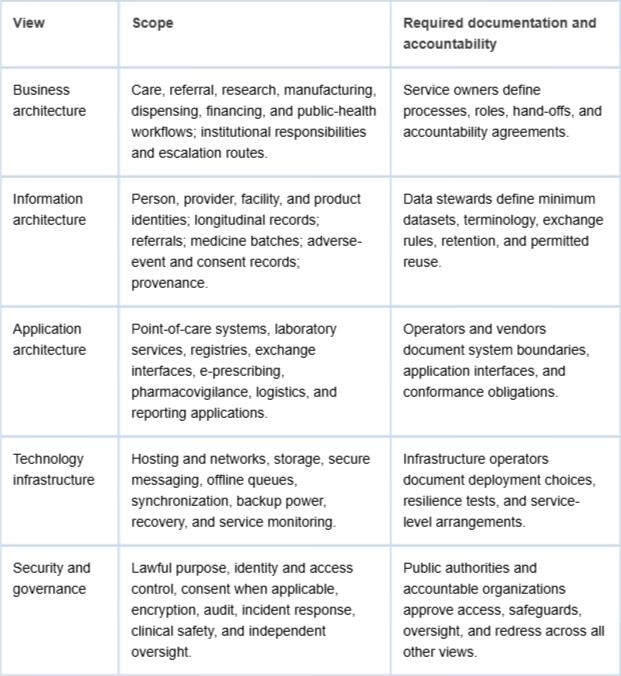
Table 2a: Five complementary architecture views for IHDS
IHDS addresses a coordination failure rather than a single disease or software gap. In the fragmented state, the patient's identity, history, referral status, diagnostic results, medicine use, eligibility for financial support, and follow-up plan are distributed across institutions and often across paper, memory, and informal communication. The resulting burden is transferred to patients and families, who must carry information physically, repeat histories and tests, navigate referrals, and absorb the cost of delay. Reviews of health-information interoperability consistently identify organizational, semantic, technical, legal, and governance requirements; connecting databases without these layers does not produce meaningful exchange [66Li, E, Clarke J, Ashrafian H, Darzi A, Neves AL. The impact of electronic health record interoperability on safety and quality of care in high-income countries: Systematic review. 2022; Journal of Medical Internet Research, 24(9), e38144. https://doi.org/10.2196/38144,77Torab-Miandoab A, Samad-Soltani T, Jodati A, Rezaei-Hachesu P. Interoperability of heterogeneous health information systems: A systematic literature review. BMC Medical Informatics and Decision Making. 2023; 23, 18. https://doi.org/10.1186/s12911-023-02115-5].
The design objectives were therefore defined as follows: preserve a longitudinal person-centred record; connect community, primary, referral, specialist, diagnostic, emergency, and public-health functions; support regional resilience and national learning; permit public and private participation without surrendering public governance; minimize data collection and access; function under constrained connectivity; make algorithms auditable and subordinate to accountable professionals; and allow staged implementation without making future technologies prerequisites (Figure 1).
Figure 1: IHDS sacred geometry-inspired conceptual architecture. The central exchange is surrounded by six direct domains and six enabling domains. The PS label in the diagram identifies pharmaceutical services, specified in Section 3.4 as the wider Pharmaceutical and Life Sciences Ecosystem. The Egg-Fruit-Flower sequence denotes foundation, integration, and learning. The geometry is a design metaphor, not an empirical claim.
Central nucleus: longitudinal health-information exchange
The central blue sphere of the geometric model is redefined as a governed set of shared capabilities rather than a single all-seeing database. Its function is to make the right information available for a legitimate purpose at the right point of care. Data may remain in source systems, be cached regionally, or be stored in shared repositories according to architecture, law, and operational need. What must be centralized is not necessarily every clinical datum, but the rules and services that permit trustworthy discovery, matching, exchange, and accountability.
The exchange core contains eight minimum capabilities: (1) person identification and record matching; (2) provider, facility, service, and product registries; (3) a longitudinal record index and document exchange; (4) terminology and value sets; (5) lawful access and purpose-of-use management, including consent when appropriate; (6) authentication, role-based authorization, and audit; (7) data-quality and conformance services; and (8) governed analytics access. These capabilities are consistent with digital health platform and health-information-exchange approaches [33International Telecommunication Union, & World Health Organization. Digital health platform handbook: Building a digital information infrastructure (infostructure) for health. 2020; https://www.itu.int/dms_pub/itu-d/opb/str/D-STR-DIGITAL.HEALTH-2020-PDF-E.pdf,44OpenHIE Community. (n.d.). OpenHIE architecture specification. Retrieved July 31, 2026, from https://guides.ohie.org/arch-spec/,1818World Health Organization, & International Telecommunication Union. Reference architecture for national digital health transformation (Version 0.1.0) [Draft]. 2025. https://smart.who.int/ra/]. FHIR APIs can support structured exchange, but semantic consistency also requires terminology services, versioned implementation profiles, and jurisdiction-appropriate policies [55Health Level Seven International. FHIR release 5 (v5.0.0): 2023; https://hl7.org/fhir/overview.html-77Torab-Miandoab A, Samad-Soltani T, Jodati A, Rezaei-Hachesu P. Interoperability of heterogeneous health information systems: A systematic literature review. BMC Medical Informatics and Decision Making. 2023; 23, 18. https://doi.org/10.1186/s12911-023-02115-5].
The nucleus must incorporate the principle of minimum necessary disclosure. A community worker conducting a follow-up visit does not require the same information as an emergency physician, an insurer, a regulator, or a researcher. Access is therefore constrained by role, care relationship, purpose, sensitivity, and time. Secondary uses should rely on de-identified or appropriately governed data environments and must not be assumed to follow automatically from clinical collection.
The six inner domains
The inner ring represents functions that interact directly with the person's care trajectory or generate knowledge needed for immediate health action. Its six domains retain the identity of the IHDS but are specified more precisely.
Emergency services coordinate triage, dispatch, pre-hospital care, emergency-department readiness, and interfacility transfer. Public health and preventive services manage surveillance, immunization, screening, risk communication, and population-level response. Specialized healthcare services encompass secondary and tertiary care, advanced diagnostics, and multidisciplinary management. Primary healthcare services provide the longitudinal first-contact platform, including noncommunicable disease management, maternal and child health, and referral coordination. Healthcare research and innovation govern ethically approved learning from routine data and prospective studies. Health education and promotion support understandable, culturally appropriate communication and self-management while guarding against digital exclusion and misinformation.
The six outer domains
The outer ring represents enabling and integrative conditions. The pharmaceutical domain is specified as a Pharmaceutical and Life Sciences Ecosystem covering pharmaceutical research and development, clinical collaboration, manufacturing, quality assurance, distribution, dispensing, and post-market safety monitoring. Its interfaces connect research institutions and clinical-trial sites with manufacturers, regulators, health facilities, public-health agencies, purchasers, and financing bodies. Governed exchange could support medicine and product identifiers, batch traceability, shortage alerts, adverse-event reporting, formulary decisions, and evidence used in reimbursement or market-access processes. Commercial participants would provide and receive only the data permitted for their roles; they would not control the public exchange core, patient records, or regulatory decisions. Insurance and financing is broadened to financing and financial protection so that the architecture can support public entitlements, targeted subsidies, insurance, claims, and transparent payment without assuming that insurance is the dominant model. Mental-health services remain visibly distinct to correct their frequent marginalization, while exchanging data under heightened sensitivity controls.
Regulatory compliance becomes governance, regulation, safety, and rights. It includes stewardship, certification, clinical safety, privacy, cybersecurity, algorithm oversight, procurement rules, grievance mechanisms, and public accountability. Telehealth and digital health services provide remote consultations, asynchronous review, citizen portals, call-centre and messaging channels, connected diagnostics, and accessibility functions. Community health programmes connect community health workers, outreach, household follow-up, local surveillance, and social support to formal care. The outer ring is therefore not peripheral; it is the infrastructure that makes clinical integration lawful, sustainable, equitable, and reachable.
Cross-cutting information and intelligence layers
Four cross-cutting layers traverse all circles. The first is interoperability: common identifiers, FHIR profiles, terminology bindings, structured documents, imaging standards, and testing services. The second is trust: authentication, consent, purpose-of-use, audit, cybersecurity, incident response, and legal accountability. The third is operational resilience: offline data capture, store-and-forward exchange, local queues, backup power, disaster recovery, and clear downtime procedures. The fourth is learning: data-quality feedback, service dashboards, surveillance, research pipelines, and carefully governed decision support. These functions operate across five complementary architecture views, summarized in Table 2a. The views describe design responsibilities and required artifacts, not a prescribed software stack.
Artificial intelligence belongs in the learning layer, not at the centre of authority. Potential uses include triage support, referral prioritization, image and laboratory interpretation, risk stratification, stock forecasting, outbreak detection, and administrative automation. WHO guidance requires protection of autonomy, safety, transparency, responsibility, inclusiveness, and sustainability, while regulatory guidance emphasizes lifecycle documentation, external validation, data quality, human intervention, and cybersecurity [1919World Health Organization. Ethics and governance of artificial intelligence for health: WHO guidance. 2021a. https://www.who.int/publications/i/item/9789240029200,2020World Health Organization. Regulatory considerations on artificial intelligence for health. 2023b. https://www.who.int/publications/i/item/9789240078871]. IHDS therefore requires local clinical validation, performance monitoring by subgroup, human override, explanation appropriate to the decision, model-change control, and a defined accountable owner for every deployed algorithm.
Blockchain is optional and use-case specific. It may be suitable for tamper-evident consent receipts, credential verification, or inter-organizational transaction logs when multiple parties lack a trusted shared operator. It is not assumed to be the clinical-record database and does not guarantee privacy. Reviews of blockchain applications in health show that many implementations remain at proof-of-concept stage and still face problems of scalability, governance, key management, confidentiality, interoperability, and regulation [2121Mackey TK, Kuo TT, Gummadi B, Clauson KA, Church G, Grishin D, Obbad K, Barkovich R, Palombini M. Fit-for-purpose?' Challenges and opportunities for applications of blockchain technology in the future of healthcare. BMC Medicine. 2019; 17, 68. https://doi.org/10.1186/s12916-019-1296-7,2222Sabiri K, Sousa F, Rocha T. A systematic review of privacy-preserving blockchain applications in healthcare. Multimedia Tools and Applications. 2025; 84(32): 39925-39980. https://doi.org/10.1007/s11042-024-20541-z]. Conventional signed audit logs, secure databases, and public-key infrastructure may be more appropriate for many IHDS functions.
Quantum computing is classified as a horizon technology outside the critical implementation path. A 2025 systematic review of quantum machine learning in digital health found no consistent evidence of practical advantage over classical methods, and only a minority of studies evaluated realistic operating conditions [2323Gupta RS, Wood CE, Engstrom T, Pole JD, Shrapnel S. A systematic review of quantum machine learning for digital health. npj Digital Medicine. 2025; 8: 237. https://doi.org/10.1038/s41746-025-01597-z]. IHDS must therefore be fully implementable with classical infrastructure. Future quantum services, if clinically validated and cost-effective, could be accessed as specialized computational resources without redesigning the health-system architecture.
Configurable federated deployment topology
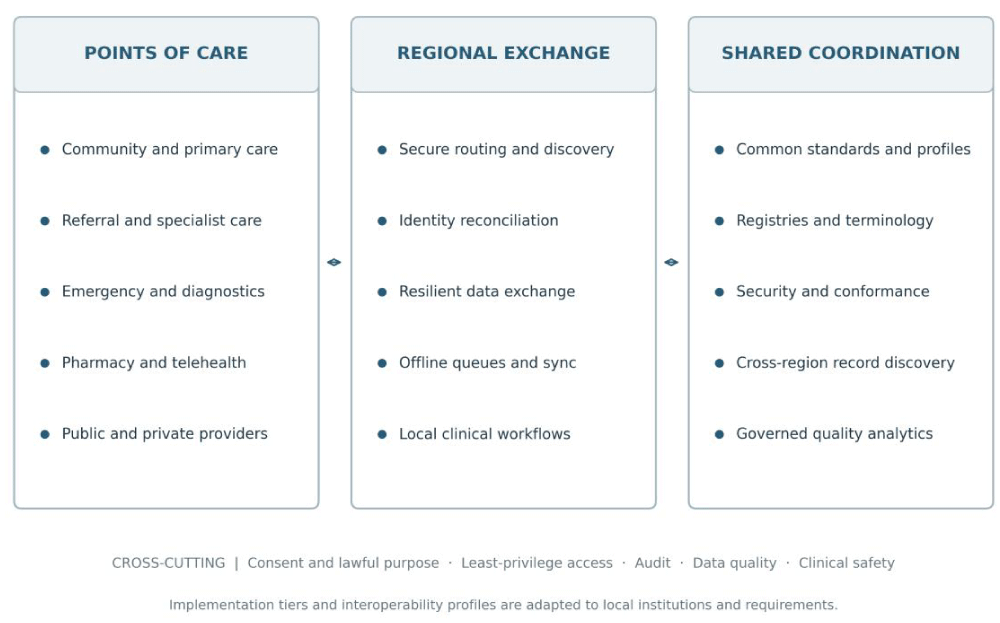
IHDS is intended to work with more than one administrative arrangement. At the point of care, local applications capture and retrieve permitted information; optional district, regional, or network exchange services provide routing, caching, local analytics, and operational continuity; and coordinating services maintain shared registries, conformance rules, cross-network discovery, and governed analytics. Some settings may use a national coordination authority, while others may operate through subnational networks or multiple accountable organizations. The diagram illustrates one federated deployment pattern rather than a universal prescription.
Federation does not eliminate central stewardship or local accountability. Shared oversight is needed for identifiers, conformance, cybersecurity baselines, procurement interfaces, and public accountability, while local services remain responsible for continuity, clinical workflows, and incident response. IHDS should permit essential operations during network disruption and subsequent reconciliation when connectivity returns. The authority to exchange information, including for public health and research, must be defined by the relevant laws and institutional agreements.
Public and private providers may participate through common standards and enforceable exchange agreements. No institution should need to adopt a single vendor solely to share records; rather, participating products should meet agreed profiles, terminology, security, and service-level expectations. Configurable components can limit vendor lock-in, subject to financing and operational capacity (Figure 2).
Figure 2: Illustrative federated deployment pattern. Local care systems communicate with regional exchange services and shared coordination capabilities. The tiers are configurable; interoperability, safety, privacy, and governance requirements apply throughout.
Illustrative patient referral pathway
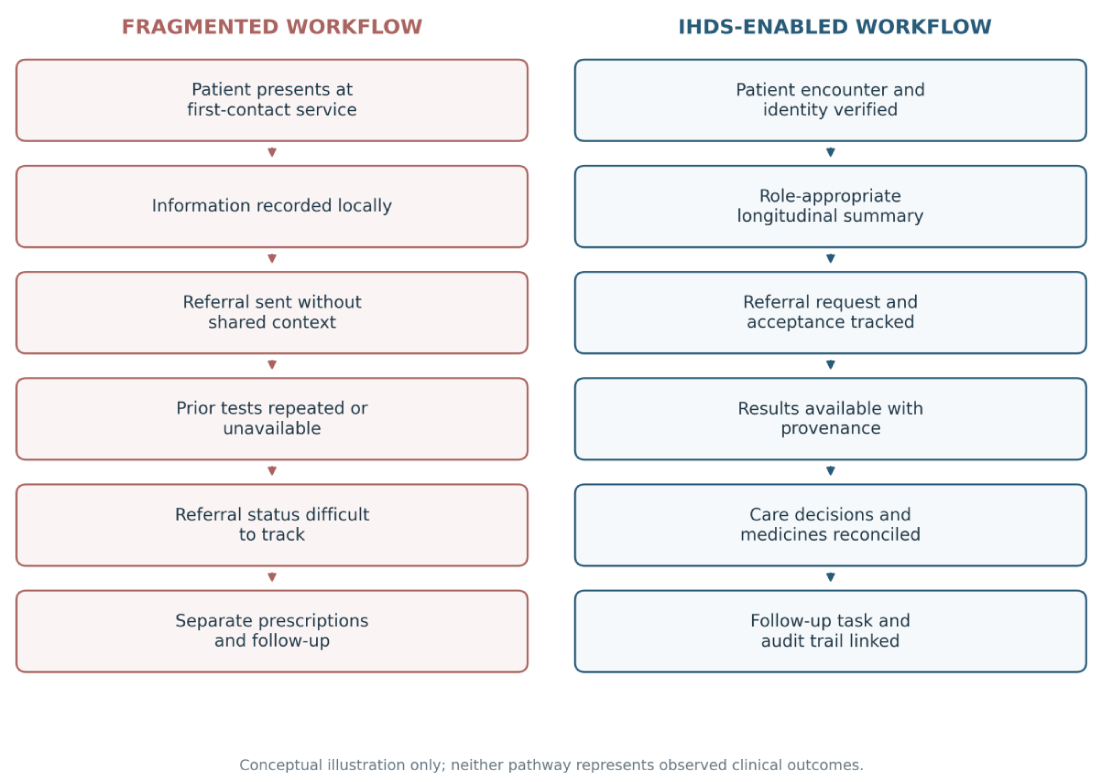
To make the information flows concrete, an illustrative rural referral pathway was drafted for a hypothetical adult patient with acute abdominal pain. In the fragmented pathway, a first-contact clinic lacks diagnostics, an intermediate service refers the patient to a distant referral centre, and clinicians may repeat registration and tests because prior records are unavailable. The scenario is a conceptual walkthrough, not a report of an actual patient, a tested implementation, or an epidemiological observation.
Under the proposed IHDS-enabled workflow, the patient is identified at a community or primary-care contact and authorized clinicians obtain a role-appropriate summary of allergies, medicines, diagnoses, prior encounters, and active referrals. Symptoms and observations are recorded using a minimum dataset. A locally validated decision-support tool could flag urgency but would not diagnose autonomously. If referral is required, the request records the clinical question, urgency, destination acceptance, and necessary documents; transport services receive only the information required for safe transfer.
At the receiving service, clinicians could retrieve the referral and longitudinal summary before deciding whether investigations need repetition. New laboratory and imaging results would be linked to the record with source attribution and critical-result acknowledgement. Remote specialist review may be used when clinically appropriate. Prescriptions, financing authorizations where applicable, discharge notes, and follow-up tasks become traceable events rather than disconnected institutional records. Any research use remains subject to a separate lawful governance process.
These steps describe proposed capabilities, not observed effects. IHDS cannot guarantee a shorter journey, create diagnostic resources, or replace clinical and referral capacity. Its potential contribution is to make information exchange, task ownership, and gaps in service capacity visible. Implementation outcomes must be measured in real care settings (Figure 3).
Figure 3: Hypothetical referral scenario comparing disconnected information flow with the proposed IHDS-enabled pathway. All events are illustrative; no patient data or measured clinical outcomes were used.
Four-stage maturity pathway
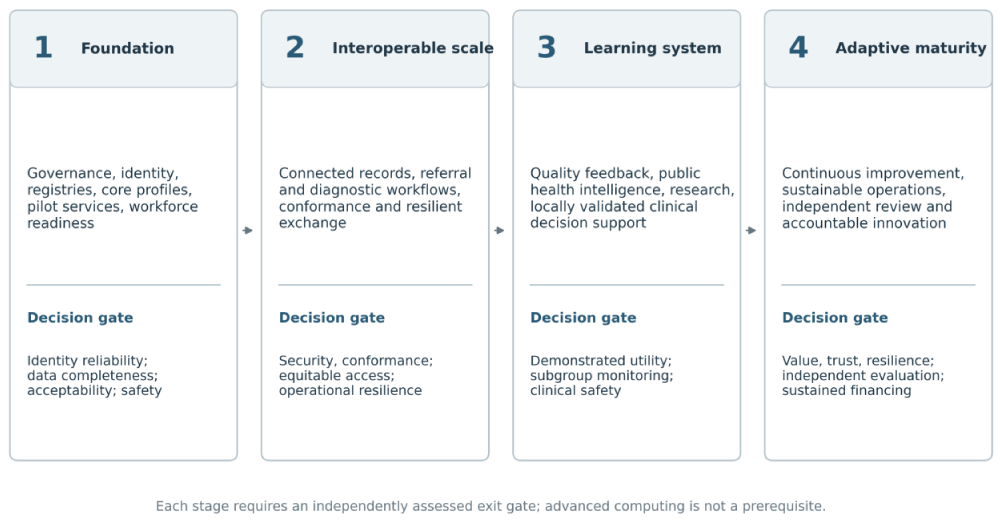
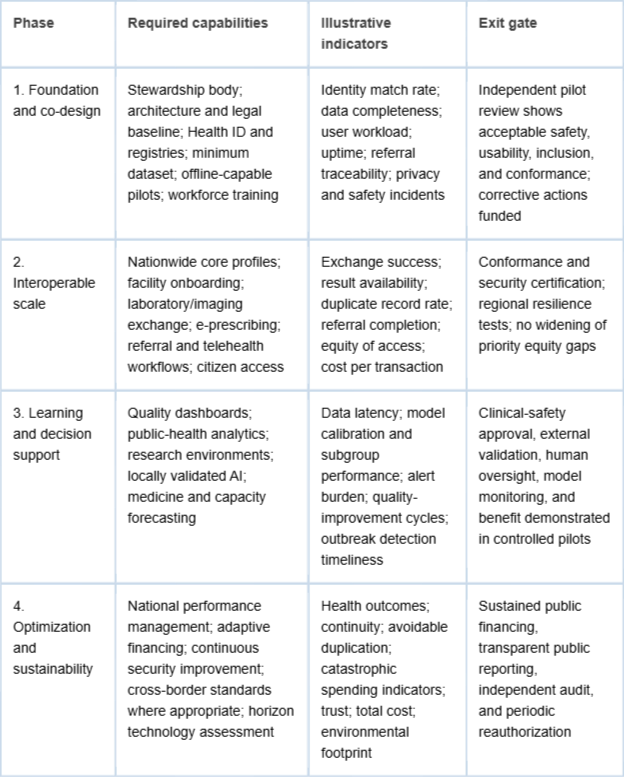
IHDS proposes four capability-maturity phases rather than a simple technology chronology. Advancement depends on exit criteria, not the passage of time. This prevents a common failure in digital transformation: procuring advanced analytics while identity, workflow, data quality, governance, and workforce readiness remain weak.
Phase 1 establishes governance and a minimum viable exchange in selected local service networks. Phase 2 scales interoperable records and referral workflows. Phase 3 develops a governed learning layer with quality improvement, surveillance, and validated decision support. Phase 4 optimizes national performance, financial sustainability, advanced analytics, and adaptive regulation. Quantum computing is excluded from the phase-gate requirements; it may be assessed through separate horizon scanning (Figure 4).
Figure 4: IHDS maturity roadmap. Advanced analytics depend on prior progress in governance, interoperability, data quality, workforce readiness, and safety. Quantum computing is outside the core roadmap and remains a horizon topic.
Theory of change and conceptual propositions
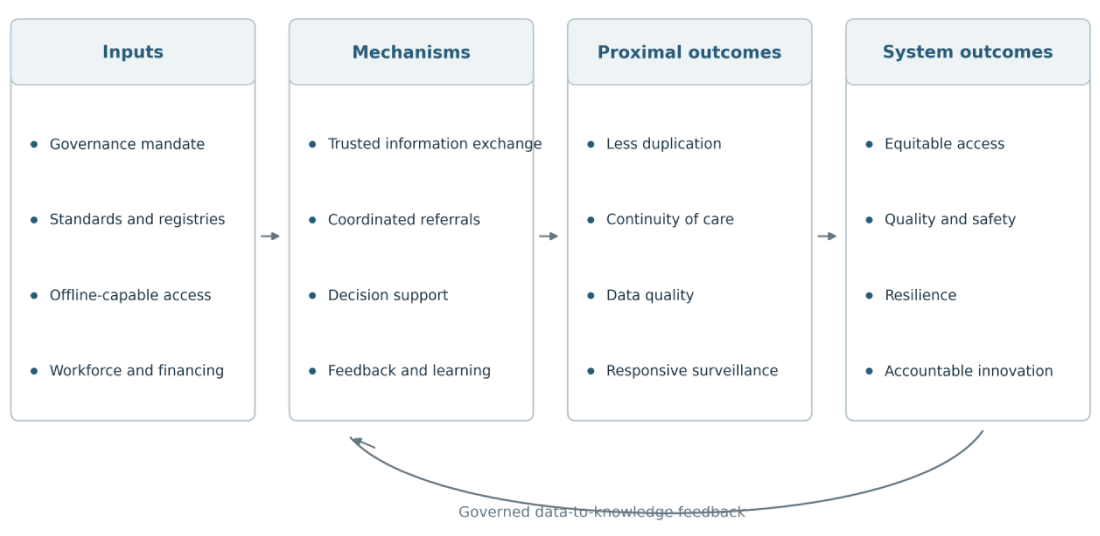
The theory of change begins with public stewardship, interoperable infrastructure, trained users, sustainable financing, and community participation. These inputs enable five mechanisms: longitudinal visibility, closed-loop coordination, regional resilience, accountable automation, and feedback from routine care to public health and quality improvement. The immediate outputs are more complete records, traceable referrals, faster result availability, safer medicine management, and improved situational awareness. The intended system outcomes are continuity, equity, efficiency, trust, resilience, and learning.
Table 3: IHDS capability-maturity roadmap and phase-gate criteria
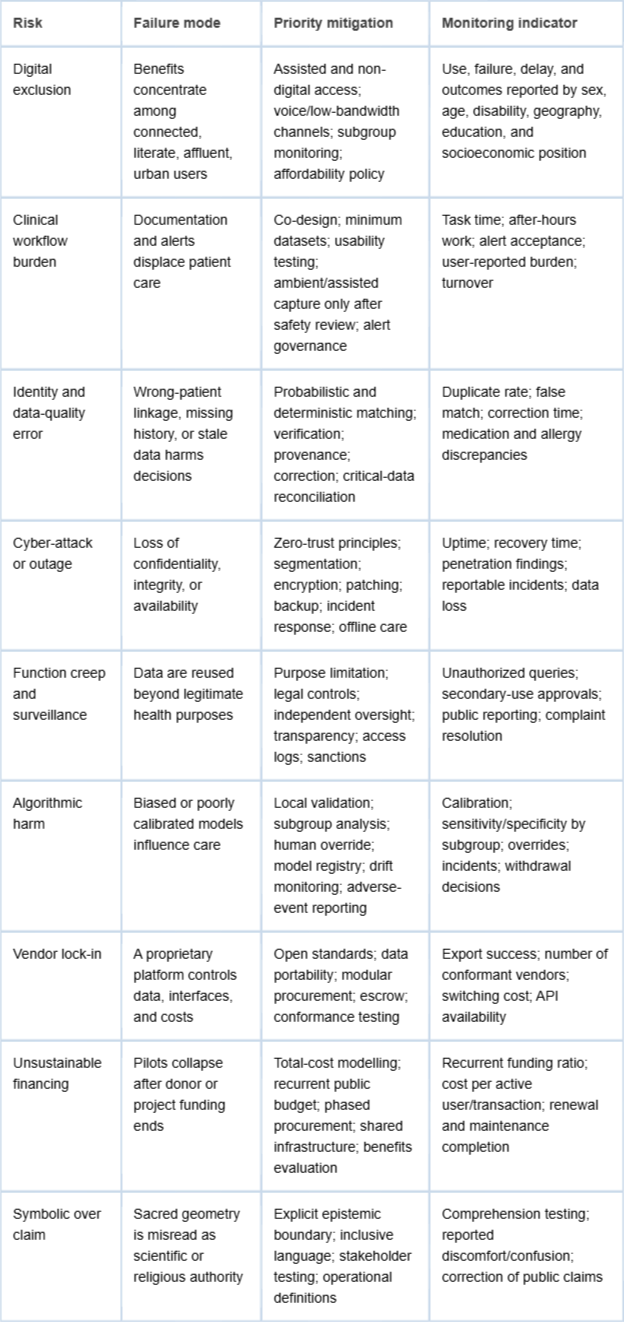
The model anticipates countervailing mechanisms. Digital documentation may increase workload; algorithmic triage may produce false reassurance or discriminatory errors; identity systems may mis-link records; central analytics may invite surveillance beyond legitimate public-health purposes; and portals may privilege people with connectivity and literacy. The theory of change is therefore conditional. Positive outcomes require governance, usability, non-digital alternatives, workforce capacity, financing, and measurement of distributional effects (Figure 5).
Figure 5: IHDS theory of change. The feedback loop represents a learning health system. Safeguards, workforce capacity, financing, and physical service availability influence the pathway from digital capability to health-system outcomes.
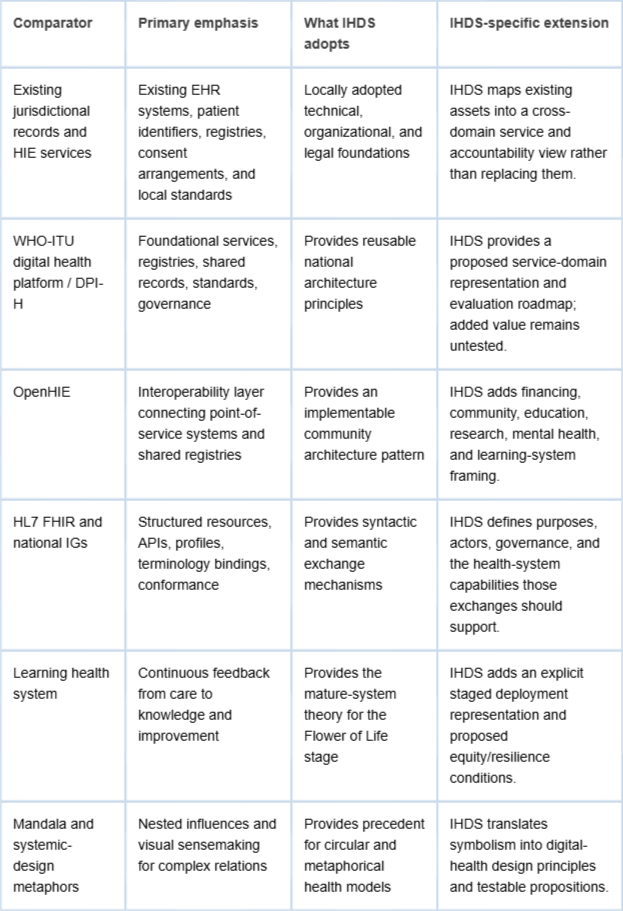
IHDS occupies the space between high-level digital-health strategy and individual software projects. Policy specifies legitimate goals, standards describe interoperable representation and exchange, and programmes deliver particular services. The contribution of IHDS is a cross-domain organizing map connecting clinical and public-health services with medicines, financing, community follow-up, education, research, and governance, supported by a staged maturity and evaluation framework.
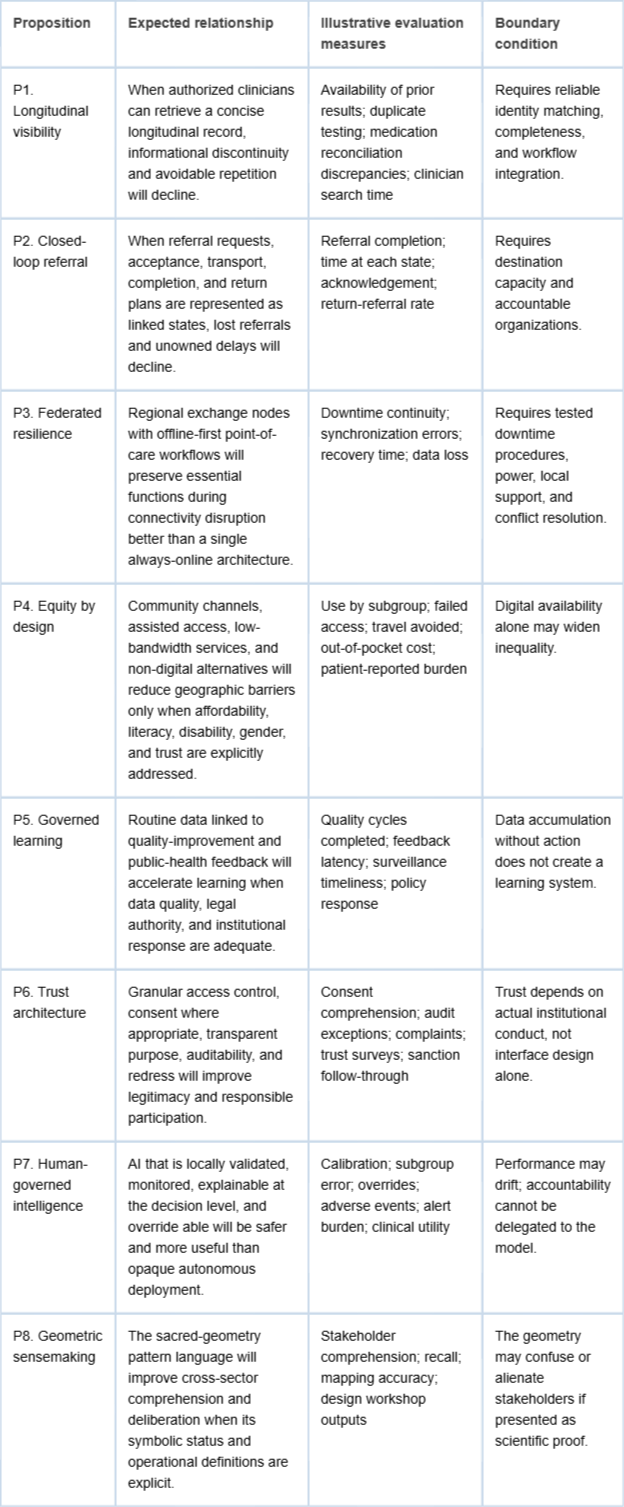
The geometry alone is not a technical contribution. The proposal becomes assessable because the domains are operationally described, the exchange core follows recognized architectural patterns, implementation prerequisites are explicit, and eight prospective propositions identify testable claims. These are proposed design relationships rather than demonstrated improvements; their usability and technical completeness require independent examination.
Applicability, transferability, and local adaptation
IHDS is not a replacement for existing health information exchanges, electronic medical records, registries, or implementation guides. In settings with mature shared services, its proposed value would be to organize relationships among those assets and otherwise disconnected care, community, financing, and governance functions. In settings where foundational services are incomplete, it may serve as a requirements map for staged development. Whether this organizational layer adds measurable value beyond established architectures remains to be tested.
Table 4: Testable conceptual propositions derived from IHDS
Table 5: Conceptual alignment of IHDS with international architectures and existing health-system capabilities.
Transfer requires local configuration rather than copying a fixed system. Implementers must identify the relevant legal authority, administrative tiers, patient and provider identifiers, terminology and FHIR profiles, financing arrangements, connectivity constraints, privacy safeguards, and public/private responsibilities. A domain that already exists in a jurisdiction should be mapped to that service, not duplicated.
Relationship to international architecture and learning-health-system theory
WHO and ITU guidance describes reusable platform functions, shared records, interoperability services, and governance [33International Telecommunication Union, & World Health Organization. Digital health platform handbook: Building a digital information infrastructure (infostructure) for health. 2020; https://www.itu.int/dms_pub/itu-d/opb/str/D-STR-DIGITAL.HEALTH-2020-PDF-E.pdf,1818World Health Organization, & International Telecommunication Union. Reference architecture for national digital health transformation (Version 0.1.0) [Draft]. 2025. https://smart.who.int/ra/]. SMART guidance and digital investment frameworks encourage standards-based, staged implementation [1717Mehl G, Tunçalp Ö, Ratanaprayul N, Tamrat T, Barreix M, Lowrance D, Bartolomeos K, Say L, Kostanjsek N, Jakob R, Grove J, Mariano B, Jr, Swaminathan S. WHO SMART guidelines: Optimising country-level use of guideline recommendations in the digital age. The Lancet Digital Health. 2021. 3(4), e213-e216. https://doi.org/10.1016/S2589-7500(21)00038-8,2424World Health Organization, United Nations Children's Fund, United Nations Population Fund, & PATH. Digital implementation investment guide: Integrating digital interventions into health programmes. 2020; https://www.who.int/publications/i/item/9789240010567]. OpenHIE separates point-of-service systems from interoperability functions and registries [44OpenHIE Community. (n.d.). OpenHIE architecture specification. Retrieved July 31, 2026, from https://guides.ohie.org/arch-spec/]. Prior scholarship also emphasizes modularity and institutional capacity [2525Braa J, Sahay S, Monteiro E. Design theory for societal digital transformation: The case of digital global health. Journal of the Association for Information Systems. 2023. 24(6): 1645-1669. https://doi.org/10.17705/1jais.00816,2626Mantri M, Sunder G, Kadam S, Abhyankar A. A perspective on digital health platform design and its implementation at national level. Frontiers in Digital Health. 2024; 6, 1260855. https://doi.org/10.3389/fdgth.2024.1260855]. IHDS builds on rather than supersedes these approaches, with a service-domain representation, cross-domain safeguards, and an explicit maturity and evaluation agenda. WHO digital-health classifications informed the representation of clinical, public-health, community, and health-education services [1414World Health Organization. WHO guideline: Recommendations on digital interventions for health system strengthening. 2019; https://www.who.int/publications/i/item/9789241550505,1515World Health Organization. Classification of digital interventions, services and applications in health: A shared language to describe the uses of digital technology for health (2nd ed.) 2023a. https://www.who.int/publications/i/item/9789240081949]. The WHO-ITU platform approach and OpenHIE informed the separation of service functions from shared exchange capabilities, while learning-health-system theory informed the research and feedback functions. Medicines, financing, mental health, telehealth, and governance were specified as enabling domains to make their connections and safeguards explicit. These are conceptual design choices; the evidence does not establish that the 1+6+6 arrangement is complete or superior to alternatives.
The Flower of Life stage is interpreted as a learning health system, not as technological autonomy. A learning system uses experience from care to improve later decisions, which requires institutions for inquiry, evaluation, implementation, and accountability in addition to data infrastructure. Maturity is therefore defined by the quality of feedback and improvement, not by data volume or computational power [2727Institute of Medicine. The learning healthcare system: Workshop summary. National Academies Press. 2007’ https://doi.org/10.17226/11903].
Why a spiritually inspired architecture can be academi-cally defensibl
A spiritual source of inspiration can be discussed in scientific work when its role is stated accurately. Health and policy frameworks often use ecosystems, pathways, pyramids, webs, cycles, and feedback loops as metaphors. Their scientific value depends on whether the proposed relationships can be defined and examined. The same standard applies to IHDS. Sacred geometry provides a visual and ethical language; interoperability, clinical safety, governance, and outcomes determine whether the architecture is useful.
Separating symbolism from evidence protects the model from claims it cannot support. The geometry does not determine the correct number of services or guarantee harmony. It supplies a declared design constraint. The health-system architecture can therefore be assessed even by readers who do not share the spiritual interpretation.
The representation itself can be studied. Future work should compare stakeholder understanding of IHDS with conventional architecture diagrams and examine whether the terms used are clear, useful, neutral, or exclusionary across different groups. Spiritual language should not become a condition for participation in public infrastructure.
Equity, resilience, and the danger of digital substitution
The proposed architecture responds to information discontinuity, diagnostic access constraints, and the burdens of navigating between services. Digital systems can nevertheless reproduce inequalities when they assume smartphones, reliable broadband, accessible interfaces, sufficient literacy, or individual capacity to negotiate complex services. Equity should therefore be treated as a design requirement: assisted access, accessible local-language content, low-bandwidth and voice channels, community-worker support, transparent redress, and reliable non-digital alternatives should be assessed in every setting. These requirements are consistent with a systems-oriented approach to digital health [22de Savigny D, Adam T. (Eds.). Systems thinking for health systems strengthening. Alliance for Health Policy and Systems Research, World Health Organization. 2009; https://ahpsr.who.int/publications/i/item/2009-11-13-systems-thinking-for-health-systems-strengthening,1414World Health Organization. WHO guideline: Recommendations on digital interventions for health system strengthening. 2019; https://www.who.int/publications/i/item/9789241550505,11World Health Organization. Global strategy on digital health 2020-2025. 2021b. https://www.who.int/publications/i/item/9789240020924].
Resilience similarly requires more than backup servers. It includes the ability of clinical work to continue during loss of connectivity, electricity, staff, or a central service. The federated design supports local operation, but only if minimum datasets, synchronization rules, conflict resolution, local technical support, and rehearsed downtime procedures exist. Redundancy should be evaluated through exercises and failure testing, not inferred from the word 'decentralized.'
Finally, digital connection cannot compensate for absent services. A perfect referral message does not create an ambulance, a surgeon, an ultrasound machine, blood products, or affordable medicine. IHDS should be embedded in workforce, infrastructure, financing, and quality strategies. The appropriate claim is that it can reduce avoidable coordination loss and make unmet capacity visible, not that data integration alone transforms care.
Governance, privacy, and public legitimacy
National health-data infrastructure creates concentrated social power. It can improve continuity and surveillance, but it can also facilitate exclusion, commercial exploitation, discrimination, or unauthorized monitoring. Public legitimacy therefore depends on a clear legal mandate, independent oversight, purpose limitation, transparency, meaningful grievance and correction processes, sanctions, and participation by patients, communities, professionals, and marginalized groups.
Consent should not be treated as the sole basis of legitimacy. Emergency care, statutory public-health reporting, treatment operations, and approved research may involve different legal grounds and safeguards. Interfaces should communicate what is optional, what is required, who can see what, and how a person can challenge an error. Sensitive domains, including mental health, reproductive health, HIV, violence, and stigmatized conditions, may require segmentation, enhanced access controls, and special disclosure rules.
Data quality is also an ethical issue. An incorrect identity link, stale allergy, missing result, or biased algorithm can produce direct harm. Governance must therefore include correction workflows, provenance, result acknowledgement, vocabulary maintenance, quality dashboards, safety incident reporting, and clear liability. Privacy and clinical safety cannot be delegated entirely to cyber security teams.
Emerging technologies: disciplined ambition
Technological ambition must be sequenced. AI may support selected tasks when the clinical problem, comparator, intended user, operating conditions, and safety response are defined [1616World Health Organization. Ethics and governance of artificial intelligence for health: Guidance on large multi-modal models. 2025. https://www.who.int/publications/i/item/9789240084759,1919World Health Organization. Ethics and governance of artificial intelligence for health: WHO guidance. 2021a. https://www.who.int/publications/i/item/9789240029200,2020World Health Organization. Regulatory considerations on artificial intelligence for health. 2023b. https://www.who.int/publications/i/item/9789240078871,2828National Academy of Medicine. Artificial intelligence in health care: The hope, the hype, the promise, the peril. National Academies Press. 2022; https://doi.org/10.17226/27111]. Block chain should be considered only after a trust problem has been specified and simpler alternatives have been compared [2121Mackey TK, Kuo TT, Gummadi B, Clauson KA, Church G, Grishin D, Obbad K, Barkovich R, Palombini M. Fit-for-purpose?' Challenges and opportunities for applications of blockchain technology in the future of healthcare. BMC Medicine. 2019; 17, 68. https://doi.org/10.1186/s12916-019-1296-7,2222Sabiri K, Sousa F, Rocha T. A systematic review of privacy-preserving blockchain applications in healthcare. Multimedia Tools and Applications. 2025; 84(32): 39925-39980. https://doi.org/10.1007/s11042-024-20541-z]. Quantum computing remains a research topic and should not enter the core roadmap until a practical advantage is demonstrated for a relevant use case [2323Gupta RS, Wood CE, Engstrom T, Pole JD, Shrapnel S. A systematic review of quantum machine learning for digital health. npj Digital Medicine. 2025; 8: 237. https://doi.org/10.1038/s41746-025-01597-z].
This approach keeps the architecture independent of particular technology cycles. The stable requirements are longitudinal identity, connected care, accountable authority, learning feedback, and equitable access. A technology belongs in IHDS only when it serves a defined need and meets the relevant safety, governance, cost, and interoperability requirements.
Risk register and mitigation priorities
Table 6: Priority IHDS implementation risks and mitigation requirements.
Research and validation agenda
IHDS should now progress through staged validation. First, a modified Delphi panel should assess domain relevance, completeness, clarity, feasibility, interoperability, equity, governance, and cultural acceptability. The panel should include public-health and clinical professionals, community-health workers, patients, health informaticians, enterprise architects, cybersecurity experts, economists, ethicists, regulators, private providers, and disability and marginalized-community representatives. Consensus should refine the model, not merely endorse it.
Second, enterprise-architecture modelling should translate each domain into actors, use cases, business processes, information objects, applications, and infrastructure using the five views in Table 2a. Interoperability requirements and FHIR/terminology profiles should be mapped to applicable local standards rather than introduced as competing standards. Interfaces involving pharmaceutical companies, clinicians, and public agencies require explicit data-sharing purposes and separation of commercial and public authority. Threat modelling, privacy-impact assessment, clinical-safety analysis, and failure-mode analysis should precede any pilot.
Third, prospective simulation and tabletop exercises should test the illustrative referral pathway and other high-value scenarios: maternal emergency, childhood pneumonia referral, chronic disease follow-up, mental-health crisis, medicine shortage, and outbreak detection. Exercises should include network failure, identity ambiguity, incorrect data, referral refusal, algorithm failure, and privacy complaints. These exercises are proposed future work; they have not been completed.
Fourth, a pragmatic pilot should compare process and equity outcomes with baseline practice. Appropriate early outcomes include record retrieval, duplicate testing, referral completion, result acknowledgement, medication reconciliation, clinician workload, patient travel and waiting, out-of-pocket expenditure, uptime, security incidents, and patient trust. Clinical outcomes and cost-effectiveness should be evaluated only after implementation fidelity and safety are established. WHO monitoring guidance provides a basis for separating implementation, process, and impact evaluation [2929World Health Organization. Monitoring and evaluating digital health interventions: A practical guide to conducting research and assessment. 2016; https://www.who.int/publications/i/item/9789241511766].
The geometric representation also requires evaluation. Mixed-method studies should compare it with conventional diagrams, document how different groups interpret the spiritual language, and test whether it improves or hinders inclusive discussion. Its communicative value should be measured rather than assumed.
Boundary conditions and unresolved questions
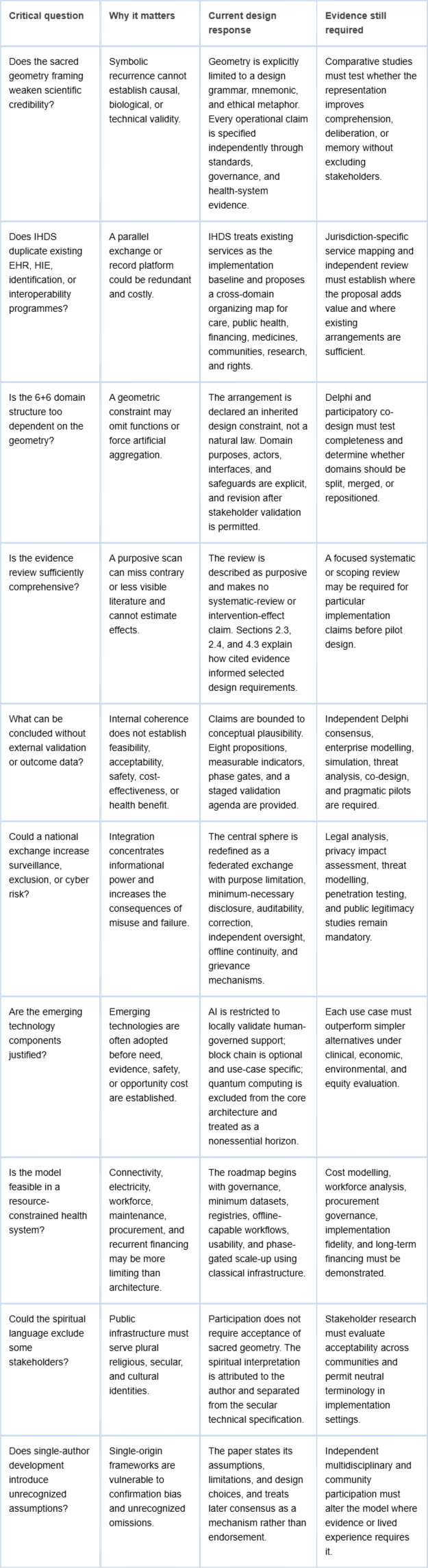
Several questions remain unresolved and should be treated as conditions for further development. Table 7 identifies where the current design provides a reasoned response and where independent evidence is still required. The table is a statement of uncertainty, not a claim that the concerns have been settled.
Table 7: Critical questions, design responses, and evidence still required.
The architecture should remain intelligible when the spiritual terminology is removed. IHDS meets that basic test because identity, consent, referral, interoperability, governance, resilience, and maturity are specified in operational terms. A separate empirical question is whether the geometric language improves comprehension or deliberation. That question cannot be answered by the present paper.
Strengths and limitations
The main strength of this paper is an explicitly specified conceptual architecture connecting care domains, technical exchange capabilities, governance, a configurable deployment pattern, a maturity pathway, and testable propositions. By comparing its assumptions with established international guidance, the manuscript provides a basis for critique and structured subsequent evaluation rather than a claim of completed implementation.
The evidence scan was purposive rather than systematic, so relevant work may have been missed. The original review did not retain a full screening log, exact search strings, or counts of identified and excluded records; the 29 cited sources should not be interpreted as a complete search yield. Development and appraisal were author-led; there has been no independent expert or community validation. The five architecture views are specifications for subsequent modelling rather than completed technical artifacts. No prototype, implementation test, formal conformance assessment, cost model, safety case, or patient outcomes were generated. Transferability across health systems remains untested, and the manuscript should not be interpreted as evidence of clinical or operational effectiveness.
IHDS treats digital health integration as a problem of relationships among people, services, information, and accountable authority. Its concentric form is a visual representation of interdependence and progressive development, not an independent scientific mechanism. The proposed specification includes an exchange-centred core, 12 described domains, interoperability and governance safeguards, a configurable federated deployment pattern, four maturity stages, and testable propositions.
This architecture may be examined in health systems with different legal, technical, and resource contexts, but it is not a universal implementation template. AI should support accountable human decisions; blockchain should be considered only for specified trust problems; quantum computing should remain outside the implementation baseline. Any practical application must map IHDS to existing services, local standards, professional workflows, and the requirements of the people it is intended to serve.
A reference architecture does not deliver care by itself. IHDS offers a proposed set of design relationships and evaluation questions. Its usefulness must be established by independent multidisciplinary review, implementable technical models, participatory assessment, and comparative pilots before benefits can be claimed.
Declarations
Ethics approval and consent to participate: Not applicable. This study developed and evaluated a conceptual artifact and used no human participants, identifiable records, or patient data.
Consent for publication: Not applicable.
Funding: No specific funding was received for this work.
Competing interests: The author declares no competing interests.
Data and materials availability: No empirical dataset was generated. The conceptual diagrams, domain definitions, architectural propositions, and cited sources are contained in this manuscript.
Use of generative AI and AI-assisted technologies: Grammarly was used for language editing and grammar checking. The author reviewed the full manuscript, checked the references and arguments, and accepts responsibility for the final content.
World Health Organization. Global strategy on digital health 2020-2025. 2021b. https://www.who.int/publications/i/item/9789240020924
de Savigny D, Adam T. (Eds.). Systems thinking for health systems strengthening. Alliance for Health Policy and Systems Research, World Health Organization. 2009; https://ahpsr.who.int/publications/i/item/2009-11-13-systems-thinking-for-health-systems-strengthening
International Telecommunication Union, & World Health Organization. Digital health platform handbook: Building a digital information infrastructure (infostructure) for health. 2020; https://www.itu.int/dms_pub/itu-d/opb/str/D-STR-DIGITAL.HEALTH-2020-PDF-E.pdf
OpenHIE Community. (n.d.). OpenHIE architecture specification. Retrieved July 31, 2026, from https://guides.ohie.org/arch-spec/
Health Level Seven International. FHIR release 5 (v5.0.0): 2023; https://hl7.org/fhir/overview.html
Li, E, Clarke J, Ashrafian H, Darzi A, Neves AL. The impact of electronic health record interoperability on safety and quality of care in high-income countries: Systematic review. 2022; Journal of Medical Internet Research, 24(9), e38144. https://doi.org/10.2196/38144
Torab-Miandoab A, Samad-Soltani T, Jodati A, Rezaei-Hachesu P. Interoperability of heterogeneous health information systems: A systematic literature review. BMC Medical Informatics and Decision Making. 2023; 23, 18. https://doi.org/10.1186/s12911-023-02115-5
Hancock T. The mandala of health: A model of the human ecosystem. Family & Community Health. 1985; 8(3), 1-10. https://doi.org/10.1097/00003727-198511000-00002
Hancock T. Health, human development and the community ecosystem: Three ecological models. Health Promotion International. 1993; 8(1), 41-47. https://doi.org/10.1093/heapro/8.1.41
Lockton D, Singh D, Sabnis S, Chou M, Foley S, Pantoja A. New metaphors: A workshop method for generating ideas and reframing problems in design and beyond. In Proceedings of the 2019 Conference on Creativity and Cognition (pp. 319-332). Association for Computing Machinery. https://doi.org/10.1145/3325480.3326570
Hevner AR, March ST, Park J, Ram S. Design science in information systems research. MIS Quarterly. 2004; 28(1), 75-105. https://doi.org/10.2307/25148625
Peffers K, Tuunanen T, Rothenberger MA, Chatterjee S. A design science research methodology for information systems research. Journal of Management Information Systems. 2007; 24(3), 45-77. https://doi.org/10.2753/MIS0742-1222240302
Jabareen Y. Building a conceptual framework: Philosophy, definitions, and procedure. International Journal of Qualitative Methods. 2009; 8(4), 49-62. https://doi.org/10.1177/160940690900800406
World Health Organization. WHO guideline: Recommendations on digital interventions for health system strengthening. 2019; https://www.who.int/publications/i/item/9789241550505
World Health Organization. Classification of digital interventions, services and applications in health: A shared language to describe the uses of digital technology for health (2nd ed.) 2023a. https://www.who.int/publications/i/item/9789240081949
World Health Organization. Ethics and governance of artificial intelligence for health: Guidance on large multi-modal models. 2025. https://www.who.int/publications/i/item/9789240084759
Mehl G, Tunçalp Ö, Ratanaprayul N, Tamrat T, Barreix M, Lowrance D, Bartolomeos K, Say L, Kostanjsek N, Jakob R, Grove J, Mariano B, Jr, Swaminathan S. WHO SMART guidelines: Optimising country-level use of guideline recommendations in the digital age. The Lancet Digital Health. 2021. 3(4), e213-e216. https://doi.org/10.1016/S2589-7500(21)00038-8
World Health Organization, & International Telecommunication Union. Reference architecture for national digital health transformation (Version 0.1.0) [Draft]. 2025. https://smart.who.int/ra/
World Health Organization. Ethics and governance of artificial intelligence for health: WHO guidance. 2021a. https://www.who.int/publications/i/item/9789240029200
World Health Organization. Regulatory considerations on artificial intelligence for health. 2023b. https://www.who.int/publications/i/item/9789240078871
Mackey TK, Kuo TT, Gummadi B, Clauson KA, Church G, Grishin D, Obbad K, Barkovich R, Palombini M. Fit-for-purpose?' Challenges and opportunities for applications of blockchain technology in the future of healthcare. BMC Medicine. 2019; 17, 68. https://doi.org/10.1186/s12916-019-1296-7
Sabiri K, Sousa F, Rocha T. A systematic review of privacy-preserving blockchain applications in healthcare. Multimedia Tools and Applications. 2025; 84(32): 39925-39980. https://doi.org/10.1007/s11042-024-20541-z
Gupta RS, Wood CE, Engstrom T, Pole JD, Shrapnel S. A systematic review of quantum machine learning for digital health. npj Digital Medicine. 2025; 8: 237. https://doi.org/10.1038/s41746-025-01597-z
World Health Organization, United Nations Children's Fund, United Nations Population Fund, & PATH. Digital implementation investment guide: Integrating digital interventions into health programmes. 2020; https://www.who.int/publications/i/item/9789240010567
Braa J, Sahay S, Monteiro E. Design theory for societal digital transformation: The case of digital global health. Journal of the Association for Information Systems. 2023. 24(6): 1645-1669. https://doi.org/10.17705/1jais.00816
Mantri M, Sunder G, Kadam S, Abhyankar A. A perspective on digital health platform design and its implementation at national level. Frontiers in Digital Health. 2024; 6, 1260855. https://doi.org/10.3389/fdgth.2024.1260855
Institute of Medicine. The learning healthcare system: Workshop summary. National Academies Press. 2007’ https://doi.org/10.17226/11903
National Academy of Medicine. Artificial intelligence in health care: The hope, the hype, the promise, the peril. National Academies Press. 2022; https://doi.org/10.17226/27111
World Health Organization. Monitoring and evaluating digital health interventions: A practical guide to conducting research and assessment. 2016; https://www.who.int/publications/i/item/9789241511766
Nishan MNH. Integrated Health Data System (IHDS): An Evidence-informed Reference Architecture for Interoperable Learning Health Systems. IgMin Res. November 13, 2026; 4(11): 431-444. IgMin ID: igmin367; DOI:10.61927/igmin367; Available at: igmin.link/p367
Department of Public Health, North South University, Dhaka, Bangladesh
Address Correspondence: MD Nahid Hassan Nishan, MBBS, MPH, Department of Public Health, North South University, Dhaka, Bangladesh, Email: nissan0808@yahoo.com
How to cite this article: Nishan MNH. Integrated Health Data System (IHDS): An Evidence-informed Reference Architecture for Interoperable Learning Health Systems. IgMin Res. November 13, 2026; 4(11): 431-444. IgMin ID: igmin367; DOI:10.61927/igmin367; Available at: igmin.link/p367
Figure 5: IHDS theory of change. The feedback loop represent...
Table 1: Translation of sacred geometry from symbolism into...
Table 2: Functional specification of the 13-domain IHDS arc...
Table 2a: Five complementary architecture views for IHDS...
Table 3: IHDS capability-maturity roadmap and phase-gate cr...
Table 4: Testable conceptual propositions derived from IHDS...
Table 5: Conceptual alignment of IHDS with international ar...
Table 6: Priority IHDS implementation risks and mitigation ...
Table 7: Critical questions, design responses, and evidence...
World Health Organization. Global strategy on digital health 2020-2025. 2021b. https://www.who.int/publications/i/item/9789240020924
de Savigny D, Adam T. (Eds.). Systems thinking for health systems strengthening. Alliance for Health Policy and Systems Research, World Health Organization. 2009; https://ahpsr.who.int/publications/i/item/2009-11-13-systems-thinking-for-health-systems-strengthening
International Telecommunication Union, & World Health Organization. Digital health platform handbook: Building a digital information infrastructure (infostructure) for health. 2020; https://www.itu.int/dms_pub/itu-d/opb/str/D-STR-DIGITAL.HEALTH-2020-PDF-E.pdf
OpenHIE Community. (n.d.). OpenHIE architecture specification. Retrieved July 31, 2026, from https://guides.ohie.org/arch-spec/
Health Level Seven International. FHIR release 5 (v5.0.0): 2023; https://hl7.org/fhir/overview.html
Li, E, Clarke J, Ashrafian H, Darzi A, Neves AL. The impact of electronic health record interoperability on safety and quality of care in high-income countries: Systematic review. 2022; Journal of Medical Internet Research, 24(9), e38144. https://doi.org/10.2196/38144
Torab-Miandoab A, Samad-Soltani T, Jodati A, Rezaei-Hachesu P. Interoperability of heterogeneous health information systems: A systematic literature review. BMC Medical Informatics and Decision Making. 2023; 23, 18. https://doi.org/10.1186/s12911-023-02115-5
Hancock T. The mandala of health: A model of the human ecosystem. Family & Community Health. 1985; 8(3), 1-10. https://doi.org/10.1097/00003727-198511000-00002
Hancock T. Health, human development and the community ecosystem: Three ecological models. Health Promotion International. 1993; 8(1), 41-47. https://doi.org/10.1093/heapro/8.1.41
Lockton D, Singh D, Sabnis S, Chou M, Foley S, Pantoja A. New metaphors: A workshop method for generating ideas and reframing problems in design and beyond. In Proceedings of the 2019 Conference on Creativity and Cognition (pp. 319-332). Association for Computing Machinery. https://doi.org/10.1145/3325480.3326570
Hevner AR, March ST, Park J, Ram S. Design science in information systems research. MIS Quarterly. 2004; 28(1), 75-105. https://doi.org/10.2307/25148625
Peffers K, Tuunanen T, Rothenberger MA, Chatterjee S. A design science research methodology for information systems research. Journal of Management Information Systems. 2007; 24(3), 45-77. https://doi.org/10.2753/MIS0742-1222240302
Jabareen Y. Building a conceptual framework: Philosophy, definitions, and procedure. International Journal of Qualitative Methods. 2009; 8(4), 49-62. https://doi.org/10.1177/160940690900800406
World Health Organization. WHO guideline: Recommendations on digital interventions for health system strengthening. 2019; https://www.who.int/publications/i/item/9789241550505
World Health Organization. Classification of digital interventions, services and applications in health: A shared language to describe the uses of digital technology for health (2nd ed.) 2023a. https://www.who.int/publications/i/item/9789240081949
World Health Organization. Ethics and governance of artificial intelligence for health: Guidance on large multi-modal models. 2025. https://www.who.int/publications/i/item/9789240084759
Mehl G, Tunçalp Ö, Ratanaprayul N, Tamrat T, Barreix M, Lowrance D, Bartolomeos K, Say L, Kostanjsek N, Jakob R, Grove J, Mariano B, Jr, Swaminathan S. WHO SMART guidelines: Optimising country-level use of guideline recommendations in the digital age. The Lancet Digital Health. 2021. 3(4), e213-e216. https://doi.org/10.1016/S2589-7500(21)00038-8
World Health Organization, & International Telecommunication Union. Reference architecture for national digital health transformation (Version 0.1.0) [Draft]. 2025. https://smart.who.int/ra/
World Health Organization. Ethics and governance of artificial intelligence for health: WHO guidance. 2021a. https://www.who.int/publications/i/item/9789240029200
World Health Organization. Regulatory considerations on artificial intelligence for health. 2023b. https://www.who.int/publications/i/item/9789240078871
Mackey TK, Kuo TT, Gummadi B, Clauson KA, Church G, Grishin D, Obbad K, Barkovich R, Palombini M. Fit-for-purpose?' Challenges and opportunities for applications of blockchain technology in the future of healthcare. BMC Medicine. 2019; 17, 68. https://doi.org/10.1186/s12916-019-1296-7
Sabiri K, Sousa F, Rocha T. A systematic review of privacy-preserving blockchain applications in healthcare. Multimedia Tools and Applications. 2025; 84(32): 39925-39980. https://doi.org/10.1007/s11042-024-20541-z
Gupta RS, Wood CE, Engstrom T, Pole JD, Shrapnel S. A systematic review of quantum machine learning for digital health. npj Digital Medicine. 2025; 8: 237. https://doi.org/10.1038/s41746-025-01597-z
World Health Organization, United Nations Children's Fund, United Nations Population Fund, & PATH. Digital implementation investment guide: Integrating digital interventions into health programmes. 2020; https://www.who.int/publications/i/item/9789240010567
Braa J, Sahay S, Monteiro E. Design theory for societal digital transformation: The case of digital global health. Journal of the Association for Information Systems. 2023. 24(6): 1645-1669. https://doi.org/10.17705/1jais.00816
Mantri M, Sunder G, Kadam S, Abhyankar A. A perspective on digital health platform design and its implementation at national level. Frontiers in Digital Health. 2024; 6, 1260855. https://doi.org/10.3389/fdgth.2024.1260855
Institute of Medicine. The learning healthcare system: Workshop summary. National Academies Press. 2007’ https://doi.org/10.17226/11903
National Academy of Medicine. Artificial intelligence in health care: The hope, the hype, the promise, the peril. National Academies Press. 2022; https://doi.org/10.17226/27111
World Health Organization. Monitoring and evaluating digital health interventions: A practical guide to conducting research and assessment. 2016; https://www.who.int/publications/i/item/9789241511766





 Scan and get link