



Abstract
The advent of room- temperature superconductors in electrical, electronic and super computing platforms, has been a dream since long time. This dream can only come true by understanding the origin of superconductivity in all superconductors. In this paper, the origin of the attractive interaction between electron pairs in superconductors are discussed, with emphasis on the role of neutrons and their direct relation to the isotope effect. Amazingly enough, no one has tried to investigate the true role of neutrons and its contribution to the superconductivity phenomenon, since its discovery in 1911. Indeed, all previous theories including the extensions of the Bardeen-Cooper-Schrieffer (BCS) theory, failed to explain the common origin of superconductivity in all types of superconductors. In this paper it is proposed that the system of electrons and nucleons (neutrons in particular) can form bosons, which may form a condensate of superconducting pairons. In the proposed theory, the hyperfine interactions (HFI) between electrons and surrounding nucleons result in pairon charge neutralization that transform some electron pairs into pairons at low temperature. We analyze the role of neutrons (which consist of charged quarks) in coupling some mobile electrons (or holes) in all types of superconductors at sufficiently low temperature. We also review some existing experimental results, which we consider as evidence supporting the proposed theory. These experiments were carried out for other investigation purposes about the properties of superconductors and their applications (e.g., in nuclear magnetic resonance NMR and fission nuclear reactors).In spite of the theoretical nature of this work, the proposed new theory is supported by some evident observables such as the Isotope Effect in superconductors, which is strongly related to the neutron content in the superconductor.
![Schematic diagram of the mechanisms of neutron-electron interactions of electromagnetic origin. QED stands for Quantum electrodynamics and QFD stands for Quantum Flavor dynamics. More details about QED and QFD can be found in [14].](https://www.igminresearch.es/articles/figures/igmin359/igmin359.g001.png)
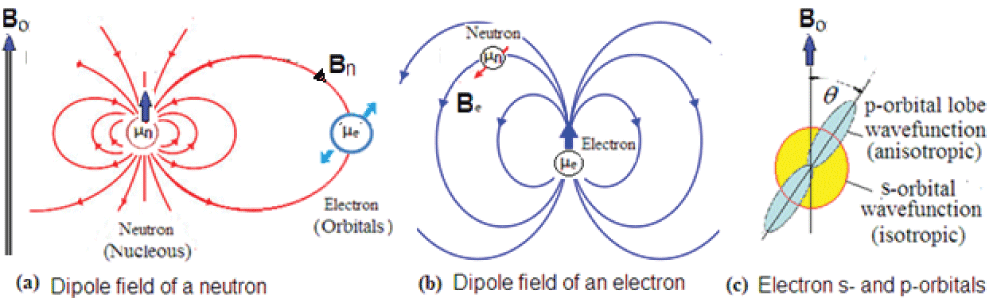
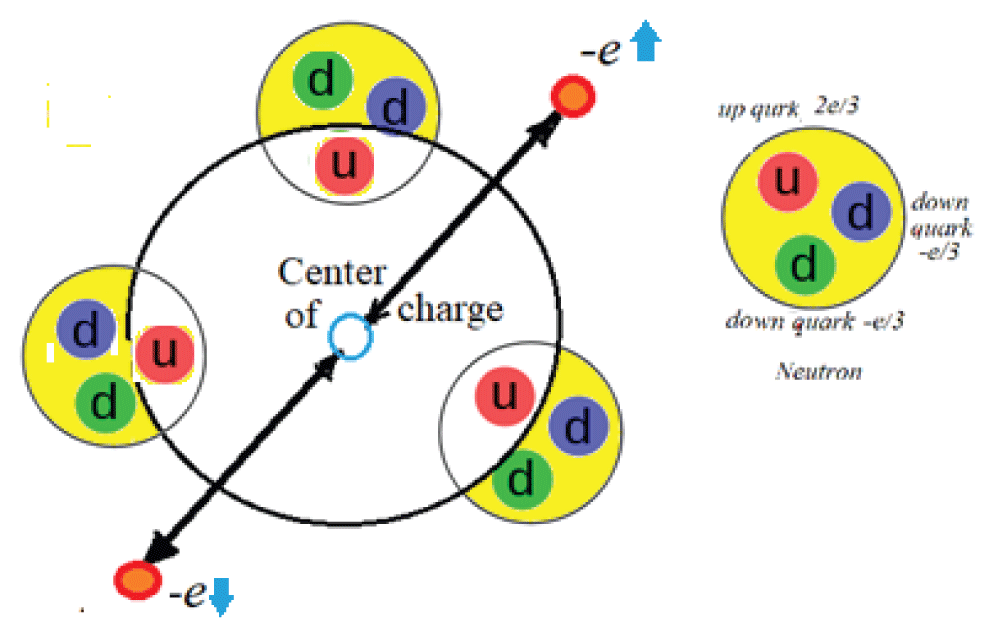
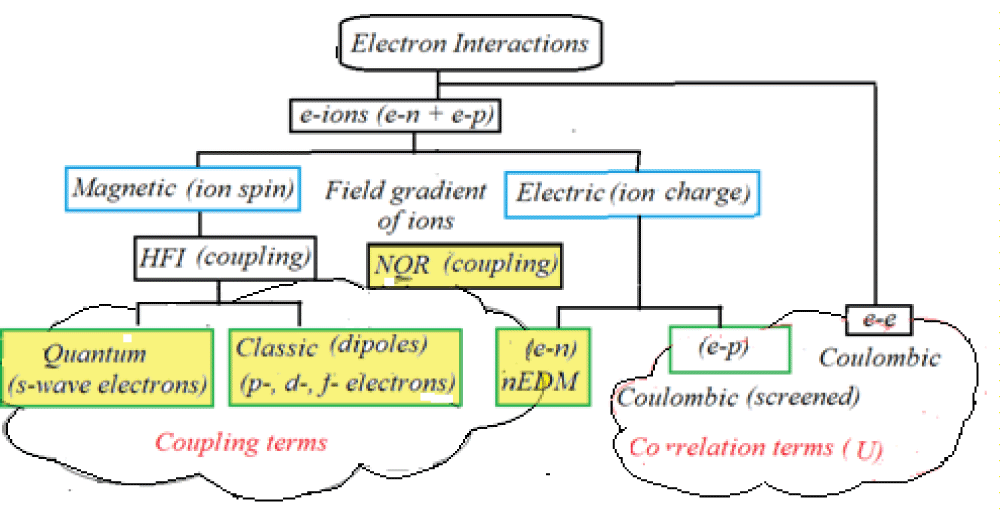
![(a) Experimental temperature dependence of magnetic hyperfine fields in a pnictide superconductor, and according to our primary calculations. The symbols refer to measurements by Saitovitcht & Litterst [69]. (b) Temperature dependence of a fluorine-doped Fe-pnictide sample (LaFe1−xMnxAsO0.89F0.11 with x=0.5%) as derived from Mössbauer spectra. This Figure was reproduced with permission from [1].](https://www.igminresearch.es/articles/figures/igmin359/igmin359.g009.png)
![Schematic of the vortices in cored regions of a type-II superconductor (left) and their Abrikosov triangular configurations in an HTS by magnetic force microscopy at two different temperatures below Tc (right). This Figure was reproduced with permission from [77].](https://www.igminresearch.es/articles/figures/igmin359/igmin359.g010.png)
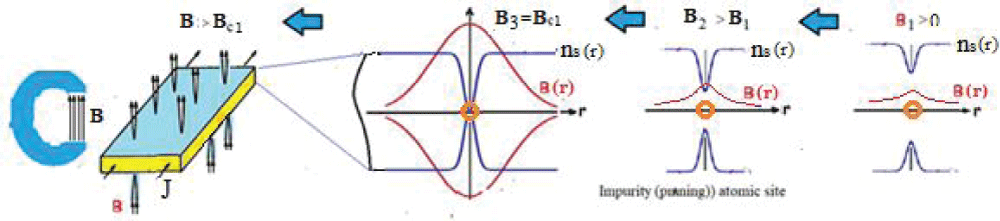
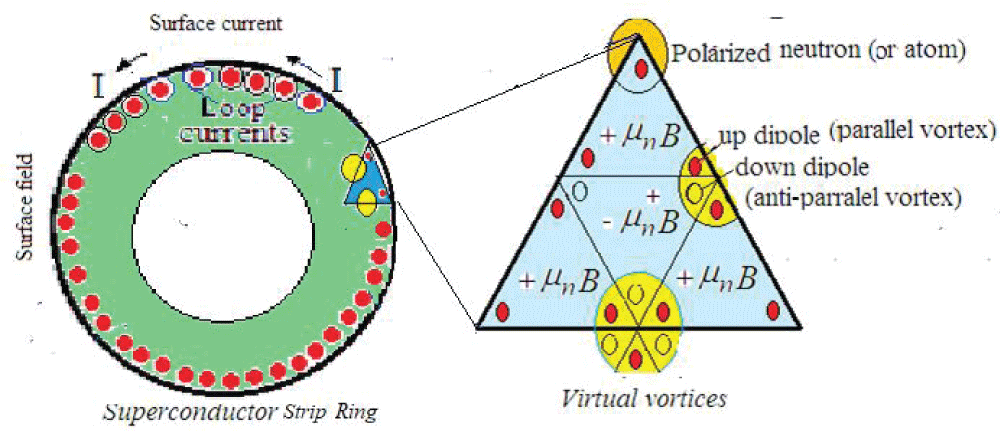
![Visualization of parallel and anti-parallel vortices in superconductors. Reproduced with permission from [78].](https://www.igminresearch.es/articles/figures/igmin359/igmin359.g013.png)